


Discover all of the podcasts in our network, search for specific episodes, get the Optimal Living Daily workbook, and learn more at: OLDPodcast.com.
Episode 3546:
Louis Chew explores how the “Diderot Effect” quietly traps us in cycles of consumption, revealing how our purchases often stem from a deeper desire for status rather than true fulfillment. By unpacking the psychology behind signaling and social comparison, he shows why chasing possessions can leave us empty. The real opportunity lies in redirecting that drive toward pursuits that build genuine value, not just appearances.
Read along with the original article(s) here: https://nosidebar.com/pursuit-of-status/
Quotes to ponder:
"The greatest reward in becoming a millionaire is not the amount of money that you earn. It is the kind of person that you have to become to become a millionaire."
"The poor man may take his ease without thinking of appearances, but the rich man is always under a strain"
"We can never have enough if we need to have more than our neighbor"
Episode references:
Spent: Sex, Evolution, and Consumer Behavior: https://www.amazon.com/Spent-Evolution-Consumer-Behavior-Miller/dp/0143117238
Regrets for My Old Dressing Gown: https://en.wikipedia.org/wiki/Regrets_on_Parting_with_My_Old_Dressing_Gown
Learn more about your ad choices. Visit megaphone.fm/adchoices
[00:00:00] It's time to refresh your yard during spring backyard days at the Home Depot. Get low prices guaranteed on propane grills starting at $179 like the NexGrill 3 Burner Gas Grill or get $50 off a select Weber Spirit Grill and bring big flavor to your backyard. Then set the scene with Hampton Bay String Lights that bring it all together. Shop spring backyard days for seven days at the Home Depot now through May 6th. Exclusion Supplies to Home Depot dot com slash price match for details.
[00:00:30] Welcome back to our Sunday bonus episode where I like to share an article with you from a different podcast in our network. Today's episode is coming from our very first podcast, Optimal Living Daily. You can find that show wherever you're listening to this and please do follow or subscribe to the show to get new episodes every day. So with that, here's Justin with another article as we optimize your life.
[00:00:55] The pursuit of status. How to avoid chasing the wrong things by Lewis Chu with no sidebar dot com. Despite composing several famous works, the French philosopher Denis Diderot spent the majority of his life in poverty. Like many Enlightenment thinkers of his time, Diderot had little concern for material possessions.
[00:01:21] That changed when he received a new scarlet robe from his friend as a gift. The robe was so beautiful that Diderot treasured it above all else. But Diderot also quickly realized that the robe was out of place amongst his other common possessions. He didn't own anything that would match the grandeur of his new robe. And so Diderot went about replacing his old possessions.
[00:01:50] He replaced his straw chair with a leather one. A large mirror took over the mantle of his fireplace. He filled up the vacant corner of his house with a writing desk. Before long, Diderot found himself in debt. As he remarks in his essay titled Regrets for My Old Dressing Gown, I was the absolute master of my old robe. I have become the slave of the new one.
[00:02:19] Pursuit of status. The Diderot effect. Diderot's story shows how the acquisition of new possessions is never a singular event. Each new purchase often creates a spiral of consumption that leads you to acquire more things. It's a social phenomenon that explains much of our modern consumption patterns. Savvy marketers often bundle complementary products together and make us offers so compelling, we can't refuse them.
[00:02:48] One seemingly innocent purchase can lead to many bad decisions. Having heard Diderot's warning, we now know what happens when we go about mindlessly acquiring new possessions. But that doesn't make the suppression of this behavior any easier. To understand our true challenge, we need to scrutinize Diderot's story more closely. As he writes in his essay,
[00:03:13] Diderot cared little for material possessions before he acquired his new robe. He didn't see them as representative of the inherent worth and value of a person. Quote, I can bear the sight of a peasant woman without disgust. That piece of simple cloth that covers her head, the hair that sparsely falls across her cheeks, those tattered rags that half cover her, that poor short petticoat that doesn't cover half her legs,
[00:03:41] her naked feet covered with muck, cannot wound me. It is the image of a state I respect. It's the ensemble of the lack of grace of a necessary and unfortunate condition for which I have pity. End quote. But shortly after he acquired his new robe, Diderot's views changed. He came to identify with the grandeur and beauty of his scarlet robe. Eventually,
[00:04:08] he thought the same of his other possessions as well. Quote, The poor man may take his ease without thinking of appearances, but the rich man is always under a strain. End quote. How did a simple robe end up causing Diderot so much grief? What we really want. As it turns out, Diderot was spot on about how material possessions become intertwined with our identity. The wealthier we get,
[00:04:38] the more things become a form of self-expression. We no longer buy shirts and shorts for the cloth that covers our skin, but also to reflect our tastes and social standing. Jeffrey Miller, an evolutionary psychologist, notes in his book, Spent, that one of the biggest reasons we buy things is to signal virtue. Quote, Humans evolved in small social groups in which image and status were all important, not only for survival,
[00:05:08] but for attracting mates, impressing friends, and rearing children. Today, we ornament ourselves with goods and services more to make an impression on other people's minds than to enjoy owning a chunk of matter, a fact that renders materialism a profoundly misleading term for much of consumption. Many products are signals first, and material objects second. Our vast social primate brains evolved to pursue one central social goal,
[00:05:38] to look good in the eyes of others. End quote. Ironically, the overt pursuit of status is a low-status activity. Chasing after someone's approval demonstrates low self-worth, which is why we instead opt to chase after possessions. This explains why the biggest companies in the world spend so much on branding. Luxury brands like BMW make it a point to advertise to everyone regardless of their income level.
[00:06:07] It seems like a mistake until you realize that they're not aiming to sell you a car, not directly at least. Their goal is to get everyone to believe that their product is valuable. The money comes in when people buy their products in a bid to signal their status. The pursuit of status. It's absurd that most of us are unhappy, and yet we've never been wealthier throughout history.
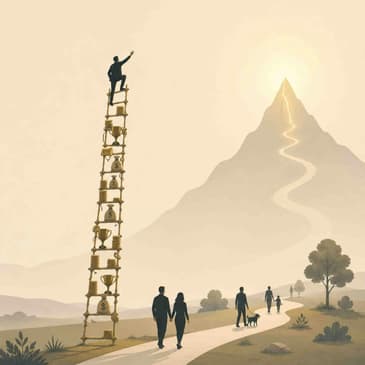
[00:06:34] The problem lies in the nature of the game we're playing. Status is hierarchical by definition, since there can only be one top dog at any time. That makes the pursuit of status an essentially zero-sum game where your gain is my loss. We can never have enough if we need to have more than our neighbor. You can never really win because the game doesn't end. All you can do is maintain your position at the top.
[00:07:04] What do we do then? Your first instinct may be to declare that you're never going to chase status again. Yet, that's unlikely to work out. Status was vital to our ancestors because it determined who got first choice of meet and mate. We were willing to give those who were more important to the group more privileges. While we don't need the protection of a tribe today, status still serves largely the same purpose. We haven't really evolved much at all.
[00:07:34] There are other ways to play this game, though. Even if we're biologically primed to chase status, it doesn't mean that we need to acquire more possessions. A bigger and better house may force us to spend half of our lives working. The same goes for luxury cars, accessories, and jewelry, although to varying degrees. These items are costly in terms of both time and money, yet have little intrinsic value.
[00:08:01] Why not pursue activities that are a form of signal but also have inherent value as well? For instance, work out at the gym. A big reason why people go to the gym is so they can tell others about it. But working out also provides the inherently valuable benefit of being healthy. Or speaking or debating publicly. Speaking from an audience signals some form of expertise, but the prerequisite is that you must be informed.
[00:08:30] Knowledge is the main benefit. Or teaching others. It's another demonstration of expertise, but it's the protege effect at work as well. You're helping others learn a skill while refining your own understanding. Jim Rohn once remarked that, quote, The greatest reward in becoming a millionaire is not the amount of money that you earn, it's the kind of person that you have to become to become a millionaire, end quote.
[00:08:59] In other words, we should be aiming for the stake and not the sizzle. If we can't give up the latter, we must make sure that it's always accompanied by the former. What are we chasing? It's easy to get lost chasing more without considering what we really want. Therein lies the danger of mindless consumption. Most of the time, all we really get are substitutes or replicas of what we truly desire in life.
[00:09:26] It takes reflection and honesty with ourselves to figure that out. Take the time to figure that out before you embark on your chase. As you may have realized from Diderot's example, it can be very costly when you chase the wrong things. You just listened to the post titled, The Pursuit of Status, How to Avoid Chasing the Wrong Things, by Lewis Chu with nosidebar.com.
[00:09:55] And I'll be right back with my commentary. When you need to build up your team to handle the growing chaos at work, use Indeed Sponsored Jobs. It gives your job post the boost it needs to be seen and helps reach people with the right skills, certifications, and more. Spend less time searching and more time actually interviewing candidates who check all your boxes. Listeners of this show will get a $75 sponsored job credit at Indeed.com slash podcast. That's Indeed.com slash podcast. Terms and conditions apply. Need a hiring hero?
[00:10:25] This is a job for Indeed Sponsored Jobs. Most leaders have a clear picture of how work is supposed to get done, but almost no visibility into how it's actually happening. So decisions about what to fix end up being based on gut feel, not data. I've been there with the Economy Conference. Pretty sure a process was slower than it should be, but with no numbers to prove it, nothing moves. Traditional process mapping takes months, and is outdated before it's finished. That's what today's sponsor, Scribe, was built to solve.
[00:10:53] Scribe Optimize passively captures how your team works across approved business apps, then uses AI to surface inefficiencies and improvement opportunities. No interviews, no manual discovery, and trusted by 80,000 plus enterprises, including nearly half of the Fortune 500. The dashboard shows in real time where time is going across tools. Start in Salesforce, finish somewhere else. It flags inefficiencies, suggests AI-powered fixes with estimated time savings, and keeps user data anonymized.
[00:11:23] It's the kind of visibility that used to take months. Now it's always on. To see what Optimize could look like for your organization, visit scribe.how slash OFD. That's S-C-R-I-B-E dot how slash OFD. Thank you to Lewis, a guest writer on No Sidebar. I've heard of the Diderot effect. I think we've talked about it here on the podcast before, but I definitely don't remember that much of his story. And I thought this was a great one.
[00:11:52] Some deep stuff in here to consider, like the self-worth part. That hit home for me a bit, especially when reflecting on what I previously wanted as a kid. Lewis said, quote, Ironically, the overt pursuit of status is a low-status activity. Chasing after someone's approval demonstrates low self-worth, which is why we instead opt to chase after possessions, end quote.
[00:12:19] I really like that one because it made me reflect on my own life. I definitely wanted status as a kid, but that's faded a bit with age, which I'm happy about. But it does make me wonder if I had feelings of low self-worth as a kid, which I can see as a possibility, in fact. It's interesting stuff, and something I'll be considering today and this weekend. Hopefully you too. And with that, thank you for being here.
[00:12:46] I hope listening every day is able to add and compound to your life like it has for mine. Have a great rest of your day, and I'll be back tomorrow, where your optimal life awaits. I hope you guys are here.