


Discover all of the podcasts in our network, search for specific episodes, get the Optimal Living Daily workbook, and learn more at: OLDPodcast.com.
Episode 3615:
Liz shares how fear and confusion around money once drove her to extreme penny-pinching and financial anxiety. By educating herself and treating money as a practical skill rather than an emotional burden, she discovered confidence, intentional frugality, and a healthier relationship with her finances.
Read along with the original article(s) here: https://www.frugalwoods.com/2015/06/02/i-used-to-be-afraid-of-money-but-things-have-changed/
Quotes to ponder:
"When we peel away the emotional elements that we often couch our money in, it’s just boring old numbers."
"When money stops serving as an analogue for self-worth, or an antidote to our pain, it starts to actually work for us."
"Think about it–if we approach money as a math problem on a spreadsheet (and one that we could ask other people advice about), how much cleaner and simpler would our lives be?"
Episode references:
ACT: https://www.act.org/
GRE: https://www.ets.org/gre.html
Learn more about your ad choices. Visit megaphone.fm/adchoices
[00:00:00] Pros trust the Home Depot for heavy duty storage solutions for any job site or garage. Right now get up to 15% off select storage and organization, impact and water resistant totes, and shelving built to hold up to 2500 pounds. Storage systems have space for all your tools and protect them in the garage, on the job site, and everywhere in between. Save time and maximize efficiency with adjustable shelving customized to your business's needs. Shop and save on pro grade storage at the Home Depot. How pros get more done.
[00:00:31] This episode is brought to you by Google Chrome. You think you know a browser, but Gemini and Chrome? That's new. They can help you with practically anything on the web, like restoring a vintage motorcycle from a 50 page restoration block, or finally break down that long article you've had open for weeks. Gemini and Chrome is here for it. Ready to make anything online make sense? There's no place like Chrome. Check responses set up required compatibility and availability varies 18 plus.
[00:00:56] This is Optimal Finance Daily. I used to be afraid of money, but things have changed. By Liz of frugalwoods.com. I used to be afraid of money, not in the sense that I thought it was going to jump out of a dark alley at me, more in the vein of fearing the unknown. Debt terrified me to such an extent that I didn't even have a credit card until I was 23. Everything related to finance seemed cryptic and complicated to me, and I wasn't sure what to do with money.
[00:01:26] And so, I saved it. Saving money isn't the worst default position, and I suppose it was smart, to an extent. The problem is that I was saving from a place of fear, not a place of strength. I couldn't spend money. I felt as though I couldn't ever spend anything, and I dreaded parting with even the least of my funds.
[00:01:48] I'd go to notorious lengths in order not to drop a dime, such as sleeping on a yoga mat on the floor of my first post-college apartment in New York City for a month before I finally caved and bought a bed. And even then, I bought the dirt cheapest bed I could find. Naturally, it wore out within a year, which is pretty atrocious considering I was the only person sleeping on it, and I'm a rather small person.
[00:02:13] Hence, I'm forced to confess that I was cheap, stupidly cheap, and a far cry from strategically frugal. As I got older, as in, I turned 23, I finally accepted the fact that I needed to become more adept with my financial activities. While eating beans and tuna from cans every day works for a while, especially when you're 22, I acknowledged it probably wasn't a totally sustainable mode of operations.
[00:02:40] Don't laugh, but what I did was read Personal Finance for Dummies, and I honestly felt a whole lot better after I did. The first portion of that book is devoted to paying off your debt, and since I didn't have any debt, I skipped ahead and started to feel a bit of relief creeping. I learned that I'd unintentionally done a very smart money move. I hadn't inflated my lifestyle one bit after college. In fact, I probably downgraded it a step. Hello, yoga mat bed.
[00:03:09] In doing so, I'd save $2,000 of my $10,000 salary while living in New York City. And I'd circumvented all debt. I'd even paid the $300 in cash for my sad little bed. Gaining confidence. Reading that simple, straightforward book gave me the awareness that I wasn't a total idiot with money, and that managing my money didn't have to be a complicated, fraught affair.
[00:03:35] Now, I come to my decision to save from a confident, enlightened position, not one mired in constant anxiety that I'll be broke. I think I labored under the delusion that my money was just going to march right out of my savings account one day, and so I checked it obsessively. Not something I'd recommend, by the way. The choices that Mr. Frugalwoods and I make regarding our plan to retire at 33 and live a life of extreme frugality are made with an open and informed mind.
[00:04:04] I know exactly what I can afford, and I just chose not to buy it. I realize that my buying power is far above what I spend, and I'm content in that determination. I finally understand compounding interest, the rudiments of investing, and the wisdom of maxing out my 403b. Similar to how many people inadvertently spend their way into excruciating debt by fearing and misunderstanding money, I was saving in a painful way.
[00:04:34] Either scenario connotes a lack of knowledge, and both are born of an inability to face reality. I had to own up to my ignorance about money and come to a place where spending isn't stressful or scary. It's a measured, thought-out declaration that I make on my own. Why is money taboo? Money is one of those things our culture has decided we shouldn't talk about openly, which I think is ludicrous.
[00:05:01] It's the lifeblood of how we all survive, more or less. And yet, we can't discuss it with each other? I cry folly. What personal finance for dummies made me grasp is that money isn't shrouded in mystery, and it's not really all that complicated. The problem was actually with me and my unwillingness to ask for help, not with the money itself. My money was cheerfully sitting in the bank, oblivious to my personal turmoil over what to do with it.
[00:05:29] This widely held belief that it's crass or rude to discuss money only serves to hinder our own education on the topic. People suffer alone and silently with debt, overspending habits, or a lack of comprehension over their finances, just because our culture thinks it's impolite to discuss. Sure, it's rude to boast about how wealthy you are to someone who's struggling to make ends meet. But is it really rude to share a great deal you found at a thrift store,
[00:05:58] or discuss sage investing strategies, or the beauty of your company's 401k match? I think not. In the same way that we share recipes with our friends, why don't we start sharing our money stories? Money is emotional, but it's just math. In talking with people about money, something I get to do on a regular basis, thanks to frugalwoods, I find that just about everyone has or had a hang-up with regard to money. We spend and we save emotionally.
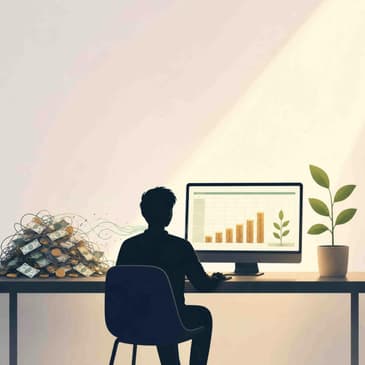
[00:06:28] For the most part, we don't see money merely as numbers on a spreadsheet. We conflate it with our self-worth, our self-esteem, our happiness, and our very perception of ourselves. And indeed, money is pretty darn critical to how we operate in the world, but it's not everything, and it doesn't need to define us. When we peel away the emotional elements that we often couch our money in, it's just boring old numbers.
[00:06:52] As far as I know, there's nothing intimidating, mysterious, embarrassing, or socially taboo about math. I want you to know that I write this as a person who is certifiably terrible at math, but with spreadsheets and calculators, that doesn't matter. Funny story, my math score on the ACT was so low, and my reading and writing score was so high, that my advisor asked me if I'd fallen asleep during the math section.
[00:07:18] And when going to grad school, I nearly panicked when I found out the GRE had a math section, but I'd managed to live through the test and not go into shock. And here I am now, talking about money. See, it's not so bad. And that's what money truly is, or truly should be. Math. Think about it. If we approach money as a math problem on a spreadsheet, and one that we could ask other people advice about, how much cleaner and simpler would our lives be?
[00:07:46] When money stops serving as an analog for self-worth, or an antidote to our pain, it starts to actually work for us. Thanks to this belief, I'm now in control of my money, as opposed to the other way around. You just listened to the post titled, I used to be afraid of money, but things have changed. By Liz of frugalwoods.com. Most of us have a clear picture of how work should get done,
[00:08:15] and almost no visibility into how it's actually happening. We've all sat in meetings where decisions about what to fix or automate can come down to gut feel, because nobody had real numbers. And the traditional fix, interviews and months of process mapping, is outdated before it's finished. That's exactly what today's sponsor, Scribe, was built to solve. Scribe Optimize passively captures how your team works across approved business apps, following workflows even when they jump between tools,
[00:08:42] and turns it into a live dashboard. Not last quarter's report, but what's happening right now. It automatically surfaces your biggest inefficiencies, and gives AI-powered recommendations with estimated time savings built in. And user-level data is anonymized by default, with sensitive info redacted, and never leaving your firewall. That kind of visibility used to take months. Now it's just always on. To see Optimize in action, visit scribe.how slash OFD,
[00:09:12] and mention OFD for a 30-day risk-free trial. That's S-C-R-I-B-E dot how slash OFD. Google is offering free AI training and tools to U.S. small businesses, so they can innovate in ways both big and small. Built by Google experts, the Google AI Professional Certificate equips small businesses with practical AI skills. Through hands-on projects, they can start using AI to get more done
[00:09:41] and unlock new opportunities for their business. This is a new era of American innovation. Find out more at grow.google slash business. This post reminds me of one of my favorite quotes about money from Ayn Rand. She says, quote, Money is only a tool. It will take you wherever you wish, but it won't replace you as the driver. End quote. It makes me think of money as a tool like a hammer.
[00:10:11] Acquiring the hammer and deciding on which features you want the hammer to have how heavy it is, where you'll store it, etc. is far less interesting than deciding on what you're going to build with that hammer. Even if it's the fanciest hammer in the world, it's not worth much if it's just sitting in a toolbox not creating anything. On this show, we talk so much about how to make money, where to put it, and how to manage it. But let's not lose sight of the fact that this incredible tool of money
[00:10:39] is worthless unless you use it to skillfully build something. I've come to learn that money is only as valuable as your clarity on how you'll use it, and your comfort level of how much is enough. But that'll do it for today and another installment of Optimal Finance Daily. Have a happy Thursday. Thank you for being here every day and listening. And I'll see you on the Friday show tomorrow, where your optimal life awaits.