


Get the 200+ Page Optimal Living Daily Workbook (PDF) - Free.
Want to turn today's episode into an actionable plan? Join the Optimal Living Weekly newsletter and I'll send you our 200-page digital workbook immediately. It's packed with the best takeaways from the show, formatted for easy reading and implementation at home.
Get your free PDF workbook here: https://oldpodcast.eo.page/join
Discover all of the podcasts in our network, search for specific episodes, get the Optimal Living Daily workbook, and learn more at: OLDPodcast.com.
Episode 3662:
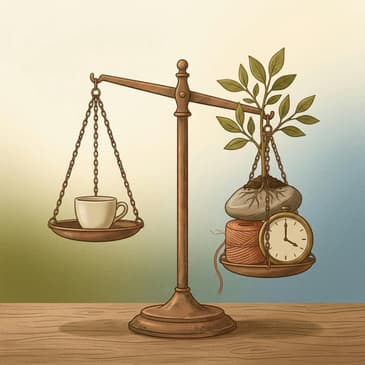
Colin Wright of Exile Lifestyle shares two essays on mindful spending. He reveals the true cost of the things we buy, from opportunity cost to the resources behind every product, then explains why knowing the real reason you buy something is the key to spending money on what actually makes you happy.
Read along with the original articles here: https://exilelifestyle.com/cost/ AND https://exilelifestyle.com/buy/
Quotes to ponder:
"Every single thing we buy has a price, and that price is typically far larger than we think."
"Money can buy happiness, but only if you're shopping for the right things."
"There's nothing wrong with spending money to fulfill a need. That's what money's for, after all."
Optimal Finance Daily is a daily personal finance podcast where we narrate the best articles on financial independence, investing, saving money, and money management, read to you by a professional narrator so you can grow your wealth a little more every day.
Learn more about your ad choices. Visit megaphone.fm/adchoices
[00:00:00] This episode is brought to you by Accenture. When your advertising operations fall out of sync, everything else follows. Spotify and Accenture are working together to reinvent the rhythm of ad sales, using automation, analytics and smarter workflows to simplify campaign delivery and access better data across the business. The result? Less time spent on operations, more time connecting brands with the moments and fandoms that matter most. Learn more at Accenture.com slash Spotify.
[00:00:31] This episode is brought to you by Google Chrome. You think you know a browser, but Gemini and Chrome? That's new. It can help you with practically anything on the web, like restoring a vintage motorcycle from a 50-page restoration block, or finally break down that long article you've had open for weeks. Gemini and Chrome is here for it. Ready to make anything online make sense? There's no place like Chrome. Check responses set up required compatibility and availability varies 18+.
[00:00:54] This is Optimal Finance Daily, the cost of things, and know why you buy. Both by Colin Wright of exilelifestyle.com. And I'm Justin Malek, your narrator, reading you articles every single day of the year with permission from the authors. And sometimes it's two articles in one episode, and that's the case today. So without further ado, let's get right to it as we optimize your life.
[00:01:25] The Cost of Things by Colin Wright of exilelifestyle.com It's amazing what we can get for $20 these days. Sure, it sometimes seems like inflation just won't quit, and the costs of living add up to a frightening sum, and a pack of gum that could once be had for less than a dollar now costs several. But this is mostly a slow burn perspective that's difficult to see clearly because it moves so steadily.
[00:01:53] Our buying power for most things, in the developed and developing worlds, has been on an upward trend for generations. And our lack of appreciation for this fact stems not from a dearth of wielded purchasing power, but from the lack of synchronicity between that power and our expectations of how much power we should possess, as explained and reinforced by marketing messages.
[00:02:18] Demand isn't created for a product or service unless you keep people aspirational. So it's in the best interest of many to keep us wanting more than we have. Beyond this dollars and cents cost for things, there are other, less obvious expenses. Price tags that we don't tend to see unless we look closely, but which are worth acknowledging nonetheless.
[00:02:42] Opportunity costs, for example, is what we give up in favor of what we choose to buy, consume, or spend our time with. When I purchase a phone, the opportunity cost is every other phone on the market, and the possibility of not having a phone, and the software, networks, and brand associations of those other phones and lifestyles. The cost of my phone, then, is not just the number on the click-to-buy button.
[00:03:10] There's also long-term monetary costs, which includes things like recurring payments and debt. Not just for the item in question, but for interest accrued on other debt that you could have paid off instead of making your purchase. If I buy a phone instead of paying off debt, the cost of that phone goes up because of the extra debt accrued through my non-payment. Or how about the resource and sustainability cost of our purchases?
[00:03:38] Smartphones are the end result of a massive supply chain connecting all the components of the device, allowing them to be constructed by machines and people who must be paid, and fed, and housed, and, in the case of the machines, maintained. These supply chains stretch far and wide, encompassing mines, and roads, and caravans of trucks, and back-channel deals with politicians.
[00:04:05] This includes the technologies required to work with the materials, and mold them into useful shapes, which makes use of scientific knowledge that's been conceived and refined over many centuries, with the most fundamental knowledge tracing back to the beginning of humankind, and the most small and specific going back only years or months. This all coalesces into something incredibly intuitive and valuable, aided by the millions of manpower hours that have gone into developing the software,
[00:04:35] and yet so common as to be barely noticeable. Every single thing we buy has a price, and that price is typically far larger than we think while swiping our cards at the checkout terminal or one-click shopping online. This doesn't make our purchases inherently harmful or wrong. If anything, it makes them all the more impressive for the chain of people and events and resources that have been linked up to make the end product available for a common consumption.
[00:05:05] But it's valuable to understand that the simple act of buying a phone, or anything else, has repercussions beyond the passive buy-and-move-on mentality we often adopt when procuring a new possession. We consider how something will improve our lives, make us feel, improve the perception others have of us, and the perception we have of ourselves, in myriad other variables associated with the capitalistic exchange of value.
[00:05:33] It only seems prudent that we consider the bigger picture, the true cost of things as well. Update, April 20th, 2017. The true cost, and the number of people involved with producing anything at all in the modern age, is staggering. It's a positive consequence of globalization that we can benefit from this, and not even notice it. Although there are downsides to our increased always-on interconnectivity,
[00:06:02] this is one of the major upsides. Know why you buy, by Colin Wright of exilelifestyle.com Why do you go to a bar? This isn't a rhetorical question. The answer most people would give, to drink, is only correct some of the time. Drinking at a bar is an excuse to have a shared experience. It's an activity that a person can do in public,
[00:06:31] among other people. People go to bars to be in public, to be social, to be with people. There are exceptions, certainly, but think about it this way. If you want to drink, there are usually better ways to do so. It's cheaper to drink at home. Home is also a place where your drinking is less likely to be interrupted by other people. You don't have to drive afterward. Logically, if one's true desire is to drink,
[00:07:01] a bar is not the most ideal place to do it. This same logic can be applied to lots of things. You generally don't buy a flashy watch to tell the time. You don't buy high-heeled shoes because they're better for walking in than sneakers. Bars, expensive watches, and high-heeled shoes all have purposes, but not always the purposes we tell ourselves they have when we spend money on them. If I want to drink,
[00:07:30] I'll get a bottle of wine and go home. If I want to hang out with people, I'll go to a bar. What's important is that we know why we buy what we buy. Awareness of the purpose behind a desired product or experience can help us better understand what we're hoping to get out of life and what could be missing from it in the meantime. I tell myself, I want a massive television for watching football, but in reality, I'm hoping for an excuse
[00:07:58] to have people over more frequently. If I'm able to get down to the root of that need, it's likely I can solve the problem, not having friends around often enough, without taking out a mortgage on the house. I can achieve those same ends in a different way. There's nothing wrong with spending money to fulfill a need. That's what money's for, after all. But it's best to be sure that what you're buying will fill the need you have, not one you're being told you should have.
[00:08:28] Money can buy happiness, but only if you're shopping for the right things. Update, February 23rd, 2017. That last line became a somewhat viral quote that people use for all kinds of random things. I see it on Instagram posts, for instance, that promote rampant, thoughtless consumption, which kind of misses the point, but I guess you can't control the words you put out into the world. One of the dangers of clicking publish on a blog.
[00:09:01] You just listened to the post titled, The Cost of Things and Know Why You Buy, both by Colin Wright of exilelifestyle.com. And I'll be right back with my commentary. This episode is brought to you by Accenture. When your advertising operations fall out of sync, everything else follows. Spotify and Accenture are working together to reinvent the rhythm of ad sales, using automation, analytics, and smarter workflows to simplify campaign delivery
[00:09:31] and access better data across the business. The result? Less time spent on operations, more time connecting brands with the moments and fandoms that matter most. Learn more at Accenture.com slash Spotify. I've tracked my income and expenses since 2010, back when that meant a spreadsheet I built myself and updated every day. I loved it, but I still missed things. Categories changed and I'd go months before noticing my spending had doubled.
[00:09:59] Monarch does in seconds what took me hours, and it catches what I never would have. Last year, the weekly AI recap flagged that my dining out had crept up almost 40% charges I'd stop seeing. My financial picture has never been clear. My favorite part is the AI assistant. I can just ask, can I afford this trip without touching my savings? And get a real answer, not a chart to interpret. It's like having a financial advisor
[00:10:29] in my pocket. Write your own money story with Monarch. Use code OPTIMAL at Monarch.com to get your first year of Monarch Core half off at just $50. That's 50% off your first year at Monarch.com with code OPTIMAL. Thank you to Colin. I really liked that second article especially, the idea that we should know why we buy what we buy. His example stuck with me. You tell yourself
[00:10:58] you want the big TV for the football games, but what you actually want is a reason to have people over. And if that's the real need, there are cheaper ways to get there than a giant television. And he mentioned something else that's important. Every purchase has a cost bigger than the price tag, whether it's what you gave up to buy it or the debt it's sitting on top of. A car is the obvious example. There's a lot of maintenance and often debt
[00:11:27] that goes along with it. So it's worth thinking about both questions at the same time. What is this really costing me? And what am I actually hoping it'll give me? So maybe this week, the next time you're about to buy something you've been eyeing, just ask yourself what the real need underneath it is and whether there's a simpler, cheaper way to meet it. You never know what you'll come up with. So thank you to Colin for this one and thank you
[00:11:57] for being here. Have a great rest of your day and I'll see you tomorrow where your optimal life awaits.