


Get the 200+ Page Optimal Living Daily Workbook (PDF) - Free.
Want to turn today's episode into an actionable plan? Join the Optimal Living Weekly newsletter and I'll send you our 200-page digital workbook immediately. It's packed with the best takeaways from the show, formatted for easy reading and implementation at home.
Get your free PDF workbook here: https://oldpodcast.eo.page/join
Discover all of the podcasts in our network, search for specific episodes, get the Optimal Living Daily workbook, and learn more at: OLDPodcast.com
Episode 3680:
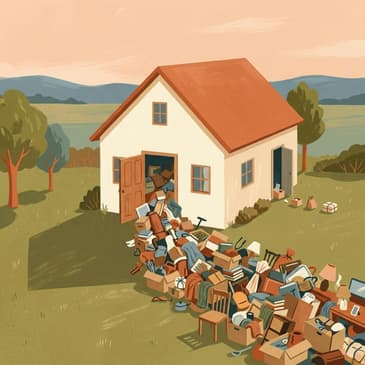
J.D. Roth shares what a team of UCLA anthropologists found when they documented the possessions inside 32 typical American homes, from overflowing garages to a second refrigerator out in the garage. He explains that we have built plenty of ways to bring things in and almost none for letting them go, and that the pile carries a real emotional and financial cost. He also describes his own decade-long purge and the sense of control it gave him back.
Read along with the original article(s) here: https://www.getrichslowly.org/cluttered-lives/
Quotes to ponder:
"Contemporary U.S. households have more possessions per household than any society in global history."
"We have many mechanisms by which we accumulate possessions in our home, but we have few rituals or mechanisms or processes for unloading these objects."
"As I purge Stuff from my life, I gain a greater sense of satisfaction."
Optimal Finance Daily is a daily personal finance podcast where we narrate the best articles on financial independence, investing, saving money, and money management, read to you by a professional narrator so you can grow your wealth a little more every day.
Learn more about your ad choices. Visit megaphone.fm/adchoices
[00:00:00] This episode is brought to you by State Farm. Listening to this podcast instead of doom scrolling? Smart move. Another smart move? Getting help from one of State Farm's 19,000 local agents when you choose to bundle home and auto. Bundling. Just another way to save with the personal price plan. Prices are based on rating plans that vary by state. Coverage options are selected by the customer. Availability, amount of discounts and savings, and eligibility vary by state.
[00:00:25] This episode is brought to you by Google Chrome. You think you know a browser, but Gemini and Chrome? That's new. It can help you with practically anything on the web, like restoring a vintage motorcycle from a 50-page restoration block, or finally break down that long article you've had open for weeks. Gemini and Chrome is here for it. Ready to make anything online make sense? There's no place like Chrome. Check responses set up required. Compatibility and availability varies 18+.
[00:00:51] This is Optimal Finance Daily, the cluttered lives of middle-class Americans by J.D. Roth of getrichslowly.org. I'm Justin Malek, the guy that reads blogs or articles to you every single day of the year, including weekends and holidays. So with that, let's get right to it as we optimize your life.
[00:01:16] The cluttered lives of middle-class Americans by J.D. Roth of getrichslowly.org. Long-time readers are familiar with my decade-long war on stuff. I was raised in a cluttered home. From a young age, I was a collector. Some might even say a hoarder. After Chris and I got married, I began to acquire adult-level quantities of stuff. When we moved to a larger house, I found ways to acquire even more stuff.
[00:01:45] I owned thousands of books, thousands of comic books, hundreds of compact discs, and scads of other... Eventually, I'd had enough. A decade ago, I began the slow process of decluttering. While I still bring new stuff into the house, Kim would tell you I bring too much stuff home,
[00:02:07] I'm not nearly so acquisitive as I used to be. In fact, for the past decade, I've purged far more than I've acquired. And that process continues week by week, month by month, year by year. The cluttered lives of the American middle-class. Turns out, I'm not the only one fighting this battle. Many Americans struggle with clutter. However, this is one reason for the popularity of the simplicity movement.
[00:02:36] When I visit my friends who live in tiny houses, they rejoice at the lack of stuff in their lives. And it's why books like Marie Kondo's The Life-Changing Magic of Tidying Up become popular bestsellers. That book is great, by the way. A while ago, I stumbled on a video that documents the work of a group of anthropologists from UCLA. These researchers visited the homes of 32 typical American families.
[00:03:04] They wanted to look at how people interacted with their environments, at how they used space. They also wanted to look at how dual-income, middle-class families related to their material possessions. They systematically documented the stuff people own, where they keep it, and how they use it. This team produced a book called Life at Home in the 21st Century, which records their findings.
[00:03:30] They also produced a 20-minute video that provides an overview of the results. Jean E. Arnold says, That's both shocking and unsurprising all at once. Her colleague, Anthony Gresh notes that our homes reflect this material abundance. He says, He says,
[00:04:07] Gresh continues, All of this stuff causes stress. It carries very real, physical, and emotional tolls. One interesting finding? Clutter bothers women more than men.
[00:04:35] This might be because the responsibility for cleaning the clutter generally falls to women. Arnold notes, The United States has 3.1% of the world's children, but consumes 40% of the world's toys. In households with children, or in my case, puppies, the toys can take over the home. Children's toys and objects spill out of their bedrooms into living areas, kitchens, and bathrooms.
[00:05:04] The push to become consumers, to value stuff, starts at an early age. Why do modern kids have so many toys? It may be because there are so many playthings available so cheaply. There's more stuff available for kids than there was 50 years ago, and that stuff costs less. Plus, priorities seem to have shifted. Modern parents see spending on kids as a priority.
[00:05:32] Parents 50 years ago did not. Food as clutter. It's not just kids, of course. Adults have their own brand of clutter. For example, many families are guilty of stockpiling. They buy food in bulk, then stack their cupboards and fridges and pantries and garages to the gills. Naturally, most of these are convenience foods. Fresh food wouldn't keep if bought in bulk like this.
[00:06:01] Researcher Eleanor Oaks observes, quote, If you brought someone from Rome or from a town in Sweden, and you showed them the size of the refrigerator in the kitchen, and then walked them to the garage, and they saw the size of the refrigerator in the garage, they would be pretty astonished. The refrigerator then becomes something to think about culturally. Why do we have these big refrigerators, and what does that say about food in our society? End quote.
[00:06:29] Note, this was something that Kim and I thought about a lot on our RV trip across the U.S. During our 15 months on the road, we had limited space for food storage. There was a small-ish fridge in the motorhome, and a few cabinets for non-perishables. At home, we tend to buy food for a week or more at a time, and we're guilty of stockpiling some stuff too. Don't ask me how much ketchup I have in the cupboard. On the road, this was fundamentally impossible.
[00:06:59] We bought only what we needed for the immediate future. This forced us to be better at meal planning, and it made us much more aware of the kinds of foods we were buying. The easy availability of convenience foods has some interesting effects on how families relate to each other. Longer ago, the household sat down to eat the same thing at the same time. That's not true anymore. Nowadays, each person tends to eat what they want, when they want.
[00:07:29] Gresh says, quote, families have bought into the idea that use of these foods will somehow save time, end quote. But researchers have found that families only save about 12 minutes per meal when they use convenience foods. And at what cost? Cluttered space. During their research, the UCLA anthropologists looked at how families use the space in their homes. Unsurprisingly to me,
[00:07:58] the kitchen tends to be the hub, the command center of the household. Gresh says, quote, everything transpires in kitchens. Activities are organized, schedules are coordinated, plans are made for the next day, meals are cooked, kids are doing homework in kitchen spaces. It's very, very intensively used. A lot of the material culture in kitchens speaks to this logistical center
[00:08:26] in everyday family lives, end quote. The refrigerator door is often a center for family artifacts. It's a place for family history and culture and nostalgia. But, says Arnold, quote, there seems to be a kind of a correlation between how much stuff is on the refrigerator panel door and how much stuff is in the broader home, end quote. Bathrooms, too, can become important places to plan and prepare for the day.
[00:08:55] They're staging areas where we get ready to go out into the world. With all of the chaos in other parts of the home, many parents work hard to make the master bedroom a sort of quiet retreat, a space isolated from the rest of the house. People value their master bedrooms so much, in fact, that they'll spend to remodel them into the oasis they desire instead of funneling their funds to remove actual bottlenecks like bathrooms or to optimize the spaces
[00:09:24] where the family spends most of its time. In some ways, the master bedroom has become a symbolic space. It's a place of refuge. The bottom line. Is clutter a uniquely American problem? I don't know. I doubt it. But I also suspect that because of our sheer material abundance, more of us struggle with clutter than folks in other countries. However, I do know that this is another area where we can take charge of our lives.
[00:09:54] As I purge stuff from my life, I gain a greater sense of satisfaction. I feel like I'm in more control of my environment and myself. You just listened to the post titled The Cluttered Lives of Middle Class Americans by J.D. Roth of GetRichSlowly.org. I'll be right back with my commentary. You know what's funny? We'll hit the gym, eat clean, track our sleep,
[00:10:23] then slam coffee all day to function. My stomach's sensitive to caffeine, so I've had to stop drinking coffee. But that's why Ultra Pouches caught my eye. Completely nicotine-free and caffeine-free. Ultra partnered with neuroscientists and packed these with proven nootropics. Infinity PX for clean energy, L-theanine for calm focus, Alpha-GPC for sharper processing, plus B6 and B12, smooth focus for up to two hours. Zero crash.
[00:10:53] Backed by Dak Prescott, Joe Burrow, and 100-plus pro athletes, Ultra is the ultimate guilt-free pouch, delivering instant focus and mental clarity without nicotine or caffeine. New customers can use code OFD to get 15% off at TakeUltra.com. That's TakeUltra.com for 15% off with code OFD. After you purchase, they will ask you where you heard about them. Please support our show
[00:11:22] and tell them our show sent you. This episode is brought to you by State Farm. Listening to this podcast instead of doom-scrolling? Smart move. Another smart move? Getting help from one of State Farm's 19,000 local agents when you choose to bundle home and auto. Bundling. Just another way to save with the personal price plan. Prices are based on rating plans that vary by state. Coverage options are selected by the customer. Availability, amount of discounts and savings, and eligibility vary by state.
[00:11:51] Thank you to JD. That line about how we have all these ways to bring stuff into our homes, but almost no rituals for getting rid of it, it's so true. We're great at acquiring, yet pretty terrible at letting go. And the bit about the United States having a tiny share of the world's children, but a huge share of the world's toys, that one made me stop. What it made me think about was gift-giving, actually. A few years back,
[00:12:21] my family talked about stopping our holiday gift exchange, not because we don't enjoy the holidays, but because the stress and the expense has started to outweigh the joy. And a lot of it was just becoming more stuff to find a place for. And that's really the cost of it all. Every object we bring in needs space and attention, and actually mental energy. So I like JD's point that this is one more area where we can actually
[00:12:49] take back a little control. You don't have to declutter your whole house today, but maybe pick one drawer, or one shelf, or one box in the garage, and just clear it out. I always feel a little lighter afterward, and I bet you will too. Thank you to JD for this one, and thank you for being here. It really means a lot. Have a great rest of your day, and I'll catch you tomorrow, where your optimal life awaits.