


Get the 200+ Page Optimal Living Daily Workbook (PDF) - Free.
Want to turn today's episode into an actionable plan? Join the Optimal Living Weekly newsletter and I'll send you our 200-page digital workbook immediately. It's packed with the best takeaways from the show, formatted for easy reading and implementation at home.
Get your free PDF workbook here: https://oldpodcast.eo.page/join
Discover all of the podcasts in our network, search for specific episodes, get the Optimal Living Daily workbook, and learn more at: OLDPodcast.com
Episode 3688:
Paula Pant contrasts a country where families build a house one room at a time over fifteen years with a country where a thirty-year-old can borrow the whole thing at once. She argues that easy credit buys real mobility and that business loans can genuinely elevate people, while the buy-now-pay-later mindset quietly corrodes net worth. Her conclusion is that borrowing should be the rare exception rather than the default money management setting.
Read along with the original article(s) here: https://affordanything.com/fueled-by-debt/
Quotes to ponder:
"When credit flows freely, consumption doesn't end."
"That type of thinking can be corrosive to your net worth if you spend that money on the wrong things."
"It reminds me that borrowing money should be the rare exception, not the norm."
Optimal Finance Daily is a daily personal finance podcast where we narrate the best articles on financial independence, investing, saving money, and money management, read to you by a professional narrator so you can grow your wealth a little more every day.
Learn more about your ad choices. Visit megaphone.fm/adchoices
[00:00:00] This episode is brought to you by Google Chrome. You think you know a browser, but Gemini and Chrome? That's new. It can help you with practically anything on the web, like restoring a vintage motorcycle from a 50-page restoration block, or finally break down that long article you've had open for weeks. Gemini and Chrome is here for it. Ready to make anything online make sense? There's no place like Chrome. Check responses set up required, compatibility and availability varies 18+.
[00:00:25] Propel Fitness Water with Gatorade Electrolytes, Zero Sugar and Vitamins. Propel Hydrates Better Than Water to help you get the most out of your workout and get back to your best self. What propels you? Propel with Gatorade Electrolytes. This is Optimal Finance Daily. Is Debt Fueling Your Life by Paula Pant of AffordAnything.com. And I'm your host and narrator Justin Malek, reading to you every day to help you
[00:00:54] save more, earn more, and invest the rest. So with that, let's get right to it as we optimize your life. Is debt fueling your life? By Paula Pant of AffordAnything.com.
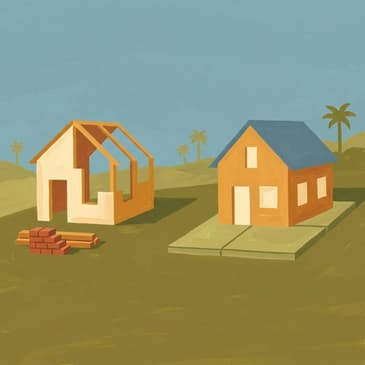
[00:01:12] Imagine staring down the road, seeing dozens of half-built houses. I'm not talking about houses that are actively under construction, and I'm not talking about decrepit old houses that need to be torn down. I'm talking about houses that were partially built, and then nothing. No active construction, no wheelbarrows or cement mixers or sweaty workers taking cigarette breaks. Just half-built house after half-built house.
[00:01:41] That's what I saw during my trip to Jamaica last week. Don't get me wrong, I spotted plenty of complete houses too, but partially constructed homes were far from rare. What's the story here? I asked my taxi driver. He smiled. People don't have money to build a whole house all at once, he said. So they build one room at a time. It might take 5, 10, 15 years for the house to be complete.
[00:02:10] Welcome to a world that's not fueled by credit. Now before I proceed with the rest of the story, let me make a disclaimer here and say that I'm certainly not an expert on Jamaican culture. I'm quoting a random cab driver. Take his words with a grain of salt. That said, I've traveled to many countries and was born in a country in which credit is much, much tougher to obtain than it is in the U.S.
[00:02:37] In those places, many 25 to 35-year-olds don't have the privilege of being able to get a mortgage as soon as they can prove two years of work history, a decent credit score, and a low debt-to-income ratio. Life is much easier here in the U.S. Of course, life in the U.S. is also fueled by debt. People in America don't have the money to build a whole house either, I told a cab driver.
[00:03:02] However, they only own a small fraction of that house, maybe one-tenth or one-fifth of it. The bank owns the rest. Here's the interesting juxtaposition between the two circumstances. In both situations, people will still spend 10 or 15 years or 30 years paying for a house. But in one scenario, that payment gets made in advance. In another scenario, the payment is retroactive.
[00:03:31] America is one of the rare countries in which people as young as 25 or 30 can buy their own home, thanks in large part to cheap debt flowing from banks. And when youngsters are buying houses, they're also buying furniture, rugs, TVs, dishwashers. When credit flows freely, consumption doesn't end. That's bad when you're keeping up with the Joneses. But let's not be pessimistic.
[00:04:00] It also has a bright side. Thanks to this situation, because we can buy now, pay later, we have mobility, which is awesome. We're not stuck in our hometown. We can chase education and career opportunities in different cities and states. When we move to a new city where we don't know a soul and can't live with family, we can borrow money to buy a house.
[00:04:24] Or we can rent a house from a landlord who almost certainly borrowed money in order to provide us with that rental.
[00:05:00] We can't go to the dealership and sign on the dotted line for no money down and low monthly payments. When the average consumer can't swipe an American Express, the scene changes, both for better and worse. People aren't stressed about their MasterCard balance, but they also deal with inconveniences that Americans can't imagine.
[00:05:30] So is a less credit-fueled society good or bad? It's a mixed blessing. On one hand, our debt-fueled spending creates jobs. After all, someone has to wear a tie and work at a car dealership. Someone needs to underwrite mortgages and pre-approve your next visa offer and sell you a mattress with a payment plan. Then again, many things create jobs, like the internet and your own imagination.
[00:05:59] Speaking of which, business loans, which are a completely different animal than consumer loans, can elevate people to a new level in life. You snag a lucrative contract, but the client will pay upon completion, so you need to borrow money to buy a forklift for the job. Or you find a rental property that features 18% returns. Or you're an optometrist who wants to borrow money to buy a LASIK machine so you can open your own clinic.
[00:06:28] Opportunities come alive when people can leverage their businesses in wise, judicious ways. That's why I said that if I had a million dollars, I'd go into debt. On a broad scale, debt can serve a fantastic social good. But here's the rub. It's easy to fall into a mentality of buy now, pay later. That type of thinking can be corrosive to your net worth if you spend that money on the wrong things.
[00:06:56] Which is why I appreciate visiting societies in which loans aren't the default method of payment. Places where no one assumes that you'll borrow the cash to buy your next car or house. It reminds me that borrowing money should be the rare exception, not the norm. And it reminds me to be grateful for those rare instances in which I'm able to use leverage to elevate my status in life. Rather than dig myself into a hole.
[00:07:28] You just listened to the post titled, Is Debt Fueling Your Life? By Paula Pant of AffordAnything.com And I'll be right back with my commentary. You know what's funny? We'll hit the gym, eat clean, track our sleep, then slam coffee all day to function. My stomach's sensitive to caffeine so I've had to stop drinking coffee. But that's why Ultra Pouches caught my eye. Completely nicotine-free and caffeine-free.
[00:07:56] Ultra partnered with neuroscientists and packed these with proven nootropics. Infinity PX for clean energy. L-theanine for calm focus. Alpha GPC for sharper processing. Plus B6 and B12 smooth focus for up to two hours. Zero crash. Backed by Dak Prescott, Joe Burrow, and 100 plus pro athletes. Ultra is the ultimate guilt-free pouch.
[00:08:21] Delivering instant focus and mental clarity without nicotine or caffeine. New customers can use code OFD to get 15% off at takeultra.com. That's takeultra.com for 15% off with code OFD. After you purchase, they will ask you where you heard about them. Please support our show and tell them our show sent you. Now I don't know about you, but most skincare seems to over-promise. One skin is different.
[00:08:50] I've been loving their OS1 face moisturizer. And just like money, the results compound. Nothing overnight, but over time, smoother skin, more even tone, and fewer fine lines. What really won me over is the science. Four PhD longevity scientists founded OneSkin and tested over 900 peptides to develop OS1, their proprietary peptide proven to address a leading driver of skin aging. Not just a surface science.
[00:09:18] It's backed by four peer-reviewed clinical studies and over 10,000 five-star reviews. Born from over 10 years of longevity research, OneSkin is helping you unlock your healthiest skin now and as you age. For a limited time, try OneSkin with 15% off using code OFD at oneskin.co slash OFD. That's 15% off at oneskin.co with code OFD. After your purchase, they'll ask where you heard about them.
[00:09:48] Please support the show and tell them we sent you. Thank you to Paula. This one really made me think, and I like when an article reframes something I take for granted. The image of those half-built houses in Jamaica stuck with me. Families building one room at a time over 5, 10, even 15 years because they pay as they go instead of borrowing. And her point is that here in the U.S., we do the exact same thing, just in reverse.
[00:10:18] We get the whole house up front and spend the next 30 years paying it off. Same house, same years. One just happens before and one happens after. But it's nice that she didn't turn it into a simple debt-is-evil lecture. She's up front that cheap credit gives us real things, like the freedom to move to a new city for a job, or to start a business with a loan that pays for itself. The distinction she draws is between borrowing to buy stuff
[00:10:48] and borrowing as a tool to build something. And the line I'll remember is that borrowing money should be the rare exception, not the default. So much of our culture just assumes you'll finance the car, finance the furniture, basically finance the whole life. It's a nice reminder that it doesn't have to be that way, and that the goal is to use debt to climb, not to dig a hole. So thank you to Paula. Thank you for being here.
[00:11:18] I'm really happy that you're here. Have a great rest of your day, and I'll see you tomorrow, where your optimal life awaits.