


Get the 200+ Page Optimal Living Daily Workbook (PDF) - Free.
Want to turn today's episode into an actionable plan? Join the Optimal Living Weekly newsletter and I'll send you our 200-page digital workbook immediately. It's packed with the best takeaways from the show, formatted for easy reading and implementation at home.
Get your free PDF workbook here: https://oldpodcast.eo.page/join
Discover all of the podcasts in our network, search for specific episodes, get the Optimal Living Daily workbook, and learn more at: OLDPodcast.com
Episode 3705:
Craig Stephens explains how a former manager's flat reaction to a major business loss reshaped the way he thinks about unexpected expenses. He describes the back-to-back home repairs at his parents' house that convinced him his own liquid reserves were too thin, and how he plans to segment his savings so that emergency money sits apart from the cash he wants to be investing. He closes on the reminder that no amount of money management matters more than health, relationships, and the experiences that bring you happiness.
Read along with the original article(s) here: https://www.retirebeforedad.com/its-only-money/
Quotes to ponder:
"But as hurtful and stressful as a big expense may be, it's only money."
"I see money as a tool to build the life you want. Not as a way to impress people, acquire fancy stuff, or go to fancy places."
"Smart money decisions are a result of knowledge. Knowledge is gained through reading and thinking."
Optimal Finance Daily is a daily personal finance podcast where we narrate the best articles on financial independence, investing, saving money, and money management, read to you by a professional narrator so you can grow your wealth a little more every day.
Learn more about your ad choices. Visit megaphone.fm/adchoices
[00:00:00] This episode is brought to you by Google Chrome. You think you know a browser, but Gemini and Chrome? That's new. It can help you with practically anything on the web, like restoring a vintage motorcycle from a 50-page restoration block, or finally break down that long article you've had open for weeks. Gemini and Chrome is here for it. Ready to make anything online make sense? There's no place like Chrome. Check responses set up required, compatibility and availability varies 18+.
[00:00:26] When you need to build up your team to handle the growing chaos at work, use Indeed Sponsored Jobs. It gives your job post the boost it needs to be seen and helps reach people with the right skills, certifications and more. Spend less time searching and more time actually interviewing candidates who check all your boxes. Listeners of this show will get a $75 sponsored job credit at indeed.com slash podcast. That's indeed.com slash podcast. Terms and conditions apply. Need a hiring hero? This is a job for Indeed Sponsored Jobs.
[00:00:56] This is Optimal Finance Daily. It's Only Money by Craig Stephens of retirebeforedad.com. And I'm Justin Malek. Welcome to one of the only podcasts in the world where articles are narrated to you for free with permission from the authors. So with that, let's get right to it as we optimize your life. It's Only Money by Craig Stephens of retirebeforedad.com.
[00:01:27] Every week, I write about money. Sometimes in a roundabout way. But ultimately, this website is about growing wealth by making better financial decisions. Life is not about money. But money can help us live a better life. When you're living paycheck to paycheck, unexpected expenses can be extremely stressful. The news of a major home repair or a car problem can be a serious punch in the gut when you're just trying to get by.
[00:01:57] It hurts when you're aggressively building wealth or living off your savings too. That's why it's good practice to prepare for financial calamities by building an emergency fund in addition to proper insurance coverage. But as hurtful and stressful as a big expense may be, it's only money. It's not a threat to life or health and doesn't need to threaten relationships or true happiness. Those are the things that really matter.
[00:02:25] Lunch with a pseudo-mentor. The title of this post comes from a conversation I had years ago with a former manager. This person was perfectly situated to be a mentor, but I disagreed with him about how to conduct business at many stages of our relationship. Because of this, I never considered him a mentor. I learned from his mistakes more than successes. Things were always going wrong, and he would often consider himself the victim.
[00:02:55] The mistakes were usually in the form of trusting people without a legal agreement. Trusting without verifying. Or assuming some business would commence that was never finalized. One day during lunch, he told me that a project suffered a large contract loss. The loss was a major blow to revenue. When I realized the gravity of this loss, I said something like, That sucks. I assumed that someone had screwed him again and was about to hear another tale of woe.
[00:03:25] But instead, his response took me by surprise. It's only money, he said. And that was that. He was over it. He may have taken that line from an old movie. Turns out, he was having a difficult year with family health problems. The blip in the business road wasn't nearly as devastating as what he was dealing with outside of work. Money wasn't important to him at that particular moment. Life went on.
[00:03:53] Why I'm increasing my emergency fund. Recent events have convinced me that I need to increase the amount in my money market account. The interest rate for my new high-yield savings account is low. But I recently realized I don't have enough cash available to pay for a major home repair. We've been lucky for the past seven years at both our home and rental property. No major repairs aside from some brickwork.
[00:04:20] I used to think about my emergency fund as a backstop in case I lost my job. This was tested late last year and I used the fund to keep us afloat. But my parents recently had two back-to-back costly home repairs that changed my thinking. If something similar would happen to us, we'd have to borrow from other sources. At my parents' house, the plumbing that takes the wastewater out of the house
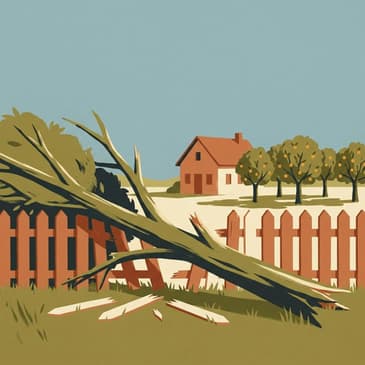
[00:04:47] had a major clog in the basement from decades of use. The plumbers had to bring in the jackhammer, dig up the basement floor and a hole outside the house to replace the pipe. It was a big, messy job. And expensive. Insurance will cover some of the repairs, but it's going to hit my parents' emergency fund hard. Then, two weeks after the plumbing problems, a 70-foot tree fell from a neighbor's yard, toppled a significant tree in my parents' yard like a domino,
[00:05:17] down some big branches from a neighbor's tree, crushed the fence, then snapped an old telephone pole with a basketball hoop on it. All on a calm and sunny day. The description and pictures don't do it justice, they tell me. Thankfully, my dad wasn't mowing at the time. Now there's a huge mess. It's going to take a ton of manual labor to remove all the wood, then haul it out of the yard.
[00:05:44] It's down a big hill, difficult to get it to street level. That's going to cost a decent chunk, too. My parents have the cash on hand, but we would not be able to cover both problems if they happened concurrently. Our properties are newer. My parents' home was built in the 1940s. But the events still make me want to have more financial control over the next calamitous home repair. As of today, our liquid reserves are insufficient. Savings segmentation.
[00:06:15] Not long ago, I wrote about how to manage excess cash flow when income outpaces expenses for the month. I segment our savings into different pools. A vacation fund, a car savings fund as a result of swearing off car payments, and our general fund, which also serves as the emergency fund. Combined, these funds should be able to cover any major home repairs when push comes to shove. But that would defeat the purpose of allocating money for specific purposes.
[00:06:44] The vacation fund we're building is already budgeted for a family trip next year. The car fund is still growing so I can buy a brand new car in four years or so. What I think needs to happen, and this is just becoming apparent as I write this, is I need to create a separate segmentation for emergency savings. Then load that up to a certain level, three to six months of expenses or more, and use the general savings fund
[00:07:11] almost exclusively for investing. The dilemma I face is that my overall cash holdings will be much larger than today. Usually I want to use most of that to build income streams, but I guess I'm becoming more risk-averse in my 40s. The other downside is, while I build up the emergency fund, less money will be available to invest. Having a high-yield savings account at my disposal alleviates this dilemma somewhat
[00:07:40] because I'll earn a return on par with some of my dividend growth stocks, though without the capital appreciation or risk. But I'm not ready to stop investing new capital in order to build a fund more rapidly. So I'll be gradually increasing our cash pool until meeting a to-be-determined arbitrary level of cash where I'm comfortable. It's only money. One reader recently called a post of mine philosophical.
[00:08:08] I get annoyed when bloggers get too philosophical, so I try to avoid that when I can. But I write so much that sometimes I can't help but go in that direction. I'm about to again. Spending so much time thinking about and writing about money can make a person seem pretentious. I hope I don't come across that way. I see money as a tool to build a life you want, not as a way to impress people,
[00:08:36] acquire fancy stuff, or go to fancy places. Smart money decisions are a result of knowledge. Knowledge is gained through reading and thinking. Good decisions will lead you down the path you want over time. But none of that is as important as your health, the health of your loved ones, and the relationships, life events, and adventures that bring you happiness.
[00:09:04] Sometimes that message is lost behind trying to count and analyze every penny that goes in and out of our pockets. But health, relationships, and the activities that bring you mental wellness are the main drivers that should be leading the important decisions in our lives, not money. You just listened to the post titled, It's Only Money. By Craig Stevens of retirebeforedad.com.
[00:09:33] And I'll be right back with my commentary. You've heard me talk about how I started tracking every dollar in and out of my life back in 2010. It began as a business school assignment, and I liked it so much, I never stopped. For years, that meant a spreadsheet I updated by hand. Now, Monarch does it for me. It tracks everything, accounts, investments, savings goals, and spending, all in one place. And going automatic showed me something my spreadsheet never did.
[00:10:02] My savings rate had slipped as my lifestyle crept up. It's like having a financial advisor in your pocket, flagging spending spikes before they become a problem. My favorite part is just asking the AI assistant, can I afford this vacation without touching my savings? And getting a real answer. Write your own money story with Monarch. Use code OPTIMAL at Monarch.com to get your first year of Monarch Core half off at just $50.
[00:10:31] That's 50% off your first year at Monarch.com with code OPTIMAL. This episode is brought to you by Google Chrome. You think you know a browser, but Gemini and Chrome? That's new. It can help you with practically anything on the web, like restoring a vintage motorcycle from a 50-page restoration block, or finally break down that long article you've had open for weeks. Gemini and Chrome is here for it. Ready to make anything online make sense? There's no place like Chrome. Check responses set up required.
[00:10:59] Compatibility and Availability varies 18+. Thank you to Craig. Nice to get that reminder that it really is only money. Because I think money stress is great at feeling like something bigger than it is. When a surprise bill hits, your body reacts like it's a genuine threat to your survival. Your heart races and so on. But if you take a step back, most money problems are solvable and usually temporary.
[00:11:28] A big repair bill is pretty terrible, but it's a number, and numbers can be worked with. Compare that to a health scare or losing someone you love. And the money stuff just isn't in the same category. And like we heard in this post, sometimes tragedy helps us put things in perspective. Unfortunately, sometimes we only learn things the hard way after something serious reminds us what actually matters.
[00:11:57] So if we can, it's best to learn from others without needing the crisis to teach it to us. It's one of the main reasons this show exists. So the next time a bill hits you hard, it's worth remembering that panic you feel is real, but the threat usually isn't quite what it seems and is something you can handle. And with that, thank you for being here. Keep handling that money. Have a great rest of your day, and I'll catch you tomorrow
[00:12:25] where your optimal life awaits. ланced. So let's see. Thank you.