



Discover all of the podcasts in our network, search for specific episodes, get the Optimal Living Daily workbook, and learn more at: OLDPodcast.com.
Episode 2407:
Rose Lounsbury shares three effective strategies to declutter children's toys, resulting in less mess and more meaningful play. By purging unused items, setting practical limits, and embracing minimalism, parents can foster their children's creativity while reclaiming a more organized living space.
Read along with the original article(s) here: https://roselounsbury.com/toy-purge/
Quotes to ponder:
"Do my kids play with you? And by 'play,' I mean regularly engage with for extended periods of time."
"Set out less toys than you think your kids will actually play with. Offer what you consider a paltry number of playthings and watch what happens."
"You will be amazed. First, your kids probably won’t care that there aren’t copious amounts of plastic dinosaurs and board books about."
Episode references:
BetterHelp: https://www.betterhelp.com
Learn more about your ad choices. Visit megaphone.fm/adchoices
[00:00:00] Brauchen wir wirklich noch einen Computer? Alle wahrscheinlich nicht. Aber wenn du Musik mit der Power eines Neuralprozessors neu erfindest oder unterwegs Migrationsmuster mit einem ganztägigen Akku analysierst oder deine Ideen mit dem KI-gesteuerten Co-Creator zum Leben erwächst, dann kann ein Co-Pilot Plus PC einen Unterschied machen. Nicht alle brauchen einen leistungsstärkeren KI-Computer. Aber wenn du versuchst, die Welt zu verändern, auch wenn es nur deine eigene ist, haben wir einen für dich entwickelt. Microsoft Co-Pilot Plus PC mit Snapdragon. Die bisher schnellsten und intelligentesten Windows PCs. Die Akkulaufzeit variiert hier nach Nutzung und Einstellungen.
[00:00:30] This is Optimal Relationships Daily. 3 Toy-Purging Rules for Less Pickup and More Play by Rose Lounsbury of roselounsbury.com
[00:00:42] Toys used to feel like the Achilles heel of my house, and I know I'm not alone. When my kids were toddlers, I often found myself having conversations like this with other moms.
[00:00:52] Me? How was Ella's birthday? Other mom? Great, but OMG, she got so much stuff. There's nowhere to put it all. It's driving me nuts.
[00:01:04] Me? I feel you, sister.
[00:01:06] And we go on like that for a while, bemoaning the Legos, Barbies, and Tonka trucks that had staked their claims in our living rooms. Yet, rarely in all this kvetching did we actually discuss a solution for the problem.
[00:01:19] I think most parents have resigned themselves, albeit grudgingly, to the fact that toys will rule their households while those households contain young children.
[00:01:28] I say, it does not have to be so. I'd like to share with you three tried-and-true toy purging rules that will result in less pickup and more play in your household. Sound good? Listen on.
[00:01:42] Rule number one. Purge like the devil is on your heels.
[00:01:47] Okay, I don't know why the devil would be on your heels while you purge toys, but it just sounds dramatic and sometimes we need a little drama to get moving.
[00:01:56] This is especially easy if you have young kids under age four who won't notice if half their matchbox collection disappears one day.
[00:02:05] Take advantage of those oblivious youngsters and purge while they're sleeping.
[00:02:08] When I started minimizing way back in 2012, I immediately purged about one-third of my kids' toy collection, and it felt great.
[00:02:18] Some questions to ask your children's toys as you purge would be...
[00:02:23] One. Do my kids play with you? And by play, I mean regularly engage with for extended periods of time.
[00:02:30] Occasionally dumping Mr. Potato Head out of his container and leaving him on the floor does not constitute play.
[00:02:37] Be picky here.
[00:02:38] Two. Do you foster educational or imaginative play?
[00:02:43] The teacher in me comes out on this one.
[00:02:45] I give more leeway to educational toys, like books, wooden puzzles, instruments, alphabet blocks, etc.,
[00:02:52] and those that encourage imagination, like dress-up clothes, play dishes and food, puppets, etc.,
[00:02:58] than toys of the light-up variety.
[00:03:01] Three. Have my children outgrown you?
[00:03:04] Two. Be honest. Are you keeping toys designed to hang on infant car seats when your kids haven't seen an infant car seat in over a year?
[00:03:12] Four. Are you part of a herd?
[00:03:15] Meaning, are you one of 35 plastic farm animals?
[00:03:19] One matchbox car among a thousand?
[00:03:21] If you have a herd, aim to cull it to a reasonable number with which your kids can actually play.
[00:03:28] Alternatively, divide the herd.
[00:03:30] Set a reasonable number out for play and put the rest in a storage location to be rotated in every few months.
[00:03:37] Five. Are you missing something important?
[00:03:40] Ditch the puzzle that doesn't have all the pieces and the train with the missing hitch.
[00:03:45] Save your precious space for toys that are fully functional.
[00:03:49] Rule number two. Set limits.
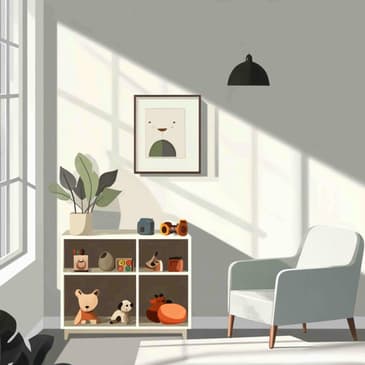
[00:03:52] This can be hard to do, but I've found that simply limiting the space available for toys helps.
[00:03:58] For example, my daughter used to love dress-up clothes.
[00:04:01] I used to put all her dress-up clothes in a large plastic tub.
[00:04:05] The tub presented several problems.
[00:04:08] First, my boys recognized it as the perfect platform for climbing onto the furniture.
[00:04:12] Second, the kids greatly enjoyed dumping all of the clothes out of the tub in order to climb inside of it.
[00:04:19] Third, I was picking unworn dress-up clothes off the floor.
[00:04:23] All. Day. Long.
[00:04:25] I needed another tactic.
[00:04:26] So, I sorted out the favorite dress-up items and put them in a small basket.
[00:04:30] I placed this basket on a toy shelf so the kids can easily access it for play and cleanup.
[00:04:36] I put the rest of the dress-up clothes in attic storage to rotate in every few months.
[00:04:41] My kids were just fine with about one-third of their original dress-up options,
[00:04:46] and I was no longer spending significant portions of my day returning errant tutus to a tub.
[00:04:51] Bliss.
[00:04:53] Rule number three. Less is more.
[00:04:56] Yes, it's a cliche, but cliches exist for a reason.
[00:05:00] They're often true.
[00:05:01] I challenge you.
[00:05:03] Set out less toys than you think your kids will actually play with.
[00:05:07] Offer what you consider a paltry number of playthings, and watch what happens.
[00:05:12] You will be amazed.
[00:05:14] First, your kids probably won't care that there aren't copious amounts of plastic dinosaurs and board books about.
[00:05:20] Second, and I promise you this, they will get more creative.
[00:05:24] Pictured in this post is my son, Reese, seven years ago at the sweet age of two.
[00:05:28] Be still my heart.
[00:05:30] Pushing small plastic balls around the floor with a wooden spoon.
[00:05:34] We'd had these balls in the toy box forever, but they had always been buried under mountains of stuffed animals and blinky toys.
[00:05:41] When I purged the excess, he discovered them anew, and they became part of his new favorite game.
[00:05:47] It also helped that the floor was no longer constantly covered with toys so he was able to play games like this.
[00:05:53] I hope this post encourages you to purge those toys so you and your kids have less pickup and more play.
[00:06:01] To your toy purging success.
[00:06:07] You just listened to the post titled,
[00:06:09] Three Toy Purging Rules for Less Pickup and More Play,
[00:06:13] by Rose Lounsbury of roselounsbury.com.
[00:06:18] And thank you so much to Rose for a great post to actually get parents moving on making changes
[00:06:24] rather than just talking about it, as she alluded to in the beginning.
[00:06:26] And her bit of humor certainly didn't hurt either.
[00:06:29] Though there are definitely some exceptions as kids get older,
[00:06:32] she is right in that children are adaptable enough to make do with fewer toys.
[00:06:37] As a matter of fact, making these changes when children are young, like she said,
[00:06:40] especially around age two, like her son Reese was when she started moving things away,
[00:06:45] it helps kids to grow up expecting less and being more creative and equally happy with less.
[00:06:51] While the comparison to other children with more toys may challenge them a bit as they get older,
[00:06:56] they're more likely to meet these feelings with grace and appreciation if,
[00:07:00] from before they're old enough to even gauge what is and isn't a lot of toys,
[00:07:04] they've had nothing but fun and imaginative experiences with the amount of toys they have had.
[00:07:10] Not to mention some lessons about not comparing oneself and maintaining gratitude could help
[00:07:15] a lot in that department too.
[00:07:17] And now folks, it is that sad time where we wrap up the episode for today.
[00:07:21] I thank you so much for being here and listening through the end,
[00:07:24] and I will see you again over the weekend where your optimal life awaits.