



Discover all of the podcasts in our network, search for specific episodes, get the Optimal Living Daily workbook, and learn more at: OLDPodcast.com.
Episode 2559:
Shelby Forsythia explores the often-overlooked transformation of friendships after grief, revealing that while some relationships fade, others deepen in unexpected, soul-affirming ways. Her reflection offers a gentle yet profound reminder that loss reshapes our social world, and sometimes, it brings surprising clarity about who truly sees us.
Read along with the original article(s) here: https://shelbyforsythia.medium.com/yes-you-lose-friends-after-loss-but-something-else-happens-too-274de4e3a2e6
Quotes to ponder:
"People disappear when you’re grieving. They drop off the map. They ghost, go quiet, or fumble their way out of your life."
"But after the loss, people also show up. People you didn’t expect to appear suddenly appear."
"These aren’t replacements for the people who left. They’re not substitutes. They are additions, and enhancements, and recalibrations."
Episode references:
Option B by Sheryl Sandberg and Adam Grant: https://optionb.org/book
Learn more about your ad choices. Visit megaphone.fm/adchoices
[00:00:00] This is Optimal Relationships Daily. Yes, You Lose Friends After Loss, But Something Else Happens Too by Shelby Forsythia of ShelbyForsythia.com In the fall of 2020, I led a workshop on life after loss. One attendee, Kathy, was grieving a recent breakup. But she was mourning, as so many grieving people do, more than one loss alongside of her romantic split.
[00:00:27] The biggest loss, she said, is the loss of my friend circle. When Maggie and I called off our engagement, everyone I spent time with, everyone I would have considered a support system, left with her. I have no one to lean on. Of course, I'm grieving the fact that she and I aren't together anymore, but the biggest loss, I feel, is the loss of my friends. Since I started doing grief work in 2016, I've led a number of workshops on the pain of broken friendships in the aftermath of loss.
[00:00:56] While friends are often touted as the more stable, more lasting family we choose, it's surprising how many friendships change or abruptly end when one friend in the relationship experiences a devastating loss. Whether our friends are directly connected to our loss, as Kathy's friends were in the breakup of her engagement, or witnesses to our grief, it's normal for us to assume that they'll stand by as we put our lives back together.
[00:01:22] But in many cases, our friends are an unexpected source of further pain after loss. They say hurtful things, they pull away with no explanation, they fail to ask how we would like to be supported, they pressure us to be happy or fine, or they plain disappear altogether. The list of emotional injuries goes on and on. And pretty soon, we're cut off or disconnected from a circle of friends that we used to call home.
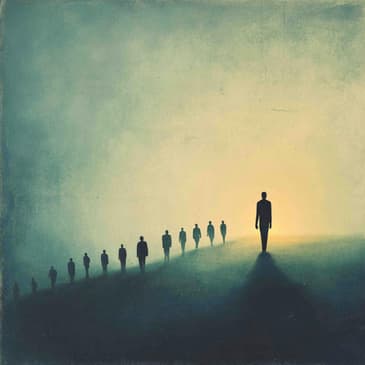
[00:01:49] Many of my clients have described this experience as feeling like they've been left out to sea with no resources, or feeling like they're standing outside of a warm, happy restaurant in the freezing cold, watching everyone else be normal and happy inside without them. The story Kathy and so many grieving people tell themselves is that they have nowhere to belong, because the place where they used to fit no longer welcomes them.
[00:02:14] They've been cast out of a closed circle, and they are doomed to be adrift in a friendless wilderness forever. I will never discount the reality of a griever's lived and felt experience, and there's often more than one way to tell a story. During the workshop, I lightly lobbed a reframe in Kathy's direction.
[00:02:34] What if, instead of being pushed out of a circle and existing forever in the lonely margins, you were hovering in the middle space of a Venn diagram? What if you weren't permanently rejected from humanity so much as you are in transition to a new circle of friends?
[00:02:53] Because here's the thing. Whether we realize it or not, losing friends after a loss, with all of its pain and confusion and internal wrestling, is a clear sign that the people we used to be in a relationship with can no longer be good companions to us in grief. For whatever reason, they don't have the tools, the space, the energy, the time, the words, the nature, or the ability to walk with us as we traverse the road of loss.
[00:03:22] And that's worth carving out specific space and time to mourn. What their absence leaves us with, however, is an invitation to seek out and welcome friends who are able to be in compassionate, informed, respectful relationships with us, and the grief that is now our permanent foundation.
[00:03:41] As we exit, or are pushed out of, a friend group that does not know how to do grief, we are simultaneously called to engage in new friendships, ones that honor the weight of our loss. It's a similar reframe to the one I offered in this piece on being told your grief is too much. Said a few different ways,
[00:04:00] What if losing friendships was not a signal that grief has made you unlovable or undesirable as a friend, but was a signal that you are about to enter a season of life where your friendships are deeper, richer, and more empathetic than ever before? What if you are not being abandoned in a friendless desert, but are simply in transition to a new oasis of friendship where you are fully welcomed and recognized for all of the ways grief has informed you?
[00:04:27] What if you didn't have to fight to retain old friendships that you've outgrown, and instead only had to receive the grief-affirming friendships waiting in the wings for you? If these reframings are tricky for you, consider this. How many times in your life have your friend groups changed? Reflect on all of the times, places, spaces, and ways in which your friendships have shifted and evolved across the course of your life. This could be when you graduated from high school and went to college.
[00:04:56] When you moved across the country, when you started a new job, when you got married or had kids, and so on. There are many seasons where you pass through a Venn diagram of friendship. You leave a former circle. You hang out in the uncomfortable, clunky, lonely, uncertain middle space for a while. You have some weird coffee dates. You make some awkward conversation. You try some different hobbies. You enter into a new circle and set roots down with new people. Rinse repeat.
[00:05:27] Ultimately, what I want you to remember is this. You've done this before. This is not new for you. You have weathered being in a Venn diagram of friendship already. What's new, this go-round, is that the driver of this transition is a profound loss. Most likely, it's not something you got to choose. It was something that was forced upon you. And it doesn't feel good either.
[00:05:50] So losing friends on top of an already painful loss seems to only add more awfulness to the pain pile of grief. It's okay to mourn the friendships you used to hold, along with the life you used to have and the person you used to be. You have permission to feel broken and busted up by friendship loss. And as you grieve the emotional and relational deaths of your friendships, rest assured that just like you've witnessed in other seasons of your life,
[00:06:18] there are new and more appropriate friendships seeking you and waiting for you to seek them out. Like a custom-fitted garment, they will wrap snugly and comfortably around you and the losses that you carry. You may feel alone now, but you won't be alone forever. You just listened to the post titled, Yes, You Lose Friends After Loss, But Something Else Happens Too,
[00:06:46] by Shelby Forsythia of shelbyforsythia.com And a post that I absolutely loved from Shelby today. Thanks a lot to her for sharing and discussing those reframes that she led Kathy through. Now, what I enjoy most about her approach here is that this positive outlook that she's trying to instill in Kathy is not at all unrealistic. Positive thinking can often get a bad rap as many of us tie it to a sense of delusion.
[00:07:13] But in Kathy's case, and in most all of our cases when we're caught in the middle of something painful that seems inescapable, our tendency to think negatively and see no solutions or opportunities are highly illogical. Though in the midst of our hurt, we might defend these tendencies to the death. So if you find yourself caught in a loop similar to Kathy's, do your best to step outside yourself,
[00:07:39] almost rise above your body and look at your life from a bird's eye view. Is it realistic for you to have reached some kind of endpoint that you'll never recover from? 99% of the time, that could not be farther from the truth. Of course, we do want to honor our difficult feelings, but that honor can coexist with reminders about hope that lies ahead. And with that, I'm going to turn you loose for today, everybody. Thank you so much for joining me, and I hope you enjoyed this post from Shelby as much as I did.
[00:08:08] Enjoy your Saturday if you're listening in real time, and I'll see you back here tomorrow, where your optimal life awaits.