



Discover all of the podcasts in our network, search for specific episodes, get the Optimal Living Daily workbook, and learn more at: OLDPodcast.com.
Episode 2574:
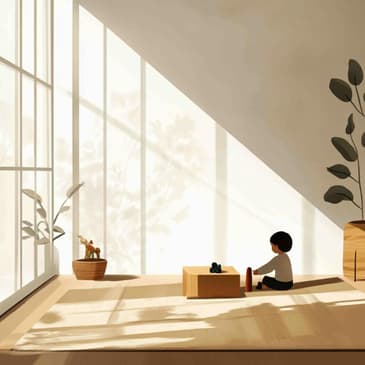
Rachel Jones highlights how a minimalist playroom not only reduces clutter but also boosts children's creativity, attention spans, and emotional wellbeing. Drawing from personal experience and research, she shows that fewer toys lead to more imaginative play, less sibling conflict, and a deeper appreciation for each item they own.
Read along with the original article(s) here: https://nourishingminimalism.com/minimalist-playroom-better-kids/
Quotes to ponder:
"Every night we would pick-up, tossing toys in the closet and into the toy box so I didn’t suffer from a Lego-related accident in the middle of the night."
"The quality of the children’s play seemed to be better when fewer toys were available."
"It was really quite amazing how much time kids can play with one toy and the only difference was removing the 50 other similar toys from their room."
Learn more about your ad choices. Visit megaphone.fm/adchoices
[00:00:00] Hey, it's Justin from Optimal Living Daily. Before we start, I want to share a super powerful practice I use called NSDR or Non-Sleep Deep Rest. In just about 10 minutes or so, this Yoga Nidra practice leaves you feeling as refreshed as after a nap without actually sleeping. Experience it for yourself on our guided podcast. Search NSDR and look for the one from Optimal Living Daily.
[00:00:24] This is Optimal Relationships Daily, Why a Minimalist Playroom is Better for Kids by Rachel Jones of NourishingMinimalism.com I don't remember any friends with playrooms when I was a kid, but when I started having my children, I attended many a playdate at people's houses, always hosted at the houses that had playrooms. It was like a daycare facility, except none of them ran a daycare.
[00:00:52] That's what they had acquired, trying desperately to keep their children entertained. The only reason I didn't have one is that I didn't have an extra room in my house to put a playroom. Otherwise, it would have happened. But, are we really doing the best for our kids when we have a playroom with an overabundance of toys? When my children had a toy box full of toys, as well as an entire closet dedicated to large toys and sets of toys, we had toys spread all over the house.
[00:01:20] They would take everything out of the toy box. I'm still not sure why I don't think there was ever anything in the bottom of the toy box that they were looking for. And, they would take all the toys out of the closet as well. Toys covered the floor of their room, so much so that it was difficult to walk through their room, and the toys often found their way out over the rest of the house. Every night we would pick up, tossing toys in the closet and into the toy box, so I didn't suffer from a Lego-related accident in the middle of the night.
[00:01:49] It repeated like this every single day, and I began to hate those toys. When I started limiting the toys, I let each child keep 20 personal items, and then evaluated which sets of toys they played with, and which ones needed to leave the house. The difference in how they played after we got rid of so many toys was quite amazing. They were occupied longer, got along better, and actually played with what toys they had.
[00:02:16] Researchers led by occupational therapist Alexia Metz at the University of Toledo in Ohio, were curious about whether the number of toys would affect how the children played, including how many toys they played with and how long they spent with each toy. The researchers also wondered about the children's creativity, such as the ability to imagine a bucket as a drum or a hat. In the experiment, 36 children ages 18 to 30 months visited a laboratory playroom twice,
[00:02:45] while cameras caught how they played. On one visit, the room held four toys. On the other visit, the room held 16 toys. When in the playroom with 16 toys, children played with more toys and spent less time with each other over a 15-minute session, the researchers found. When the same kids were in a room with four toys, they stuck with each toy longer, exploring other toys less over the 15 minutes.
[00:03:12] What's more, the quality of the children's play seemed to be better when fewer toys were available. The researchers noted more creative uses of the toys when only four were present versus 16. Science will say that more studies like this one need to be done, but as parents, it's not hard to test this out for ourselves, even if the toys are only hidden away for a time. For many years, my method was this. We piled all the toys into the middle of the floor,
[00:03:40] had each child pick out his 20 items, and then we boxed the rest for either trash or giveaway. We kept different sets of toys in the closet, and eventually learned to take them out one at a time. This worked well for the older three children, and they did play longer, more imaginatively, and with less arguing all around. My younger children, however, are more attached to toys, and asking my daughter to only pick 20 seemed traumatizing to her sentimental nature. So instead, I had to pack things up,
[00:04:09] vowing not to get rid of them until she gave me permission. We tried a two-month experiment where we left out only a handful of toys. It went so well, we never went back. It was really quite amazing how much time kids can play with one toy, and the only difference was removing the other 50 similar toys from their room. Joshua Becker of Becoming Minimalist shares, Why Fewer Toys Will Benefit Your Kids Kids learn to be more creative. Kids develop longer attention spans.
[00:04:37] Kids establish better social skills. Kids learn to take greater care of things. Kids develop a greater love for reading, writing, and art. Kids become more resourceful. Kids argue with each other less. Kids learn perseverance. Kids become less selfish. Kids experience more of nature. Kids learn to find satisfaction outside of the toy store. Kids live in a cleaner, tidier home. Keep their personality in mind. As you're working through the toys,
[00:05:07] helping your children to decide what to keep out and what to put away, whether it's permanently or as an experiment, keep in mind your child's personality and play style. Some children will play more with building toys, Legos, blocks, etc., while others are drawn to role-playing, baby dolls, kitchen toys, etc. Limit the categories as well. When you keep the baby doll out, only keep out a few essentials to play with, a blanket and an outfit, perhaps. Don't keep out all the accessories,
[00:05:37] the stroller, the bed, 10 outfits, diapers, shoes, etc. Keep it simple, or the experiment won't work. When you keep out the Lego sets, limit it to a manageable amount, a shoebox full or similar. If the kids are worried about losing their toys, assure them that you won't get rid of them without their permission. That way, they can enter the experiment without any worry. You just listened to the post titled,
[00:06:04] Why a Minimalist Playroom is Better for Your Kids, by Rachel Jones of NourishingMinimalism.com And thanks a lot to Rachel for this one. It's so hard for a lot of parents to get on board with minimalism content, because it often feels like the kids just will not allow such a thing. I totally understand that. I probably wouldn't have when I was a child. That's for sure. So, it is nice to have some research attached to it, like Rachel provided today. And as always, remember parents,
[00:06:32] that perhaps the best way of getting your kids to believe in this idea, the way that you do, is to model it for them. If your children see you enjoying yourself more or being more resourceful with less items, and they get familiar with that lifestyle, it does become more likely for them to not desire an excess of toys, or an excess of anything really. Children who have great relationships with their parents often want to be just like them. And this is no different. So, set the stage while they're young, and live by the values that you hope they'll live by when they're older.
[00:07:03] Okay, friends, that will bring us to the end. I appreciate you being here and sticking it out. And be sure to come back and do the same tomorrow, where I will have another post for you. That's where your optimal life awaits. Andена Langmuack