



Discover all of the podcasts in our network, search for specific episodes, get the Optimal Living Daily workbook, and learn more at: OLDPodcast.com.
Episode 2630:
Julie Morgenstern explores the hidden cost of hyper-independence, revealing how trying to "do it all alone" often leads to burnout and disconnection. By shifting from self-reliance to strategic collaboration, listeners can unlock greater productivity, deeper relationships, and sustainable success.
Read along with the original article(s) here: https://www.juliemorgenstern.com/tips-tools-blog/2020/1/10/dont-do-it-all-alone
Quotes to ponder:
"Trying to be everything to everyone, all by yourself, is not a badge of honor, it’s a recipe for exhaustion."
"Inviting support into your life is not a weakness; it’s a strength."
"The truth is, none of us is meant to go it alone."
Learn more about your ad choices. Visit megaphone.fm/adchoices
[00:00:01] Wenn jemand Charles und Melanie gesagt hätte, dass sie nach ihrem Tinder-Match gemeinsam einen Channel mit crazy Aufgaben starten, also wirklich crazy, fünf Tage auf einer einsamen Insel verbringen, eine Zipline an einem Gurt runterrasen, eine Million Views knacken, eine Wand mit Saugnöpfen hochklettern und Falschirm springen in Ägypten? Das hätten die beiden niemals geglaubt. Aber das ist das Ding mit Tinder. Es führt dich an Orte, die du nie erwartet hättest. Wohin es dich auch führt. It starts with a swipe. Tinder.
[00:00:29] Hey Sandra, wir haben uns ja lange nicht mehr gesehen. Grüß dich Nadine. Mensch, du siehst ja toll aus. Ja danke. Ich habe mein Plus fürs gesündere Ich entdeckt. Was? Komm, ich zeig's dir. Die Bewegungskurse der AOK Plus. Kostenfrei für AOK Plus Versicherte. Entdecke dein Plus fürs gesündere Ich und starte mit unserem Self-Check. Ganz einfach online auf aok.de. Aus Liebe zur Gesundheit. AOK Plus.
[00:01:00] This is Optimal Relationships Daily. Don't Do It All Alone. By Julie Morgenstern of juliemorgenstern.com. Becky, a divorced mom with two kids, 10 and 15, wished she could spend less time organizing household logistics and more quality time with her family. Unfortunately, she'd become the person taking sole responsibility for maintaining the household, determining what needed to be done, telling people what to do, and nagging them to do their jobs.
[00:01:30] In other words, Becky had become the family's default arranger. Naturally, the kids didn't like the nagging. But Becky, tired from the amount of brain space and time it took to run the household, was unsure of how to approach her family to fix things. How much time would you gain if you didn't have to be the resident supervisor, I asked. Two hours a day, she answered, without skipping a beat, along with a boatload of stress I feel every day as I deliberate how to
[00:01:57] remind them nicely and minimize conflicts without deciding it's easier to just do it all myself. Running a household is hardly for the faint of heart. It's a tremendously difficult logistical task that is underestimated in terms of its complexity. Whether you were organized or not before you had kids, arranging logistics for family life is different and more complex than organizing for a single person. It requires an unusual combination of skills, the ability to hold a strategic vision of the big picture,
[00:02:27] pay fine attention to detail, and be simultaneously organized and flexible, which rarely exist in one person. Because it's easy to underestimate the amount of time it takes, families rarely talk openly about the responsibilities. Often, like Becky, one person becomes the default arranger and absorbs the entire job. Or, individual family members silently gravitate toward certain tasks based on what they notice or care about, but since no one talks about it,
[00:02:55] they often don't feel recognized for the work they put in, only criticized for what they don't do. A conversation can help overcome misunderstanding and resentment, and you can have one with your kids at any age or stage. Family life is dynamic, and discussing what's required and how it'll get done is fair game at every transition point. Whether that's your children growing and developing new skills to pitch it, the birth of a new baby, taking on a new job, or simply entering a new year.
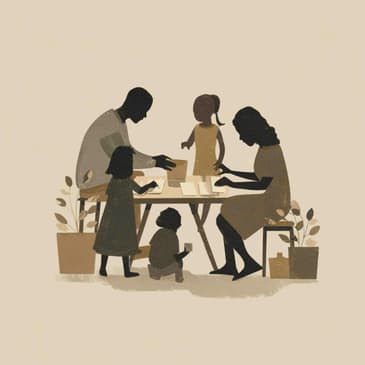
[00:03:24] But, how do you actually discuss a range with your family? I had Becky and her family engage in a practical exercise, which I call, Put All the Cards on the Table. Literally. 1. Make a note card for each task and chore involved in running your household. Laundry, vacuuming, yard work, grocery shopping, pet management, paying bills, cooking, setting the table, clearing the table, etc.
[00:03:53] Eve Rodsky recently came out with a book called Fair Play, which focuses solely on this exercise, and even suggests a list of 100 common chores for the cards. 2. First, categorize the cards by who does what. This immediately creates a visual of how evenly or unevenly the labor is divided among the family members of your household. You may discover that some things are unclear, done by multiple people, or that some things are not done at all. Whoops.
[00:04:22] 3. Once you see how the labor is currently divided, lay all the cards back out in the middle of the table. Discuss the fact that these are the family tasks, not just one person's. Now, go back through the cards and allow everyone to choose tasks that they enjoy and can commit to doing. 4. Are any tasks left over or unclaimed? Decide how these tasks should be handled. Do you rotate? Do you hire someone?
[00:04:50] Is there a better system that takes less time? Can you let it go entirely? Becky's teenage son, Aaron, who'd felt very put upon by lawn and pet care, was humbled when he saw that his mom had 24 cards, while he had 6, and his little sister had 1. The discussion revealed that much of the nagging was the result of misunderstandings around timing. Angelica, the 10-year-old, expressed that she was very willing to do more but needed to be taught. The family reallocated the tasks,
[00:05:19] made a plan for teaching Angelica how, and created a chore chart, including expectations on when things had to be completed. For example, dishes cleared as soon as dinner is done, but Saturday's dusting and vacuuming can happen anytime before 5. Engaging every member of the household in arranging tasks, including kids from an early age, is a good thing. It promotes a sense of responsibility and belonging, imparts the value of caring for others in relationships,
[00:05:47] and teaches critical life skills that translate easily outside the home to school, work, and any situation that requires cooperation. Plus, what kids want most is time with you, and one of the greatest motivations for sharing the work of a range is that it creates space for quality time for the family. You just listened to the post titled Don't Do It All Alone
[00:06:13] by Julie Morgenstern of juliemorgenstern.com
[00:06:47] And I really enjoyed this post from Julie today. I hope you all did too. You know, as I was reading it, one line that stuck out to me was when she said that leading a household is just plain old difficult. And it's paraphrasing. But I don't think anyone who's doing it is denying that. And I'm sure people who aren't in that position can imagine how difficult it is. But what I want to address is, I think, how normalized it is. Because so many people are in the same position of running a household,
[00:07:17] you might feel like you're not allowed to stress over it or be overwhelmed. It's not a unique position to be in, and therefore it's easy to shame ourselves for being stressed by it because so many others are going through the same grind. And I think that perspective can be helpful sometimes. But I just want to remind anyone who's the head of a busy household that just because you are one of many doing it and it's a normal struggle doesn't mean it's not a struggle at all or that you're not allowed to be frustrated by it.
[00:07:48] Just because it's a common weight to carry doesn't mean it's a lightweight to carry. So I just want to encourage anyone who's in this position to allow yourselves to feel run down sometimes, to not know what to do next or how to manage, etc. Certainly posts like this help out a lot, which is why we shared it. But there is no shame in feeling or expressing a sense of exhaustion when you're in this position or any position that's both difficult and common.
[00:08:15] We don't have to be going through a unique struggle to be deserving of patience with our feelings, if that makes sense. So think on that. Time to get out of here, everyone. I appreciate you coming and listening until the end. Have a fun and fulfilling weekend and I will see you right back here with more exciting content where your optimal life awaits.