



Discover all of the podcasts in our network, search for specific episodes, get the Optimal Living Daily workbook, and learn more at: OLDPodcast.com.
Episode 3040:
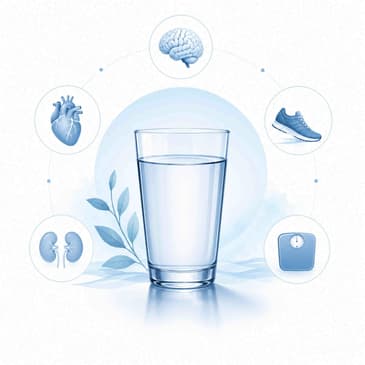
Joe Leech examines the science behind proper hydration and explains how drinking enough water may support physical performance, brain function, digestion, kidney health, and weight management. By separating well-supported benefits from areas that need more research, he provides practical insights that can help listeners make smarter choices about their daily water intake.
Read along with the original article(s) here: https://www.healthline.com/nutrition/7-health-benefits-of-water
Quotes to ponder:
"Losing as little as 2% of your body’s water content can significantly impair your physical performance."
"Mild dehydration (fluid loss of 1–3%) can impair energy levels, impair mood, and lead to major reductions in memory and brain performance."
"Make sure that you get enough water each day, whether your personal goal is 64 ounces (1.9 liters) or a different amount. It’s one of the best things you can do for your overall health."
Episode references:
National Kidney Foundation – Kidney Stones: https://www.kidney.org/kidney-topics/kidney-stones
MedlinePlus – Constipation: https://medlineplus.gov/constipation.html
Centers for Disease Control and Prevention – Water and Healthier Drinks: https://www.cdc.gov/healthy-weight-growth/water-healthy-drinks/index.html
Harvard T.H. Chan School of Public Health – The Nutrition Source: Water: https://nutritionsource.hsph.harvard.edu/water/
Learn more about your ad choices. Visit megaphone.fm/adchoices
[00:00:00] Sehr gut, sehr gut, sehr gut! Sehr gut? Wieso Steuer ist sehr gut! Das sagen ganz viele! Cool, wer sagt das? Stiftung Warentest, Computerbild, Focus Money, Chip, Finanztipp, such dir was aus! Mega! Aber das ist doch bestimmt kompliziert! Nö! Einfach Foto von der Lohnsteuerbescheinigung machen und fertig! Klingt sehr gut! Ist sehr gut! Hol dir dein Geld zurück mit Wieso Steuer!
[00:00:21] Was deine Haut braucht, ist was deine Haut braucht! Pigmentflecken reduzieren und vorbeugen durch innovative Wirkstoffe und höchsten UV-Schutz. Euboss Anti-Age – dein neues Duo gegen Pigmentflecken und Hautalterung. Euboss – Individual Skincare.
[00:00:54] Optimal Health Daily. I think you're going to like this one. So without further ado, let's hear Dr. Neal's narration and commentary as we optimize your life. 7 Science-Based Health Benefits of Drinking Enough Water by Joe Leech with Healthline.com Our bodies are around 60% water, give or take. It is commonly recommended to drink 8-ounce glasses of water per day. Think the 8x8 rule.
[00:01:23] Although there is little science behind this specific rule, staying hydrated is important. Here are 7 evidence-based health benefits of drinking plenty of water. 1. Water helps to maximize physical performance. If we do not stay hydrated, physical performance can suffer. This is particularly important during intense exercise or high heat environments. Dehydration can have a noticeable effect if you lose as little as 2% of your body's water content.
[00:01:51] However, it is not uncommon for athletes to lose anywhere from 6 up to 10% of their water weight via sweat. This can lead to altered body temperature control, reduced motivation, increased fatigue, and make exercise feel much more difficult, both physically and mentally. Optimal hydration has been shown to prevent this from happening, and may even reduce the oxidative stress that occurs during high-intensity exercise. This is not surprising when you consider that muscle is about 80% water.
[00:02:20] So, if you exercise intensely and tend to sweat, then staying hydrated can help you perform at your absolute best. Bottom line. Losing as little as 2% of your body's water content can significantly impair physical performance. 2. Hydration has a major effect on energy levels and brain function. Your brain is strongly influenced by hydration status.
[00:02:46] Studies show that even mild dehydration, think 1-3% of your body weight, can impair many aspects of brain function. In a study of young women, fluid losses of just 1.36% after exercise impaired both mood and concentration and increased the frequency of headaches. Another similar study, this time in young men, showed that fluid losses of 1.59% was detrimental to working memory and increased feelings of anxiety and fatigue.
[00:03:14] A 1-3% fluid loss equals about 1.5-4.5 pounds, or 1.5-2 kilograms, of body weight loss for a 150-pound or 68-kilogram person. This can easily occur through normal daily activities, let alone during exercise or high heat. Many other studies, ranging from children to the elderly, have shown that mild dehydration can impair mood, memory, and brain performance. Bottom line.
[00:03:43] Mild dehydration, which is defined in fluid losses of 1-3%, can impair energy levels and mood, and lead to major reductions in memory and brain performance. 3. Drinking water may help to prevent and treat headaches. Dehydration can trigger headaches and migraines in some individuals. Several studies have shown that water can relieve headaches in those who are dehydrated. However, this appears to depend on the type of headache.
[00:04:09] One small study found that water had no effect on the frequency of headaches, but did reduce the intensity and duration somewhat. Bottom line. Drinking water can sometimes help relieve headache symptoms, especially in people who are dehydrated. 4. Drinking more water may help relieve constipation. Constipation is a common problem, characterized by infrequent bowel movements and difficulty passing stool.
[00:04:35] Increasing fluid intake is often recommended as a part of the treatment protocol, and there is some evidence to back this up. Low water consumption appears to be a risk factor for constipation in both young and elderly individuals. Carbonated water shows particularly promising results for constipation relief, although the reason is not entirely understood. Bottom line. Drinking plenty of water can help prevent and relieve constipation, especially in people who generally do not drink enough water.
[00:05:03] 5. Drinking water may help treat kidney stones. Urinary stones are painful clumps of mineral crystal that form in the urinary system. The most common form are kidney stones. There is limited evidence that water intake can help prevent recurrence in those with a history of kidney stones. Higher fluid intake increases the volume of urine passing through the kidneys, which dilutes the concentration of minerals, so they are less likely to crystallize and form clumps.
[00:05:31] Water may also help prevent the initial formation of stones, but studies are required to confirm this. Bottom line. Increased water intake appears to decrease the risk of kidney stone formation. More research, though, is needed in this area. 6. Water helps prevent hangovers. A hangover refers to the unpleasant symptoms experienced after drinking alcohol. Alcohol is a diuretic, so it makes you lose more water than you take in. This can lead to dehydration.
[00:05:59] Although dehydration is not the main cause of hangovers, it can cause symptoms like thirst, fatigue, headache, and dry mouth. A good way to reduce possible hangover symptoms is to drink a glass of water between alcoholic beverages and to have at least one big glass of water before going to bed. And 7. Drinking more water can help with weight loss. Drinking plenty of water can help you lose weight. This is due to the fact that water can increase satiety and boost your metabolic rate.
[00:06:28] In two studies, drinking half a liter or 17 fluid ounces of water was shown to increase metabolism by anywhere from 24 to 30% for up to 1.5 hours. This means that drinking 2 liters of water every day can increase your total energy expenditure by up to 96 calories per day. The timing is important too. And drinking water half an hour before meals is the most effective. It can make you feel more full so that you eat fewer calories.
[00:06:56] In one study, dieters who drank half a liter of water before meals lost 44% more weight over a period of 12 weeks. It's actually best to drink water cold because then the body will use the additional energy or calories to heat the water to body temperature. You just listened to the post titled 7 Science-Based Health Benefits of Drinking Enough Water by Joe Leach with Healthline.com Ein perfekter Frühlingstag.
[00:07:27] Sonne. Park. Park. Picknick. Und so viele Pollen. Shop Apotheke sagt Tschüss Allergie und Hallo Frühling. Hier findest du alles um unbeschwert durch die Allergiezeit zu kommen. Als Neukunde sparst du sogar 10% ab 35 Euro Bestellwert. Mit dem Code 910. Du hast ein E-Rezept? Einfach Shop Apotheke App runterladen und direkt einlösen. Gutschein-Bedingungen auf shop-apotheke.com slash Gutscheine. Hey, it's Justin from Optimal Living Daily.
[00:07:55] Before we start, I want to share a super powerful practice I use called NSDR or Non-Sleep Deep Rest. In just about 10 minutes or so, this Yoga Nidra practice leaves you feeling as refreshed as after a nap without actually sleeping. Experience it for yourself on our guided podcast. Search NSDR and look for the one from Optimal Living Daily. Dr. Neil here for my commentary.
[00:08:21] There's another really interesting fact about drinking cold water as opposed to warm or room temperature water. We're learning that drinking cold water may actually get absorbed more quickly when compared to warm or room temperature water. They're not exactly sure why that is, but the theory is that it has to do with neurons and how the body responds to cold water. It somehow triggers the nerves in the gut to want to absorb that water more quickly. Again, just kind of a theory.
[00:08:51] They're not exactly sure if that's what's truly happening, but it's an interesting theory no less. But we do know that it is absorbed more quickly. And so particularly after a workout when your fluid needs are probably the highest, why not drink cold water if you can stand it and get it into your cells that much more quickly? When it comes to kidney stones, there are a number of studies that are finding that regular soda consumption seems to be highly linked with the development of kidney stones. There are a number of theories as to why this is.
[00:09:20] It could be that a person that drinks too many sodas just isn't drinking enough water, or maybe it's the sugar in the sodas, maybe the phosphates. They really don't know for sure, but there seems to be a relationship there. So one potential way to prevent kidney stones would be to swap out one soda for eight ounces of water. And these last two things I'll mention I know aren't the most comfortable things to discuss, but I'm going to say it anyways. When it comes to constipation, yes, absolutely, water can be helpful.
[00:09:49] Something else a person could try, though, is to go for a walk. Regular walking, and especially even jogging, seem to help peristalsis. It helps get things moving in the gut. So if you combine walking or jogging with more water consumption, that may help relieve constipation. And the last thing, I've said this many times before, how do you know if you're actually hydrated? Do you really need to follow the eight by eight rule? No. What you do is you look at your urine color.
[00:10:17] If it's light yellow most of the time, think pale lemonade, you're perfect. If it's clear all the time, you're probably getting too much water. However, if it's darker than that pale lemonade color, you're dehydrated. So I will leave you with that thought. Now, quick reminder, we do book giveaways every month to random people on our mailing list. So if you want to be a part of that, come by oldpodcast.com and join the weekly newsletter. It's totally free and a great way to show your support.
[00:10:45] Again, you can join at oldpodcast.com. All right, that wraps up today's episode. Thank you, as always, for listening. Thank you for being a subscriber. Have a great rest of your day. I'll be back here tomorrow for another Q&A episode and where your optimal life awaits.