



Discover all of the podcasts in our network, search for specific episodes, get the Optimal Living Daily workbook, and learn more at: OLDPodcast.com.
Episode 1483:
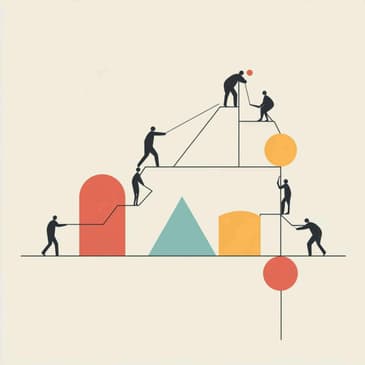
Derek Sivers explores the concept of becoming "robust" - developing resilience by making decisions that are future-proof and adaptable to unexpected events. Instead of optimizing for perfection in the short term, Sivers advocates for creating systems and habits that can withstand disruptions, ensuring long-term growth and stability.
Read along with the original article(s) here: https://sive.rs/robust & https://sive.rs/hi
Quotes to ponder:
"Robust means future-proof. It means taking actions and making decisions that are good no matter how the future turns out."
"The best systems are the ones that thrive even when chaos comes, because they’re built to be flexible, adaptable, and resilient."
"If your life is designed only for good weather, you’re in trouble when a storm hits."
Episode references:
Antifragile: https://www.amazon.com/Antifragile-Things-Gain-Disorder-Incerto/dp/0812979680
Learn more about your ad choices. Visit megaphone.fm/adchoices
[00:00:00] This complex financing talk is very challenging. Do I get my depot ever?
[00:00:06] But you already have a depot.
[00:00:08] No.
[00:00:09] Yes, you have the Vodafone Gigadepot.
[00:00:11] That's right! And I have myself in the hand how big my depot is.
[00:00:15] Now with the Vodafone Gigadepot and the data volume of耐用 in the next month. Go on in the 5G-Net of Vodafone.
[00:00:22] Vodafone. Together we can.
[00:00:26] This is optimal work daily.
[00:00:29] Fragile Plan vs Robust Plan by Derek Sivers of Sivers, S-I-V-E dot R-S.
[00:00:37] When I first had the idea for Wood Egg, publishing 16 books about 16 countries every year, I thought I would write them all myself.
[00:00:45] Visit 16 countries for 3 weeks each doing intensive research the whole time.
[00:00:49] That's 48 weeks so I could do it again each year.
[00:00:52] But I had a baby on the way, so that idea lasted about a minute.
[00:00:56] Then I thought of a journalist I know who would love that kind of life.
[00:01:00] I asked, she said yes, she flew to Singapore and started working.
[00:01:04] But it was a really bad fit.
[00:01:05] So after 5 weeks, we called it quits.
[00:01:08] Then I decided to hire one writer per country.
[00:01:11] 16 authors to write 16 books.
[00:01:14] This went okay at first.
[00:01:16] Mohit Pawar did a great job with India and Cameron King did a great job with Taiwan.
[00:01:21] But the people I hired for the other countries flaked out.
[00:01:24] So I realized this plan was still too fragile.
[00:01:27] Making a robust plan.
[00:01:29] I really wanted this to work.
[00:01:31] I had to be smart.
[00:01:32] I had to make a better plan.
[00:01:34] I re-read my notes on E-Myth, The Wisdom of Crowds, Crowdsourcing, and Here Comes Everybody.
[00:01:40] In fact, I re-read my notes on 130 books.
[00:01:43] It was an enlightening week.
[00:01:45] I learned a few things.
[00:01:46] One, if you want to help, it helps to get specific.
[00:01:50] And two, a plan that's too dependent on any one person is too fragile.
[00:01:56] Getting specific.
[00:01:57] Before, I had a very vague outline of what I wanted the book to cover.
[00:02:01] I asked the authors to include sections on culture, government, business setup, hiring, banking, and marketing.
[00:02:08] That was it.
[00:02:08] The details were up to them.
[00:02:10] Go.
[00:02:11] In hindsight, I can see how daunting that was.
[00:02:14] Too wide open.
[00:02:15] I've written about the need to get specific before.
[00:02:18] See my articles, get specific, and restrictions will set you free.
[00:02:22] But I had forgotten to apply it to this.
[00:02:24] So, I spent a couple weeks and came up with 200 specific questions.
[00:02:28] Now, to write the book, we just had to answer those 200 questions.
[00:02:32] It's infinitely easier to find someone to answer a specific question
[00:02:36] than to find someone to impart wisdom on a vague topic.
[00:02:39] It puts the burden on the asker to come up with a good question
[00:02:42] and lifts the burden from the answerer.
[00:02:45] Multiple people.
[00:02:46] So that the book was not dependent on any one person and the book was not one person's opinion,
[00:02:51] I made a system where each of those 200 questions had to be answered by three different people.
[00:02:56] Ideally, one local, one foreigner, and one other.
[00:03:00] 16 countries times 3 researchers equals 48 people.
[00:03:03] I used upwork.com to find people in each country.
[00:03:07] Of course, some disappeared, some never finished, and a few gave bad answers.
[00:03:11] But that was okay.
[00:03:12] Life happens.
[00:03:13] People's circumstances change.
[00:03:15] I understand.
[00:03:16] But it won't hurt my plan.
[00:03:18] If any one person is gone, I can still carry on.
[00:03:21] When all 200 questions had three answers each, 16 times 200 times 3 equals 9600 answers,
[00:03:27] I hired a few writer editors to combine the answers into one essay per question.
[00:03:32] Again, one person disappeared, but it was easy for another to step in.
[00:03:36] And that was the robust plan that got it done.
[00:03:39] Note, I was also visiting every country myself and contributing my own research to the books,
[00:03:44] but it was important that the plan didn't require me either.
[00:03:48] Lessons learned?
[00:03:49] If you're starting a project or company,
[00:03:51] 1.
[00:03:52] Don't expect anyone to care as much as you.
[00:03:54] 2.
[00:03:55] Don't require them to think as hard about this as you have.
[00:03:58] 3.
[00:03:59] Do expect them to change their mind and disappear.
[00:04:01] 4.
[00:04:02] Make a robust plan that includes numbers 1 through 3.
[00:04:05] As the founder, the burden is on you to come up with a great plan,
[00:04:08] to lift the burden from the people helping you.
[00:04:11] Then, when you find some brilliant people, it's a great bonus,
[00:04:14] instead of an absolute necessity.
[00:04:20] 4.
[00:04:20] Human Intervention as a Competitive Advantage by Derek Sivers of SiversSive.rs
[00:04:28] The Listening Algorithm
[00:04:30] A year after I started CD Baby when it was still just me in my bedroom,
[00:04:34] the CEO and VP of a hugely funded Silicon Valley online music company contacted me,
[00:04:40] saying they wanted to fly out to New York to meet me.
[00:04:42] I said okay, and we met a week later for dinner.
[00:04:45] Dinner was a lot of blah blah blah small talk, and I wondered what they really wanted.
[00:04:50] Then, they finally got to the real point.
[00:04:52] The reason we flew out to meet you is because we've been looking at many music recommendation engines,
[00:04:56] and the one that's powering CD Baby.com is one of the best we've found.
[00:05:01] Could you tell us a little something about the algorithms and data points you're using?
[00:05:04] Uh, I was confused and asked what they meant.
[00:05:07] They said, the music recommendations on your site don't seem to be sales driven like Amazon.
[00:05:12] The music matching algorithm comes up with incredible recommendations.
[00:05:15] What software are you using for that?
[00:05:18] Ah, I get it.
[00:05:19] I smiled and pointed to my ear.
[00:05:21] No software, I just listen to everything that comes in and recommend other good stuff like it.
[00:05:26] Now they look confused.
[00:05:27] But how will that scale?
[00:05:29] You can't just listen to every single album.
[00:05:31] What will you do when you start getting 100 albums a day?
[00:05:34] I said, maybe hire someone just to listen.
[00:05:36] I don't know, I'm not there yet.
[00:05:38] I'll worry about it then.
[00:05:39] And that's what I did.
[00:05:40] When we were getting 100 albums a day,
[00:05:42] it became someone's full-time job to listen to every new arrival
[00:05:45] and do the internal recommendations.
[00:05:48] Minimizing or maximizing.
[00:05:50] When everyone else is trying to automate everything,
[00:05:52] using a little human intervention can be a competitive advantage.
[00:05:55] The problem is when business owners see it as a cost instead of an opportunity.
[00:06:00] Trying to minimize costs instead of maximize income,
[00:06:04] quality, loyalty, happiness, connection,
[00:06:06] and all those other wonderful things that come from real human attention.
[00:06:10] You can buy a fancy phone routing system so people have to listen to 9 options,
[00:06:14] choose option 5, then listen to 6 more options.
[00:06:18] Or you can hire a charming person to pick up the phone on the first ring
[00:06:21] and make a great impression.
[00:06:23] Which one do you think will win you new fans?
[00:06:25] You can put rules into your online forms.
[00:06:27] So if someone puts a dash in their phone number or writes coming soon as their URL,
[00:06:32] it tells them they're wrong and makes them do it over again.
[00:06:34] Or you can have new submissions be checked over quickly by a real person.
[00:06:39] It's worth the 10 seconds of human effort to keep the end user experience easy
[00:06:43] but the internal data correct.
[00:06:45] It's fun for techies to try to find the tech solution to everything.
[00:06:49] But don't forget that even a tiny touch from a real person can be the best algorithm
[00:06:53] and a massive business maximizer.
[00:06:56] Who should do the work?
[00:06:58] I understand the mindset.
[00:06:59] It's saying, by having our software and our users do most of the work,
[00:07:02] we can keep our business efficient and scalable.
[00:07:05] But if you want them to pay you, if you want to be more valuable,
[00:07:08] you have to take on more of that work.
[00:07:10] I meet so many entrepreneurs who are convinced their thing will be as big as Facebook
[00:07:14] so they can't afford to have a personal touch for all those billions of users that are going to start flowing through their app.
[00:07:20] But by removing all human contact, they're making their app less valuable.
[00:07:24] They'll never get big enough for how does it scale to matter.
[00:07:31] You just listened to the posts titled,
[00:07:33] Fragile Plan vs. Robust Plan and Human Intervention as a Competitive Advantage.
[00:07:38] Both by Derek Sivers of Sivers, S-I-V-E dot R-S.
[00:07:42] This show is sponsored by BetterHelp.
[00:07:45] We're all marveled at how quickly kids learn and that sense of wonderment they have while doing it.
[00:07:51] But as adults, sometimes we lose that curiosity.
[00:07:54] Well, if there's something you've been wanting to learn,
[00:07:57] know that therapy can help you reconnect with your sense of wonder.
[00:08:00] Because your back-to-school era can come at any age.
[00:08:03] And make no mistake, therapy is for everyone.
[00:08:06] Whether or not you've been through significant trauma,
[00:08:09] therapy can be a great tool for setting boundaries, learning new skills,
[00:08:13] and ultimately becoming the best version of yourself.
[00:08:15] If you're thinking of starting therapy, give BetterHelp a try.
[00:08:19] It's entirely online, designed to be convenient, flexible, and suited to your schedule.
[00:08:24] Just fill out a brief questionnaire to get matched with a licensed therapist
[00:08:27] and switch therapists anytime for no additional charge.
[00:08:31] Rediscover your curiosity with BetterHelp.
[00:08:33] Visit BetterHelp.com slash WorkDaily today to get 10% off your first month.
[00:08:39] That's BetterHelp, H-E-L-P dot com slash WorkDaily.
[00:08:44] And big thanks again to Derek.
[00:08:46] He often writes about productivity and even personal development,
[00:08:50] so he's narrated pretty frequently over on Optimal Living Daily,
[00:08:53] and you can check out that show for a lot more from him.
[00:08:56] But that's going to do it for me today.
[00:08:58] I thank you so much for being here and for clicking subscribe if you haven't done that already.
[00:09:02] And I'll see you right back here tomorrow, where your optimal life awaits.