



Discover all of the podcasts in our network, search for specific episodes, get the Optimal Living Daily workbook, and learn more at: OLDPodcast.com.
Episode 1593:
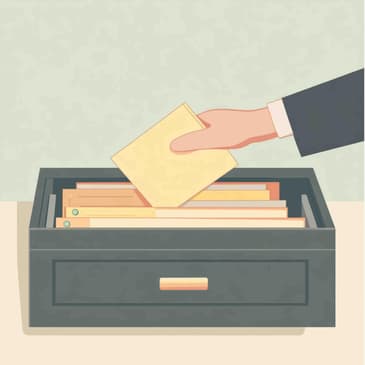
Leo Babauta shares a streamlined approach to filing, reducing categories, eliminating the need for elaborate labeling, and embracing a simple "stack and file" method. By minimizing decisions and friction, staying organized becomes second nature rather than a dreaded chore.
Read along with the original article(s) here: https://zenhabits.net/how-to-simplify-your-filing-system-or-why-stacking/
Quotes to ponder:
"Most people have a complicated filing system, which is why they don’t file because it takes too much time and effort."
"The key to a simple filing system is having as few categories as possible."
"When you need to find something, just flip through the stack, it takes only a few seconds."
Learn more about your ad choices. Visit megaphone.fm/adchoices
[00:00:00] Klar können wir Multitasking, aber wenn's drauf ankommt, konzentrieren wir uns gerne auf eine Sache. Das ist jetzt möglich mit dem neuen Samsung Galaxy S25 Ultra. Klick aufs Banner und entdecke deinen persönlichen AI-Begleiter. Aktiviere Google Gemini und frag die AI einfach zum Beispiel nach Restaurantoptionen und teile sie mit deinen Kontakten. Das klingt dann so. Hey, such mir ein indisches Restaurant in der Nähe raus und sende es an Luca. Was das Galaxy S25 Ultra noch kann, erfährst du auf samsung.de.
[00:00:30] Das ist Optimal Work Daily. Wie Stacking Just Doesn't Work by Leo Babauta of Zenhabits.net Does your filing system include stacks of paper? Or is your to-be-filed folder overflowing? If you have trouble with filing your documents, you may need to find a way to simplify your filing system to keep yourself organized. Filing is something that many people have a problem with. You're not alone.
[00:00:56] But organization can not only make you more productive, it can simplify your life and make it less stressful. Being organized doesn't take a complicated system for filing. It simply requires that you have a place for everything and get into the habit of putting things where they belong right away. Whether you've got a complicated filing system you'd like to simplify, or whether you have no filing system at all, let's take a look at how to simplify the system and keep things perfectly organized.
[00:01:22] One, reduce before organizing. The first rule to organizing is that you should eliminate the unnecessary before organizing at all. If you've got a filing drawer that's overflowing, or stacks of paper that need filing, it'll take forever to organize, and even then, it'll be hard to find stuff. Here's how to simplify your papers and files before you organize. First, put everything in one big pile. If it can't all go in one pile, make more than one. But look at them as continuations of the first pile.
[00:01:50] If you have folders that are a mess, take them out and add them to the stack. I recently did this with my home filing system and reduced the files by two-thirds. It only took about an hour. Second, go through them one at a time. Pick up each document or folder and decide what needs to be done with them. If you can't see yourself needing it in a couple of months, toss it. Default to toss, or shred, or recycle. Get rid of as much as you can. I have never regretted tossing a document.
[00:02:17] Third, route. If you can't toss something, try to route it to someone else. Get it off your desk. And last, file. If a document is absolutely critical and you're sure you'll need it again, then it needs to be filed. Let's take a look at how to set up a simple system for doing that. Two, simple filing.
[00:02:35] I agree with David Allen's Getting Things Done, which recommends that you use a simple, alphabetical filing system. Just use plain manila folders with labels. You can buy a label maker if you like, creating a file for each client, vendor, and or project. I believe that most people only need one drawer for filing.
[00:02:53] Now, I'll admit that there are some jobs that require much more than this, but for the average employee or self-employed person, one drawer is really all you need. And if you limit yourself to one drawer, you force yourself to toss out unnecessary files when the drawer gets full. Don't overthink this. Just create a file and file it alphabetically. Keep it simple. Three, file immediately. The key to keeping your filing system up to date is to file things right away.
[00:03:19] When you're processing your inbox and you run across something that doesn't require action but that you might need to file later, don't put it in a pile to be filed later. Don't put it in a folder labeled to file or miscellaneous. Just open your filing drawer. It should be close on hand. Pull out the appropriate folder, put the document in it, and file it. That takes about five seconds, and then you're done. If you don't do it now, it will start to pile up and stacking just doesn't work.
[00:03:46] Why doesn't stacking work? Because it just piles up and then the pile gets a little intimidating, and then before you know it, you've got a huge pile that you never want to go through. Then you can't find anything when you need it, and now you no longer have a filing system. I know some people think that their piles are organized into a kind of system, but piles are inefficient if you're not working on them at this moment, because you constantly have to refactor what pile is for what and which documents are in each pile, and when you need a document, it takes too long to find it.
[00:04:15] Plus, it clutters up your desk, distracting you from your work. Four, have materials on hand. Always have a big supply of manila folders and labels on hand. If you have a document that needs to be filed for future reference, but no file exists for it yet, you will put off the filing until later if you don't have the materials on hand. You don't feel like getting up to get a manila folder or label every time you need to file something, so you'll put it off, and that will create piles. So instead, just have the materials in a drawer for easy access.
[00:04:44] When you need to make a new file, just put a label on, stick the document in, and file it alphabetically. Five, reduce your needs over time. Over the last year or so, I've consciously been reducing my filing needs so that I now barely use my filing drawer. Sure, at least once a week I'll pull open the drawer to look at a file, but I file many fewer documents than I used to. I recommend you do the same, slowly and consciously reducing your filing needs. Here are a few tips for doing that.
[00:05:13] One, store reference information online. Now when I need to look something up, I press a hotkey combination. I use auto hotkey to open websites and documents, and the appropriate document opens up with all the info I need. Contacts, budget information, ideas, logs, and much more are all online, so I no longer need hard copies of them and don't need to file them. Two, reduce incoming paper. Ask people to email you instead of faxing or sending a document by post.
[00:05:41] First, in this age, everything is created on computer, and sending hard copies is outdated. Insist on digital. Also take steps to stop paper versions of newsletters, magazines, and other such regular documents. Three, stop printing stuff. Lots of people still print out email or documents they receive, or even documents they create themselves. But then you have two copies of it, and you're killing trees. Plus, you now have to file the paper version as well as the digital, and it's much easier to search for digital information when you need it.
[00:06:12] Four, analyze other incoming docs. Every time you file something, ask yourself if you really need a hard copy version of it. Is it available online? Does it really need to be sent to you? Is it better to scan it and store it digitally? Is there any way to eliminate the need for this document? And slowly, one by one, reduce your need for all the incoming stuff.
[00:06:37] You just listened to the post titled, How to Simplify Your Filing System, or Why Stacking Just Doesn't Work, by Leo Babauta of zenhabits.net. And a little about Leo, who is an old friend of the network. Leo Babauta of Zen Habits is an author that we hear on our other podcasts because he blogs about personal development and health, as well as finance. So he's been read on pretty much all of our shows. But the reason you're hearing him here is because he's also an entrepreneur. So you can look forward to some more of his stuff on this show as well.
[00:07:08] Now, Leo's a pretty regular guy, but he's become an expert in changing habits by making small incremental changes since 2005. He's originally from Guam. He was an overweight smoker who was barely making enough money to support his big family. He's got six kids. And he turned all that around, blogging about it throughout the process. These days, he lives in San Francisco quite comfortably and in charge of how and when he works. It is really a great story. So you can check it out at zenhabits.net.
[00:07:35] And again, to hear his work being narrated across a couple of our shows, please check out our other podcasts by searching for Optimal Living Daily wherever you're hearing me right now. And that'll do it for today. I thank you so much for being here and for supporting the show. And I'm going to be back with you tomorrow for the Monday show where your optimal life awaits. We will be back with you tomorrow. We are going to be back with you tomorrow for the Monday the weeks. Bye.