



Discover all of the podcasts in our network, search for specific episodes, get the Optimal Living Daily workbook, and learn more at: OLDPodcast.com.
Episode 2037:
Phil LeNir shares a practical approach to transforming management training by replacing passive learning with reflective, discussion-driven meetings that inspire real action. By combining conceptual ideas with lived experience, teams can boost morale, strengthen collaboration, and actually follow through on meaningful changes.
Read along with the original article(s) here: https://digtofly.com/how-to-improve-management-training/
Quotes to ponder:
"Thoughtful reflection on natural experience, in the light of conceptual ideas, is the most powerful tool we have for management learning.”
"I didn’t want people to come to these meetings to talk about grand ideas on how to change things, but leave without intending to put anything into practice."
"We were simply human beings doing their best to get on with the job of managing, solving problems, and making things happen."
Learn more about your ad choices. Visit megaphone.fm/adchoices
[00:00:00] Hey, sweetie. Your mother showed me this Carvana thing for selling the car. I'm gonna give it a try. Wish me luck. Me again. I put in the license plate. It gave me an offer. Unbelievable. Okay. I accepted the offer. They're picking it up Tuesday from the driveway. I haven't even left my chair. It's done. The car is gone. I'm holding a check. Anyway, Carvana, give it a whirl. Love ya. So good, you'll want to leave a voicemail about it. Sell your car today on Carvana. Pick up these may apply.
[00:00:35] As a chef, I know flavor doesn't begin in the kitchen. It begins on the land. And West Home's Nature Led Australian Wagyu is a story written in the landscape of Northern Australia. Cooking is storytelling and West Home Wagyu carries a story of Northern Australia itself. Raw, powerful and deeply authentic. It's a testament to the passion and care raised in the rhythm of Northern Australia.
[00:01:01] I'm Chef Maylin from ADA Club in Los Angeles, and I invite you to visit westhome.com slash maylin to learn more. And taste a story only West Home Nature Led Australian Wagyu can tell. That's W-E-S-T-H-O-L-M-E dot com slash M-E-I-L-I-N. This is Optimal Work Daily. How to Improve Traditional Management Training by Phil Lanier with digtofly.com.
[00:01:29] There are a lot of management development training programs out there. They help managers and employees to improve their skill sets and become better at what they do. But what if there was a way to apply self-help concepts to the corporate world? What if managers could train each other, learn through discussions, and be inspired by stimulating material? Keep listening to find out how we found ourselves doing exactly that.
[00:01:51] Let's go back to the beginning. We had just hit rock bottom. After three rounds of layoffs, the company offshored our software development to Eastern Europe, and our competitor acquired us. That sounds pretty dire, doesn't it? We knew we needed to do something to boost morale, and we needed a solution that didn't cost much. We literally had no time, no money, and we were expected to change quickly. Luckily, when I approached Professor Henry Mintzberg, the author of several management development books, he had an idea.
[00:02:19] He suggested I read his book, Managers, Not MBAs, and one sentence from this book still sticks with me today. Quote, So, instead of having more crisis meetings, planning meetings, and status meetings, my team and I got together for a learning meeting with the goal of making things better.
[00:02:45] During that first meeting, we made the objective to learn something new about management and to reflect on our own experience in light of conceptual ideas. If it worked, then we'd do it again. There was one caveat. I didn't want people to come to these meetings to talk about grand ideas on how to change things, but leave without intending to put anything into practice. I didn't want to fall into that self-help trap of talking about our feelings, but not doing anything about them.
[00:03:12] During the weekends, I worked on the content of the sessions by editing and crafting the material that Henry Mintzberg and his colleagues had put together for their master's level management courses. It included lots of provocative questions and exercises to get the meetings to stimulate change. Amazingly, it worked. These meetings created a space where our team could come together to make important management decisions, to bond, and to help each other grow. Suddenly, we weren't the head of engineering talking to the head of QA anymore.
[00:03:40] We were simply human beings doing their best to get on with the job of managing, solving problems, and making things happen. The result? We started coming up with new initiatives on both small and large scales that we actually were following through on. You can probably relate to meetings where lots of ideas are discussed, but nothing ever comes of them. This was different because we came up with simple changes in a safe environment that fostered collaboration between managers.
[00:04:07] Once we started taking action, we saw the time we spent in these meetings differently. This is how I marketed the meetings to my team. Because, really, who wants to attend more meetings when there is so little time to begin with? Quote, We all spend some 50-plus hours a week running around and making things happen and doing things. Imagine if we spent one hour a week talking about what's going on, reflecting on experiences around our current management challenges, and discussing what we could do to make things better,
[00:04:35] all stimulated by some really cool management topics developed by some of the best thinkers in the world. Then we could run around making things happen for the other 49 hours. Do you think we might get more done during the 49 hours than the original 50 hours? End quote. We had stumbled upon management development that really works, and it was just a matter of opening up to each other, putting our heads together, and then taking action. This was like reading a great self-help book, doing all of the exercises, and actually living differently.
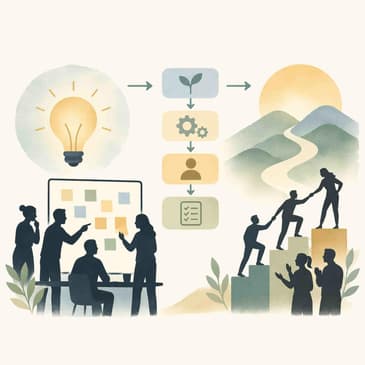
[00:05:05] Wow! The Three-Step Formula Now it's time for you to take action with these ideas in your own organization. Here's the simple three-step formula. Step 1. Schedule a meeting with fellow managers and team members to discuss the issues that are most pressing. If we're talking about case studies or potential situations, it's not application, and no one will get anything out of it. Make it relevant and make it actionable. Step 2. Find some materials that relate to the issues at hand.
[00:05:35] Strategic theories. Advice for office politics. Models of communication between silos and slabs. Once you've got some stimulating material, tease some questions out of it to act as starting points during your meeting. And Step 3. During the meeting, allow everyone a chance to voice their opinions, and take notes on the interesting ideas that bubble up. Make a meeting a safe place for people to share their experiences as managers, to come together to explore new ways of solving problems together.
[00:06:02] Then, after the meeting, follow up by taking action on the new ideas. What will this three-step process do that a self-help book won't? It will get you talking to other people who share a similar background. It will boost morale, and make your entire operation run much smoother. This works because companies are made up of people, not cogs. Unless we take the time to talk about things, we're going to keep running around inefficiently. How you can apply this to your work?
[00:06:29] It's simple. Put together a few questions to help you and some team members mastermind together. Then, set aside some uninterrupted time to discuss. It might take a few minutes before everyone warms up to each other and begins to share the deep stuff within. The first few meetings might be focused more on surface issues. Over time, you'll see that having these types of candid conversations, and knowing that everyone else is in the same boat together, can really transform the way you live your life and lead your team.
[00:06:56] So go ahead. I challenge you to give this self-help for managers idea a try. It may seem overly simple, but why complicate things when there's an inexpensive solution at hand that works? You just listened to the post titled, How to Improve Traditional Management Training, by Phil Lanier with dig2fly.com. Spring is in the air, which means now is the time to save during spring outdoor power deals at the Home Depot.
[00:07:25] Make cleanup easier when you go cordless with a Milwaukee M18 String Trimmer, designed to deliver more runtime, more speed, and maximum performance. Then grab a select Milwaukee fuel attachment, like the pole saw, edger, or brush cutter, included at no extra cost when you buy the Milwaukee M18 String Trimmer. Shop seven days of spring outdoor power deals at the Home Depot, now through April 29th. Study and play. Come together on a Windows 11 PC.
[00:07:54] And for a limited time, college students get the best of both worlds. Get the Unreal College Deal. Everything you need to study and play with select Windows 11 PCs. Eligible students get a year of Microsoft 365 Premium and a year of Xbox Game Pass Ultimate with a custom color Xbox wireless controller. Learn more at windows.com slash student offer. While supplies last, ends June 30th. Terms at aka.ms slash college PC. And thank you to Phil. Phil Lanier developed Coaching Ourselves,
[00:08:23] following a new approach to management education implemented in the International Master's Program in Practicing Management. As Executive Director at Coaching Ourselves, Phil is working to bring this approach to management development to organizations worldwide. And thank you also to Carl Stabe, who is the creator of Dig to Fly. He helps entrepreneurs understand their struggles and turn them into stepping stones. He's the author of the book Bring Gratitude and has a lot to offer on his site, which again is digtofly.com.
[00:08:53] You can find lots there. And I have that linked in this episode's description. But that's it for today. Thank you for listening each and every day. That is, of course, how we can keep this show going for you. So have a great rest of your day. And I'll be back again with you tomorrow, where your optimal life awaits.