
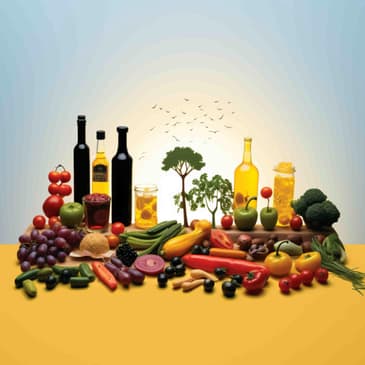



2453: Can Changing Your Diet Make You Feel Happier? by Dr. Jenny Brockis on Ultra-Processed Foods & Gut-Brain Connection
Optimal Health DailyFebruary 10, 2024
2453
00:13:38

2453: Can Changing Your Diet Make You Feel Happier? by Dr. Jenny Brockis on Ultra-Processed Foods & Gut-Brain Connection

Discover all of the podcasts in our network, search for specific episodes, get the Optimal Living Daily workbook, and learn more at: OLDPodcast.com.

Episode 2453:

Dr. Jenny Brockis explores the profound impact of diet on mental health in her article on DrJennyBrockis.com. She emphasizes that depression is more than just a brain disorder and is interconnected with our gut, immune, and endocrine systems. By adopting healthier dietary habits, like a Mediterranean-style diet and reducing ultra-processed foods, we can not only improve mood but also reduce the risk of depression.

Read along with the original article(s) here: https://drjennybrockis.com/2023/10/27/can-changing-your-diet-make-you-feel-happier/

Quotes to ponder:

"Dietary intervention can improve mood."

"Depression is now considered a whole-body disorder because of the interconnection between our brain, gut, immune, and endocrine systems."

"The microbiome is dynamic, and the balance of good and bad bacteria is changed by what you eat."

Episode references:

The Mood and Food Institute at Deakin University: https://www.deakin.edu.au/business-and-community/donate/stories-of-giving/the-dkin-difference-2021/food-and-mood

Learn more about your ad choices. Visit megaphone.fm/adchoices

[00:00.000 --> 00:06.640] Hey there! Did you know Kroger always gives you savings and rewards on top of our lower than low prices? [00:06.640 --> 00:12.380] And when you download the Kroger app, you'll enjoy over $500 in savings every week with digital coupons. [00:12.380 --> 00:16.720] And don't forget fuel points to help you save up to $1 per gallon at the pump. [00:16.720 --> 00:21.520] Want to save even more? With a Boost membership, you'll get double fuel points and free delivery. [00:21.520 --> 00:24.000] So shop and save big at Kroger today! [00:24.000 --> 00:29.920] Kroger, fresh for everyone. Savings may vary by state. Restrictions apply. See site for details. [00:30.400 --> 00:36.640] This is Optimal Health Daily, Episode 2453. Can changing your diet make you feel happier [00:36.640 --> 00:42.080] by Dr. Jenny Brockes of Dr. JennyBrockes.com and I'm Dr. Neal, your host and narrator. [00:42.800 --> 00:47.840] Hey there, happy Saturday. I hope your weekend is off to a great start and welcome back to Optimal [00:47.840 --> 00:53.680] Health Daily or OHD, where I act as your narrator of popular health and fitness blogs [00:53.680 --> 00:59.440] and always provide my commentary at the end. Now, don't forget we have a bunch of shows covering a [00:59.440 --> 01:04.800] bunch of different topics. Just search for Optimal Living Daily in your podcast app to find them. [01:05.360 --> 01:08.960] But with that, let's get right to it and start optimizing your life. [01:13.360 --> 01:19.680] Can changing your diet make you feel happier by Dr. Jenny Brockes of Dr. JennyBrockes.com [01:21.120 --> 01:27.120] Depression. There's a lot of it about. Have you had it too? It's the leading cause of [01:27.200 --> 01:34.720] disability in Australia. Australia holds national days to ask, are you okay? We train as mental [01:34.720 --> 01:40.400] health first-aiders and offer employee assistance programs. Still, despite our greater awareness [01:40.400 --> 01:46.000] of depression and other mental health disorders, government cash injections, increased support [01:46.000 --> 01:51.920] services, and attempts to improve access to mental health care, we have failed to turn the tide. [01:52.640 --> 01:57.040] The reasons why so many of us are struggling with depression and other mental health disorders [01:57.120 --> 02:03.440] are many, including genetic factors, drug and alcohol abuse, having a diagnosis of type 2 diabetes [02:03.440 --> 02:09.440] or Parkinson's disease, your early childhood environment, exposure to trauma, your personality [02:09.440 --> 02:15.360] traits, and living with chronic high levels of stress. What's not included in this list [02:15.360 --> 02:20.960] has the potential to reduce your overall risk, lower the risk of recurrence, and help you recover [02:20.960 --> 02:27.120] more quickly from depression. Are you wondering what this is? We have accumulated a wealth of [02:27.120 --> 02:32.320] research and scientific evidence that shows how embracing positive lifestyle choices, including [02:32.320 --> 02:38.480] healthy eating, physical activity, good quality uninterrupted sleep, and keeping stress levels [02:38.480 --> 02:44.800] in the tolerable zone all play a role in keeping us well. While there is no single diet that is [02:44.800 --> 02:50.000] best for health and well-being, following a Mediterranean style of eating has been shown [02:50.000 --> 02:54.320] to provide many benefits, including helping you manage your mental well-being. [02:55.280 --> 03:01.840] Depression is more than a brain disorder. Depression is now considered a whole body disorder [03:01.840 --> 03:07.600] because of the interconnection between our brain, gut, immune, and endocrine systems. [03:08.320 --> 03:14.160] The effect of our multiple life stressors leads to an accumulation of higher systemic inflammation [03:14.160 --> 03:18.320] that contributes to the development of illness and diseases such as depression. [03:19.200 --> 03:24.800] Knowing this means we can take positive steps to help ourselves stay mentally well, while diet [03:24.800 --> 03:30.480] alone is not the answer to all our ills, choosing to make healthier food choices and embrace the [03:30.480 --> 03:37.120] other aspects of lifestyle that keep us healthy makes a difference. The proof is not in the pudding. [03:38.000 --> 03:43.440] For decades, we've been encouraged to eat more fruit and vegetables. We've all heard the message, [03:43.520 --> 03:49.360] but we're not truly listening. That's because our lives are so busy and often so stressful, [03:49.360 --> 03:54.960] the idea of changing our dietary habits can all feel too difficult and with so much conflicting [03:54.960 --> 04:01.200] advice from various arenas, it's difficult to know what to believe. Fortunately, we now have the [04:01.200 --> 04:08.000] evidence from scientific studies that dietary intervention can improve mood. Led by Professor [04:08.000 --> 04:14.480] Felice Jaka and her team at the Mood and Food Institute at Deacon University, the Smiles trial [04:14.480 --> 04:19.200] was the world's first randomized control trial that sought to answer the question, [04:19.840 --> 04:26.240] can improving the quality of my diet improve my depression? The short answer is yes, [04:26.800 --> 04:34.000] and it was a significant yes. Since then, other randomized control trials involving more than 45,000 [04:34.000 --> 04:39.680] people have confirmed these findings. The suggestion is that following a healthier diet [04:39.680 --> 04:47.120] is associated with a 30% reduced risk of depression. It's important to note that this is not a cause [04:47.120 --> 04:53.440] and effect result, rather it's an association. Diet plays a role in health at every age. [04:54.400 --> 05:00.240] Another study from the Mood and Food Institute revealed how poor maternal diet during pregnancy [05:00.240 --> 05:05.360] affects the child's behaviors and risk of mental health disorders. Did you know that if a [05:05.360 --> 05:12.240] pregnant parent is obese, it elevates the child's risk of autism spectrum disorder and neurodevelopmental [05:12.240 --> 05:17.280] delay, and let's not forget the epigenetic effect that a dad's obesity also plays here. [05:18.000 --> 05:22.240] This is not about a scribing blame, because there are many other factors that work too, [05:22.240 --> 05:28.000] but to recognize that diet is a modifiable risk factor, and we can all contribute to making a [05:28.000 --> 05:33.280] meaningful difference. With half of all mental illness presenting before the age of 14, [05:33.280 --> 05:38.400] if we are serious about looking for ways to reduce the burden of mental illness in our younger [05:38.400 --> 05:45.520] generation, let's focus on improving our family's diets. The key to better mental health using diet. [05:46.400 --> 05:52.080] This is a good time to reflect on our own dietary patterns. We often have the best intentions, [05:52.080 --> 05:58.720] but what happens can be entirely different. Two reminders. One, eating more healthy foods [05:58.720 --> 06:05.520] include a wide variety of leafy grains, other vegetables, fruits like berries, seeds and nuts, [06:05.520 --> 06:13.280] legumes, whole grains, healthy fats like those from fish and seafood. And two, reducing the amount [06:13.280 --> 06:19.120] of red meat consumed each week to several meals rather than every meal. Reducing the amount of [06:19.120 --> 06:24.400] refined sugar in the diet is found in sugary drinks and some processed snack foods and reducing [06:24.400 --> 06:31.440] the overall amount of ultra processed foods in the diet. No surprises here. The problem isn't [06:31.440 --> 06:38.240] that we don't know. We don't do because of time constraints, fussy kids, fatigue, stress and [06:38.240 --> 06:46.080] economic constraints. The allure of ultra processed foods. Food manufacturing has revolutionized [06:46.160 --> 06:52.240] what foods are available to us at any time. They've experimented and perfected new techniques [06:52.240 --> 06:58.320] to improve the mouth field, texture and taste of many processed foods, including fast foods, [06:58.320 --> 07:04.880] snack foods and to go foods. They are hard to resist because they taste so yummy. But the [07:04.880 --> 07:09.600] greater our consumption of highly processed foods that include high fructose corn syrup, [07:09.600 --> 07:15.840] hydrolyzed fats, also known as trans fats, salt and other additives and coloring are not [07:15.840 --> 07:20.720] only linked to an increased risk of anxiety and depression, but poorer cognition as well. [07:21.520 --> 07:27.920] In a world where between 50 and 60% of the food Americans and Australians consume is highly processed, [07:27.920 --> 07:35.200] we have a problem. But it is reversible. Adding more healthy options can offset the bad effects [07:35.280 --> 07:41.200] of consuming ultra processed foods. That's still not an excuse to pick the unhealthy options, of course. [07:42.240 --> 07:48.400] Switching to a healthier diet for a better mood. If you're addicted to hot chips, pizza and ice [07:48.400 --> 07:53.440] cream and your kids revolt at the mere sight of a vegetable on their plate, you can relax. [07:54.000 --> 08:01.040] All it takes is to adopt a slow, steady approach with some patience to make one small change at a time [08:01.040 --> 08:06.240] because you can change your taste bud preferences over time and you can influence the balance of [08:06.240 --> 08:12.960] your gut microbes to create and maintain a healthy microbiome. This is because the microbiome is [08:12.960 --> 08:19.200] dynamic and the balance of good and bad bacteria is changed by what you eat. To ensure the bacteria [08:19.200 --> 08:23.840] in your gut that are screaming out to your brain demanding room service are the ones that keep your [08:23.840 --> 08:30.720] microbiome healthy, this is about providing them a five star Michelin meal of prebiotics, including [08:30.720 --> 08:37.600] legumes, chickpeas, kidney beans and so on. These are foods that your microbes chow down with [08:37.600 --> 08:43.440] relish and provide us with plenty of fiber to keep our guts working well. And don't forget those [08:43.440 --> 08:49.280] helpful probiotics found in fermented foods like yogurt, kefir, kimchi and sauerkraut. [08:49.920 --> 08:56.640] Many traditional diets also include these. Gabba is a human neurotransmitter and mood modulator [08:56.640 --> 09:02.320] associated with reducing symptoms of depression and the risk of developing depression. It's also [09:02.320 --> 09:08.560] produced by certain bacteria in our gut, confirming the vital role our microbes play in the gut brain [09:08.560 --> 09:14.960] communication channel. Another neurotransmitter involved in regulating mood and general well-being [09:14.960 --> 09:23.120] is serotonin and 95% of serotonin is produced in the gut by specialized cells that respond [09:23.120 --> 09:29.200] to the stimulatory effect of short chain fatty acids produced by, you guessed it, [09:29.200 --> 09:35.280] certain gut microbes, getting better at reducing the burden of chronic disease and depression. [09:36.240 --> 09:41.520] As I've already mentioned, while dietary choices play an important role in managing your gut health, [09:41.520 --> 09:46.560] so do other aspects of your lifestyle including sleep, exercise and relaxation. [09:47.200 --> 09:51.360] This is why lifestyle medicine is critical to future health and well-being, [09:51.360 --> 09:56.800] when you are empowered to make the choices you know make you feel well and function at your best, [09:56.800 --> 10:02.320] you cope better with life stressors, you're more resilient and enjoy greater health and happiness. [10:03.120 --> 10:08.720] Is your eating pattern something you intuitively know keeps you mentally healthy or is there room [10:08.720 --> 10:18.560] for improvement? You just listened to the post titled, Can Changing Your Diet Make You Feel Happier [10:18.640 --> 10:24.560] by Dr. Jenny Brockes of Dr. JennyBrockes.com and I'll be right back with my commentary. [10:24.560 --> 10:28.320] When you're hiring, it feels amazing to finally close out a job search, [10:28.320 --> 10:33.920] but what if you could get rid of the search and just match? You can with Indeed. Indeed is your [10:33.920 --> 10:40.800] matching and hiring platform with over 350 million global monthly visitors and a matching engine [10:40.800 --> 10:46.800] that helps you find quality candidates fast. Ditch the busy work, use Indeed for scheduling, [10:46.800 --> 10:53.440] screening and messaging. 93% of employers agree Indeed delivers the highest quality matches [10:53.440 --> 10:58.480] compared to other job sites. One of the things I love about Indeed is that it filters out [10:58.480 --> 11:04.160] incompatible applicants. So when you're hiring, the process is much faster and you only have to [11:04.160 --> 11:09.920] consider applicants that are already likely to be a great fit. And listeners of this show [11:09.920 --> 11:16.480] will get a $75 sponsor job credit to get your jobs more visibility at Indeed.com [11:16.480 --> 11:24.000] slash health. Just go to Indeed.com slash health right now and support our show by saying you heard [11:24.000 --> 11:31.680] about Indeed on this podcast, Indeed.com slash health terms and conditions apply need to hire [11:31.680 --> 11:39.760] you need Indeed. Dr. Neal here for my commentary. Dr. Brockes mentioned that reducing meat consumption [11:39.760 --> 11:45.840] specifically red meat consumption may help reduce feelings of depression. How is that possible? [11:46.640 --> 11:52.080] First, she's absolutely right. And yes, it is possible. It turns out that for many people, [11:52.080 --> 11:57.440] red meat increases inflammation throughout the body. Inflammation throughout the body is [11:57.440 --> 12:04.080] basically putting the body under stress all the time. And this inflammation increases our risk [12:04.080 --> 12:09.760] for all types of diseases from cardiovascular disease, meaning heart attack and stroke, [12:09.760 --> 12:17.040] to diabetes, to cancer, to even dementia. And again, in some people, red meat can contribute to [12:17.040 --> 12:23.040] this inflammation throughout the body. So by reducing red meat consumption, we can reduce this [12:23.040 --> 12:29.200] stress on the body and hopefully reduce our risk of future disease. Now, what would classify [12:29.200 --> 12:35.280] as a red meat? These would be foods like beef. So steak and hamburgers, of course, would be included. [12:35.920 --> 12:42.800] Pork is a red meat. It is not the other white meat. And of course, any foods made from pork like [12:42.800 --> 12:50.640] bacon and ham would also classify as red meat, game like deer, bison, rabbit, and so on, [12:50.640 --> 12:58.080] would also be considered red meats. So swapping out some of these protein rich foods with fish, [12:58.080 --> 13:04.160] chicken, or turkey may help reduce inflammation throughout the body and reduce disease risk [13:04.240 --> 13:09.120] over time. All right, that'll do it for today. Thank you so much for being here. Thank you for [13:09.120 --> 13:13.440] listening every day. I hope you're having a great weekend if you're listening in real time. [13:13.440 --> 13:17.440] And I'll see you back here tomorrow, where your optimal life awaits. Transcription results written to '/home/forge/transcribe3.sonicengage.com/releases/20240210005758' directory