



Discover all of the podcasts in our network, search for specific episodes, get the Optimal Living Daily workbook, and learn more at: OLDPodcast.com.
Episode 2521:
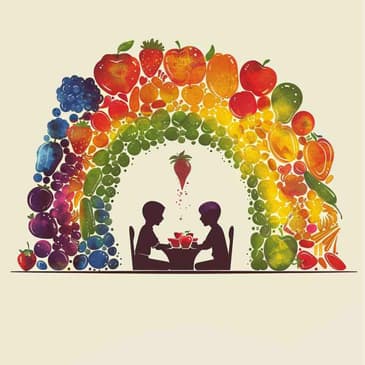
Renae Earle illuminates the profound impact of eating a colorful array of fruits and vegetables on preventing diseases, backed by the latest nutritional biochemistry. Discover the health-transforming power of phytochemicals like lycopene and polyphenols, and how they contribute to combating cancer, blindness, and hypertension. Dive into this kaleidoscopic nutritional journey with Earle and learn how diversifying your plate can not only enhance your health but also bring visual delight to your meals.
Read along with the original article(s) here: https://www.idealnutrition.com.au/eat-a-rainbow/
Quotes to ponder:
"Eating a wide range of fruit and vegetables ensures adequate vitamin and mineral consumption. Aside from this, fruits and vegetables of different colours contain a myriad of phytochemical compounds with a plethora of health benefits."
"Lycopene has antioxidant functions and is thought the be an active component in fighting against some cancers, particularly prostate."
"Polyphenols have been linked to a range of health benefits including cardiovascular health, obesity reduction, anti-carcinogenic properties, decreased oxidative stress and inflammation."
Learn more about your ad choices. Visit megaphone.fm/adchoices
[00:00:00] Your brain needs support. And new Oli brain-eachews are a delightful way to take care of your cognitive health, made with scientifically backed ingredients like Thai ginger, L-theanine and caffeine.
[00:00:11] Brain-eachews support healthy brain function and help you find your focus. Stay chill. Or get energized.
[00:00:17] Be kind to your mind and get these new tropic chews at oli.com. That's O-L-L-Y dot com.
[00:00:22] These statements have not been evaluated by the Food and Drug Administration. This product is not intended to diagnose, treat, cure or prevent any disease.
[00:00:30] This is Optimal Health Daily, Episode 2521. Eat A Rainbow by Renee Earle with ideallnutrition.com.au
[00:00:39] And I'm Dr. Neal, your very own personal narrator.
[00:00:43] Welcome to a Tuesday edition of Optimal Health Daily. This is one of just a few podcasts in the world where blogs are read to you for free so that you don't have to read them yourself.
[00:00:53] Now to check out our other shows, just search for Optimal Living Daily wherever you're hearing this.
[00:00:59] But with that, let's get right to today's post and start optimizing your life.
[00:01:08] Eat A Rainbow by Renee Earle with ideallnutrition.com.au
[00:01:14] If you live in Australia, you will know all about the Go For Two In Five campaign.
[00:01:20] That is unless you've been living under a rock for the past couple of years.
[00:01:24] The Australian government created a funny, friendly-looking fruit and veg man who informed Australian kids and adults about the importance of consuming two fruits and five vegetables each day.
[00:01:36] The government pushed this campaign hard with fliers, television advertisements and even educational programs in schools.
[00:01:44] The campaign was an effort to promote healthful behaviors in our increasingly unhealthy population.
[00:01:51] However, is two and five enough?
[00:01:55] While it's a good place to start, good health may not be so simple.
[00:01:59] Nutrition Australia has pushed for a movement away from two and five and toward Eat the Rainbow.
[00:02:07] Nutrition Australia's Eat the Rainbow campaign refers to the importance of consuming not only healthy amounts of fruit and veg, hello two and five,
[00:02:17] but stresses the need to eat a wide variety of colorful fruits and vegetables.
[00:02:22] Eating a wide range of fruit and vegetables ensures adequate vitamin and mineral consumption.
[00:02:28] Aside from this, fruits and vegetables of different colors contain lots of phytochemical compounds with a plethora of health benefits.
[00:02:37] Let's start with fire engine red.
[00:02:40] Some red and pink fruits such as tomato, watermelon, papaya and grapefruit contain the carotenoid lycopene.
[00:02:50] Lycopene has antioxidant functions and is thought to be an active component in fighting against some cancers, particularly prostate cancer.
[00:03:00] Prostate cancer is one of the leading causes of death in Australian males over the age of 50.
[00:03:06] Perhaps by increasing lycopene consumption, these statistics can become a little less alarming.
[00:03:12] Once ingested, lycopene is metabolized to apolipopenal derivatives.
[00:03:18] These apolipopenals are capable of interfering with cancer cell proliferation.
[00:03:24] Exact mechanisms are as of yet unknown and epidemiological studies are currently inconclusive.
[00:03:30] However, there is enough evidence to suggest some relationship, so including some red on your plate is probably wise.
[00:03:39] Other carotenoids such as keratines and cryptozanthins as well as being antioxidants are vitamin A precursors.
[00:03:47] They are responsible for yellow and orange hues of carrots, mango and yellow plums.
[00:03:53] Once consumed, carotenoids are cleaved by enzyme BCO1.
[00:03:59] This produces one or two active vitamin A molecules depending on the carotenoid cleaved.
[00:04:04] The active vitamin A molecule binds with a protein called opsin.
[00:04:09] Together, this complex can absorb light at the rods of the eye, facilitating monochromatic vision in the dark,
[00:04:17] meaning this may prevent night blindness.
[00:04:20] In cases of extreme deficiency, permanent blindness can occur.
[00:04:25] In this case, mucus secreting cells within the conjunctiva of the eye are replaced with hardened epithelium or keratinized skin cells.
[00:04:35] This results in cornea destruction and total blindness.
[00:04:39] If you fail to consume yellow or orange fruits or vegetables in your daily two and five,
[00:04:45] you might find yourself at risk for blindness.
[00:04:48] That being said, you can also get active vitamin A from non-vegetable sources such as liver.
[00:04:55] The final two carotenoids that have significant health benefits are lutein, which is yellow,
[00:05:01] and zeaxanthin, which is orange.
[00:05:04] They absorb potentially oxidative blue light.
[00:05:07] When insufficient lutein and zeaxanthin are present, blue light has damaging effects on the macula of the eye,
[00:05:14] promoting its degeneration and eventual blindness.
[00:05:18] If you enjoy your eyesight and want to avoid macular degeneration, which I'm sure you do,
[00:05:23] make sure to stock up on orange and yellow vegetables.
[00:05:27] Polyphenols are another group of healthful phytochemicals, of which flavonoids are the most abundant group.
[00:05:34] The most obvious flavonoid is anthocyanin, which is a red, blue, and sometimes purple color.
[00:05:41] Think purple carrots, plums, and sweet potatoes.
[00:05:45] Yes, you can get purple sweet potatoes.
[00:05:47] Polyphenols have been linked to a range of health benefits including cardiovascular health,
[00:05:53] obesity reduction, anticharsanogenic properties, decreased oxidative stress, and decreased inflammation.
[00:06:01] Flavonoids pass through the stomach and continue to the small intestine, where only a small amount is absorbed.
[00:06:07] The remainder moves to the large intestine, where the real action takes place.
[00:06:13] Here, flavonoids are metabolized by bacteria within the gut to form phenolic acids,
[00:06:18] which have vasodilation effects within the blood vessels.
[00:06:22] This vasodilation, which is another way of saying relaxation of artery muscular walls, lowers blood pressure.
[00:06:30] Hence, flavonoids are particularly important for mildly hypertensive individuals.
[00:06:36] Now those who are very hypertensive will require something stronger than just a little purple food.
[00:06:42] Glycosinalates, although not pigmented, are found in green vegetables such as broccoli, cabbage, and kale,
[00:06:49] as well as red radish and white cauliflower.
[00:06:52] Epidemiological studies show a relationship between risk of developing heart disease
[00:06:57] and some forms of cancer and diets rich in these vegetables.
[00:07:02] Glycosinalates are metabolized in the body to produce isothiocyanates,
[00:07:07] which increase the antioxidant response to cancer cells, helping destroy them.
[00:07:12] Furthermore, some are even capable of inhibiting the bad enzymes that activate cancer-promoting mutagens.
[00:07:20] However, not all glycosinalates are here to help.
[00:07:23] Some actually have anti-nutritional properties such as progoitrin, which is found in kale.
[00:07:29] Progoitrin is converted to goitrin, which inhibits thyroid hormone production by blocking iodine uptake.
[00:07:37] In extreme cases, this results in a large protruding swollen thyroid gland on the neck.
[00:07:43] This is also known as a goiter.
[00:07:45] However, you have to eat a lot of kale to elicit these effects, so your daily green smoothie is still good to go.
[00:07:52] While 2-in-5 is a great campaign that has been successful in increasing health, it does have a loophole.
[00:07:59] By following eating a rainbow as well as 2-in-5, health can be maximized.
[00:08:05] Since research into these amazing little compounds is only in early stages and many exact mechanisms are still unknown,
[00:08:12] there are currently no prescribed nutrient reference values.
[00:08:16] However, trying to eat a rainbow is a good place to start.
[00:08:21] I don't know about you, but anti-cancer, anti-blindness, and anti-hypertension are just a few things that get me excited about eating a rainbow.
[00:08:30] Not to mention how pretty it will look on the plate.
[00:08:36] You just listened to the post titled Eat a Rainbow by Renee Earle with idealnutrition.com.au
[00:08:44] and I'll be right back with my commentary.
[00:08:47] Dr. Neal here for my commentary.
[00:08:49] Phew, that was a nice review of some nutritional biochemistry, right?
[00:08:54] Now if there were parts of this episode you need to replay and listen to again, I wouldn't blame you.
[00:08:59] Renee did a great job summarizing some of the complex mechanisms behind food, the nutrients they contain, and potential disease mechanisms.
[00:09:09] But there were lots of terms that we may not have been familiar with.
[00:09:12] The bottom line is this.
[00:09:14] If we can eat a variety of foods, especially fruits and vegetables, the potential disease fighting effects increase.
[00:09:22] It's like the fruits and vegetables we eat strengthen each other.
[00:09:26] If one fruit or vegetable is weak in certain disease fighting nutrients, another will pick up the slack and say, I got you.
[00:09:35] Wait a second, I feel a superhero analogy coming on.
[00:09:39] Hold on, I'm about to go full nerd on this.
[00:09:41] Fruits and vegetables are like, get this, the Avengers.
[00:09:46] And imagine their ultimate villain, Thanos, one of the worst beings in the universe, is a disease like cancer.
[00:09:53] The Avengers, the good guys, or in our case fruits and vegetables, are trying to defeat Thanos, the bad guy, or cancer in this example.
[00:10:03] Each member of the Avengers has their own strengths and weaknesses.
[00:10:07] Iron Man is super smart but can sometimes act impulsively which gets the Avengers into trouble.
[00:10:13] What Iron Man lacks in careful planning, Captain America balances out with a more balanced, thoughtful approach to fighting evil.
[00:10:22] The Hulk is not as smart or careful in his approach to fighting evil but makes up for it with brute strength.
[00:10:29] So when these forces are combined, weaknesses and all, the team is much stronger when facing a really bad villain like Thanos.
[00:10:38] Alright, yeah you stuck with me?
[00:10:40] So fruits and vegetables behave similarly.
[00:10:44] Each one individually isn't perfect, but when we combine them and eat a rainbow like today's author Renee said,
[00:10:51] we create a powerful force to help ward off disease.
[00:10:56] Now you may be wondering, since I'm a huge Batman fan, what's with the Avengers analogy and not the Justice League analogy?
[00:11:03] Well I hate to admit it, The Avengers was a far better film.
[00:11:06] Even Zack Snyder's cut of the Justice League didn't do it for me.
[00:11:10] Anywho, that wraps up today's episode.
[00:11:13] Thank you so much for listening.
[00:11:14] Thank you for being a subscriber of the show.
[00:11:16] I hope you have a great rest of your day and I'll see you back here tomorrow where your optimal life awaits.