



Discover all of the podcasts in our network, search for specific episodes, get the Optimal Living Daily workbook, and learn more at: OLDPodcast.com.
Episode 2585:
Explore the enduring wisdom of traditional eating habits with Kathy Robinson as she reflects on her grandmother's time-tested culinary practices, rooted in the modest kitchens of Brooklyn's early 20th-century Italian immigrants. This episode delves into the vital connection between past and present dietary choices, demonstrating how historical eating patterns can inspire healthier modern lifestyles.
Read along with the original article(s) here: https://athenawellness.com/blog/2021/3/15/what-our-ancestors-can-teach-us-about-healthy-eating
Quotes to ponder:
"Food was seasonal (i.e., on sale) and locally sourced because air freight didn’t exist yet. She ate whole foods before both words came to be capitalized."
"The food was homemade, prepared with love and eaten in community."
"There was always gratitude - a moment to say grace, to be thankful for the food they were about to eat - because they could remember what it was like to grow up during The Great Depression."
Learn more about your ad choices. Visit megaphone.fm/adchoices
[00:00:00] At EverNorth Health Services, we believe costs shouldn't get in the way of life-changing care.
[00:00:05] And we're doing everything in our power to make it possible.
[00:00:08] Behavioral health solutions that also keep your projections at their best? It's possible.
[00:00:13] Pharmacy benefits that benefit your bottom line? It's possible.
[00:00:16] Complex specialty care that cares about your ROI? It's possible.
[00:00:21] Because we're already doing it. All while saving businesses billions.
[00:00:25] That's Wonder. Made Possible.
[00:00:27] Learn more at evernorth.com slash wonder.
[00:00:30] Many of us have those stubborn pounds that seem impossible to lose, no matter how good we eat or how hard we work out.
[00:00:37] My solution is Plushcare.
[00:00:39] Plushcare is a leading telehealth provider with doctors who are there for you day and night to partner with you in your weight loss journey.
[00:00:46] They can prescribe FDA-approved weight loss medications like Wagovi and Zeppound for those who qualify.
[00:00:52] Plus, they accept most insurance plans.
[00:00:54] To get started, visit plushcare.com slash weight loss. That's plushcare.com slash weight loss.
[00:01:00] This is Optimal Health Daily, Episode 2585.
[00:01:04] What Our Ancestors Can Teach Us About Healthy Eating by Kathy Robinson of athenawellness.com.
[00:01:11] And I'm Dr. Neil.
[00:01:12] Hey there, happy Tuesday and welcome back to Optimal Health Daily,
[00:01:16] where I simply read to you from the best health and fitness blogs for free.
[00:01:20] I cover fitness, nutrition, stress management, weight management and lots more.
[00:01:25] This is just like an audiobook, but from a bunch of different authors.
[00:01:29] And always with permission from the sites and always with a bit of my commentary at the end.
[00:01:34] Now on Fridays, I do something a little different.
[00:01:36] I answer your questions.
[00:01:38] You can send me a question by going to oldpodcast.com slash ask
[00:01:44] or you can email your question to health at oldpodcast.com.
[00:01:49] And with that, I'm sure you're excited to hear today's article.
[00:01:53] So let's get right to it and continue optimizing your life.
[00:02:00] What Our Ancestors Can Teach Us About Healthy Eating by Kathy Robinson of athenawellness.com.
[00:02:08] Much of what I learned about healthy eating came from my grandmother's kitchen.
[00:02:12] My grandmother lived to be 96.
[00:02:15] She was born in Brooklyn, New York in 1904.
[00:02:19] Her mother emigrated from southern Italy through Ellis Island by herself at age 18
[00:02:24] to marry and begin a new life in America.
[00:02:27] I remember my great-grandmother who lived to be 88 herself.
[00:02:31] Sitting in a rocking chair I still have and rattling off Italian I didn't understand.
[00:02:37] What was the secret to their longevity?
[00:02:40] My great-grandmother brought the ways of her upbringing with her when she came to America.
[00:02:45] In the early 1900s, she and my great-grandfather grew much of their own food in a small yard in Brooklyn.
[00:02:51] Grapes for wine, figs and other fruit, tomatoes, olives,
[00:02:56] and vegetables that they would enjoy in the summer
[00:02:59] and preserve the surplus for the winter months by canning and storing the jars in their root cellar.
[00:03:05] It's completely urban now, but my grandmother used to tell stories of walking across big open fields
[00:03:12] to get to school among horses and wagons making deliveries in the neighborhood.
[00:03:16] When my grandmother married, she fed her growing family with what is known as peasant food.
[00:03:22] These meals were simple and hearty and made from inexpensive ingredients.
[00:03:27] Meals such as polenta, which is cornmeal and red gravy,
[00:03:31] macaroni with garlic and olive oil,
[00:03:33] and ditalini pasta and cannellini beans in tomato sauce.
[00:03:38] These modest dinners kept her family nourished in a healthy and economical way.
[00:03:43] Sundays were different.
[00:03:45] I have fond memories of my grandmother coming home after church
[00:03:48] and cooking up a storm for the legions of cousins, nephews, siblings, children and grandkids
[00:03:54] that would visit her three-room apartment.
[00:03:56] The tomato gravy would have meatballs and meat.
[00:03:59] There would be Italian bread and rice balls.
[00:04:01] We'd always start off with a tomato, onion and lettuce salad with oil and vinegar.
[00:04:06] The red wine flowed.
[00:04:08] For dessert, she'd make black coffee and a homemade treat,
[00:04:11] maybe a pie or donuts or Zeppoles if we were lucky.
[00:04:15] Exercise was embedded in the day-to-day.
[00:04:18] My grandmother never learned to drive, but she walked her beloved Bay Ridge neighborhood every day.
[00:04:24] She walked to church, the bread store, the cheese store, the butcher, the supermarket,
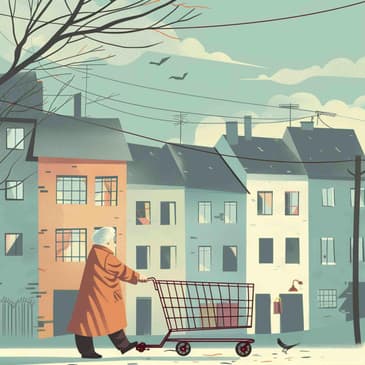
[00:04:30] pulling her groceries behind her in a metal shopping cart
[00:04:32] and then lugging that cart up four flights of stairs to the top floor of her walk-up apartment.
[00:04:39] This sounds like the ultimate Stairmaster workout.
[00:04:42] She knew where her food came from, even in a city of 8 million people.
[00:04:46] She enjoyed long established relationships
[00:04:49] because she was born and lived within a one-block radius her whole life.
[00:04:54] Her healthy eating patterns came out of necessity, not from being health-minded.
[00:05:00] Small portions and no snacking came from limited resources.
[00:05:04] My grandmother did enjoy her little sweet treat in the afternoons with a cup of decaf coffee though,
[00:05:09] and I loved those coffee breaks.
[00:05:12] Food was seasonal and locally sourced because air freight didn't exist yet.
[00:05:17] She ate whole foods before both words came to be capitalized.
[00:05:21] The food was homemade, prepared with love and eaten in community.
[00:05:26] And there was always gratitude, a moment to say grace,
[00:05:29] to be thankful for the food they were about to eat
[00:05:32] because they could remember what it was like to grow up during the Great Depression.
[00:05:36] Now that I think about it, this was mindful eating before there was such a label.
[00:05:42] I know how lucky I was to grow up as I did.
[00:05:45] We didn't have much, but we had all we needed and love was plentiful.
[00:05:50] My eating habits have evolved over the decades and in many ways, they've come full circle.
[00:05:55] As I reflect on this, I wonder how much epigenetics come into play here,
[00:06:00] that is, the degree to which I've been influenced by the behaviors and environment of my ancestors.
[00:06:07] I can feel the connection.
[00:06:08] I can feel it in my love of sharing home-cooked meals, fresh ingredients,
[00:06:13] chatting with the folks at the market, harvesting wild foods,
[00:06:17] living an active lifestyle, enjoying a nice glass of wine and my coffee breaks,
[00:06:23] all a nod to those who came before me.
[00:06:26] To be clear, I don't want to go back to the old ways.
[00:06:29] Life was hard for my grandparents and my great-grandparents.
[00:06:32] Women were expected to run the household, raise the kids with no modern conveniences,
[00:06:37] and many worked in the home, as did both my grandmothers.
[00:06:40] So no, this isn't about going back.
[00:06:44] It's about moving forward mindfully, learning our lessons from those who came before
[00:06:49] in order to live our best lives today.
[00:06:56] You just listened to the post titled,
[00:06:58] What Our Ancestors Can Teach Us About Healthy Eating, by Kathy Robinson of athenawellness.com.
[00:07:04] And I'll be right back with my commentary.
[00:07:07] When you're hiring, it feels amazing to finally close out a job search.
[00:07:11] But what if you could get rid of the search and just match?
[00:07:14] You can, with Indeed.
[00:07:16] Indeed is your matching and hiring platform,
[00:07:19] with over 350 million global monthly visitors
[00:07:23] and a matching engine that helps you find quality candidates fast.
[00:07:27] Ditch the busy work. Use Indeed for scheduling, screening, and messaging.
[00:07:32] 93% of employers agree Indeed delivers the highest quality matches compared to other job sites.
[00:07:38] One of the things I love about Indeed is that it filters out incompatible applicants.
[00:07:43] So when you're hiring, the process is much faster,
[00:07:46] and you only have to consider applicants that are already likely to be a great fit.
[00:07:50] And listeners of this show will get a $75 sponsored job credit
[00:07:55] to get your job's more visibility at indeed.com slash health.
[00:08:01] Just go to indeed.com slash health right now
[00:08:05] and support our show by saying you heard about Indeed on this podcast.
[00:08:09] Indeed.com slash health. Terms and conditions apply.
[00:08:13] Need to hire? You need Indeed.
[00:08:17] Dr. Neil here for my commentary.
[00:08:19] Today's author, Kathy, said something really important.
[00:08:22] When it comes to our eating habits, it does seem as though we're coming full circle.
[00:08:27] During World War II, the food industry had to come up with ways to get non-perishable food to the troops.
[00:08:34] This food had to last a long time without spoiling.
[00:08:37] It also had to be full of calories to supply the troops with lots of readily available energy.
[00:08:43] And it had to be easily transported across the world.
[00:08:47] Now at the time, most people weren't used to eating this way.
[00:08:50] Instead, foods were eaten fresh and seasonally.
[00:08:54] But these advances in food technology changed all of that.
[00:08:58] After World War II ended, lots of these convenience foods that were being sent to the troops ended up left over.
[00:09:06] And instead of wasting them, these foods were sent to grocery stores around the country.
[00:09:10] Now, these highly processed foods were readily available to pretty much everyone.
[00:09:16] That meant folks didn't have to rely on shopping every day for fresh foods.
[00:09:20] Instead, they could leave foods in the pantry without refrigeration for days and weeks.
[00:09:26] Baking became much less tedious.
[00:09:28] Plus, these foods were cheaper than fresh foods.
[00:09:32] Now of course there's more to this story,
[00:09:34] but this partly explains where our reliance on convenient processed foods came from.
[00:09:40] Now through 60 years of health-related research,
[00:09:43] we have seen now how these foods affect our health.
[00:09:47] And again, we're coming full circle.
[00:09:50] Back to the idea of mostly fresh, mostly unprocessed seasonal foods.
[00:09:56] You know, the way our ancestors ate.
[00:09:59] Thank you so much for being here.
[00:10:00] Thank you for listening every day.
[00:10:02] I hope you're having a great week so far.
[00:10:04] And I'll see you back here tomorrow where your optimal life awaits.