



Discover all of the podcasts in our network, search for specific episodes, get the Optimal Living Daily workbook, and learn more at: OLDPodcast.com.
Episode 2657:
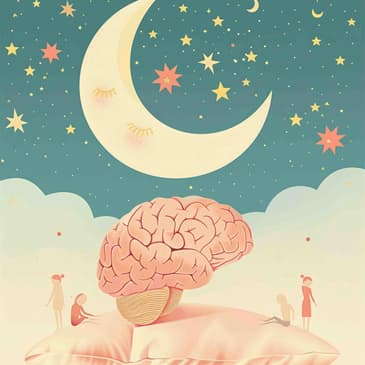
Discover the crucial balance between too much and too little sleep with insights from Dr. Jenny Brockis. Learn how optimal sleep impacts your cognitive health, why both extremes of sleep duration can be detrimental, and the importance of those golden 7-8 hours for peak brain performance.
Read along with the original article(s) here: https://www.drjennybrockis.com/2018/12/11/your-goldilocks-brain-and-sleep/
Quotes to ponder:
"Chronic sleep deprivation increases our risk of heart disease, diabetes, and obesity."
"Seven to eight hours of good quality uninterrupted sleep is the ideal for better reasoning, verbal and overall cognition."
"Regularly sleeping in excess of eight hours has been linked to an increased risk of depression, poor health, reduced physical fitness, and increased morbidity."
Episode references:
University of Western Ontario Brain and Mind Institute: https://www.uwo.ca/bmi
Sleep Journal: https://academic.oup.com/sleep
Learn more about your ad choices. Visit megaphone.fm/adchoices
[00:00:00] Delicious meets nutritious in the snack that packs a real protein punch, Wonderful Pistachios. Each one-ounce serving of Wonderful Pistachios has 6 grams of protein, giving you over 10% of your daily value and making Wonderful Pistachios one of the highest protein nuts. But perhaps more
[00:00:17] than that, I love all of the flavors they have. Their sea salt and vinegar ones are my favorite when I'm craving that flavor but want to keep it healthy. But that's just the tip of the iceberg.
[00:00:27] Wonderful Pistachios come in a variety of flavors like chili roasted, honey roasted, smoky barbecue and jalapeno lime, perfect for enjoying with family and friends or taking them with you on the go. Whether you're a pistachio purist who loves cracking open every nut or you
[00:00:44] prefer the convenience of no-shells pistachios, Wonderful Pistachios has got you covered. Grab Wonderful Pistachios and elevate your snacking game today. So fill up with a healthy snack when hunger strikes. Visit wonderfulpistachios.com to learn more. That's wonderfulpistachios.com. This is Optimal Health Daily, episode 2657.
[00:01:08] Your Goldilocks, Brain and Sleep by Dr. Jenny Brawkus of drjennybrawkus.com. And I'm Dr. Neil, your host and narrator. Welcome back to Optimal Health Daily or OHD, where I act as your narrator of popular health and fitness blogs and always provide my commentary
[00:01:26] at the end. Now don't forget we have a bunch of shows doing just that. Just search for Optimal Living Daily in your podcast app to find them. Alright and with that, let's get right to it and
[00:01:37] start optimizing your life. Your Goldilocks, Brain and Sleep by Dr. Jenny Brawkus of drjennybrawkus.com. How's your sleeping? Sleep is one of those things we often pay little attention to unless you have a sleep disorder or have difficulty getting enough. What's the link between our brain and sleep?
[00:02:01] We've heard it before, how we are all horribly sleep deprived and how this is impacting our health, mood, our memory and thinking skills. And yes, while it's true many of us struggle to get
[00:02:14] enough shut-eye, there are others who have no such issue. In fact they're happily tucked up under their quilt all cozy in their beds for far longer, maybe nine or ten hours. Does this matter? Is
[00:02:27] sleeping longer as bad for us as not sleeping enough? This is what a group of neuroscientists from the University of Western Ontario Brain and Mind Institute set out to discover. Their findings from the world's largest brain and sleep study were recently published in the Sleep Journal.
[00:02:43] Over 10,000 people from around the world took part, completing an in-depth questionnaire and undertaking a battery of 12 cognitive tests supplied by Cambridge Brain Sciences to examine selective attention, reasoning, verbal short-term memory, spatial working memory, planning, visuospatial working memory, cognitive flexibility and various aspects of inattention.
[00:03:09] The questionnaire asked about people's sleeping habits, what medications they were taking, their age, where they lived and what level of education they had received. Can you guess what they discovered? Let's take a look at the five big takeaways.
[00:03:24] One. Many of us fall way below the bar of getting enough sleep. While it's recommended we get between seven and eight hours of sleep for better brain health and function, around half of the respondents were getting only 6.3 hours. Worse still, those who reported that they were surviving
[00:03:41] on four hours or less performed as if they were nine years older on their cognitive tests. Yikes! This is not good news if you're a bright go-getter seeking to climb the corporate ladder and are currently burning the candle at both ends in order to achieve this.
[00:03:58] I listened in horror to a conversation where a CEO, a woman in her mid-30s, shared how she regularly only gets four to five hours of sleep because this is what she perceives as necessary
[00:04:10] to stay at the top of her game. She cheerfully added that while she knew this was probably not ideal in the long term, she anticipated being able to back off from her work a little in four or
[00:04:23] five years time. Have I mentioned that the first insight we lose when chronically sleep-deprived is just how tired we are and that chronic sleep deprivation increases our risk for heart disease, diabetes, and obesity? Not only that, it leads to detectable impairments in our overall cognition.
[00:04:43] Whether you're running a company, leading a team, or working on the tools, being able to think clearly, rationally, and logically is imperative to everyone's safety. 2. Age doesn't come into it. Adults over the age of 18, regardless of age, all need seven to eight
[00:05:01] hours of sleep for a highly functioning brain. Neither did age have any bearing on those who were deemed to be sleeping too much or too little in terms of cognitive impairment. 3. There is an optimal amount of sleep. Yes, you guessed it, seven to eight hours of good
[00:05:19] quality uninterrupted sleep is the ideal for better reasoning and overall cognition. 4. What about the long sleepers? The brain is often described as being a bit of a Goldilocks. Everything has to be in balance for it to function at its best, and this is certainly true in relation
[00:05:37] to our sleep patterns. Sleeping for too long isn't good for us either. Yeah, I know, you just can't win. Why this is, apart from being grossly unfair, remains a bit of a mystery. However, regularly
[00:05:51] sleeping in excess of eight hours has been linked to an increased risk for depression, poorer health, reduced physical fitness, and increased morbidity. It's also associated with greater sleep inertia that lasts longer and is more intense. Sleep inertia is that horrible groggy
[00:06:09] feeling when we're awakened from our slumbers by the alarm clock, or the kids jumping onto the bed to announce it's time to play, or the dog scratching at the door at 3am asking to be let
[00:06:19] out for a week. Not feeling fully awake can have disastrous consequences if you're suddenly being called upon to make that important decision or solve a problem. And 5. There's a world of difference between short and long-term sleep deprivation on our cognition. Long-term sleep
[00:06:36] deprivation appears to have a prolonged effect on reasoning and verbal ability, but little on short-term memory performance. That's good to know because I guess we've all had those nights where sleep eludes us for one reason or another. One thing this study did reveal was that having a
[00:06:54] slightly longer night's sleep than normal when you're normally running a bit short will boost performance the next day. Meaning that even one good night's sleep can make a positive difference. Thank goodness there's a silver lining after all. So where do you lie on the sleep spectrum?
[00:07:11] Are you getting enough, verging on too much, or getting it about right? While we are all individuals and genetic differences do play a role, it appears we all benefit from getting enough, but not too much, good quality sleep. You just listened to the post titled
[00:07:32] Your Goldilocks Brain and Sleep by Dr. Jenny Brockes of drjennybrockes.com and I'll be right back with my commentary. Dr. Neil here for my commentary. Please, please don't lose sleep over thinking about how you're probably not getting enough
[00:07:47] sleep. That just makes things worse. We've all had those nights where we think, if I fall asleep right now that will still give me six hours of sleep. Fast forward an hour later
[00:07:59] and we're still awake thinking, okay if I fall asleep right now I will get at least five hours of sleep. And before you know it, it's time to get up and we haven't slept a wink. If you find
[00:08:12] it's difficult to fall asleep here are my suggestions. First, continue to exercise regularly. Many, many studies have found that those that exercise regularly are able to fall asleep faster and achieve that deeper REM sleep longer when compared to those that don't exercise regularly.
[00:08:31] Second, keep your bedroom cold and dark. But if you find that getting enough sleep is an ongoing issue it may be time to have a conversation with your health care provider. I wouldn't necessarily recommend using an antihistamine like Benadryl every night without your doctor's approval to
[00:08:48] help you fall asleep. That's because studies have found that regular use of these types of antihistamines may increase the risk for dementia later in life. I would also check with your health care provider before using melatonin. But in the meantime, see if you can squeeze in some
[00:09:03] regular exercise and keep your bedroom on the cooler side and dark and see if that helps. All right, that'll do it for today and I'll see you back here tomorrow for the Wednesday show and where your optimal life awaits.