



Discover all of the podcasts in our network, search for specific episodes, get the Optimal Living Daily workbook, and learn more at: OLDPodcast.com.
Episode 2673:
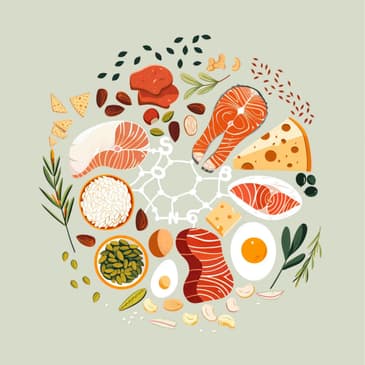
David Cameron-Smith delves into the crucial role proteins play in fitness, explaining how different amino acids, such as leucine, glutamine, and tryptophan, contribute to muscle repair, gut health, and mental well-being. Learn the science behind optimal protein intake and how to incorporate these vital nutrients into your diet for better exercise recovery and overall health.
Read along with the original article(s) here: https://www.lesmills.com/fit-planet/nutrition/protein-power/
Quotes to ponder:
"Leucine has the ability to increase the activity of the protein-making machinery in muscles."
"Dietary glutamine can maintain the healthy integrity of the many millions of cells that line the digestive tract."
"Transport of tryptophan into the brain enables the many neurons of the serotonergic system to make serotonin, which influences mood and mental health."
Learn more about your ad choices. Visit megaphone.fm/adchoices
[00:00:00] [SPEAKER_00]: Have you ever noticed how a calm mind can really set the stage for a good night's sleep?
[00:00:04] [SPEAKER_00]: That's the idea behind our new podcast, Good Sleep.
[00:00:08] [SPEAKER_00]: Greg, our host from Optimal Relationships Daily, is here to help ease you into a peaceful night's
[00:00:13] [SPEAKER_00]: rest with some positive affirmations, and these affirmations aren't just comforting
[00:00:18] [SPEAKER_00]: they can help ease anxiety and nurture positive thoughts, setting you up for true, good sleep.
[00:00:24] [SPEAKER_00]: So, press play on Good Sleep tonight because a good tomorrow starts with a Good Night's sleep.
[00:00:31] [SPEAKER_00]: Just search for Good Sleep in your podcast app and be sure to pick the one from Optimal Living Daily.
[00:00:39] [SPEAKER_00]: This is Optimal Health Daily. How does Protein improve your fitness by David Cameron-Smith of Les Mills.com
[00:00:46] [SPEAKER_00]: and I'm Dr. Neal, your host and narrator. Welcome back to Optimal Health Daily or OHD where I act as
[00:00:53] [SPEAKER_00]: a trainer narrator of popular health and fitness blogs and always with a bit of my commentary at the end.
[00:00:59] [SPEAKER_00]: And with that, let's get right to it and start optimizing your life.
[00:01:06] [SPEAKER_00]: How does Protein improve your fitness by David Cameron-Smith of Les Mills.com?
[00:01:14] [SPEAKER_00]: Not all proteins are alike, some are definitely better than others in helping with exercise recovery
[00:01:19] [SPEAKER_00]: and metabolism. Of the three major sources of energy, fat, carbohydrates, and proteins,
[00:01:25] [SPEAKER_00]: the importance of proteins to human health has remained the most elusive.
[00:01:30] [SPEAKER_00]: Proteins are absolutely essential for human life,
[00:01:33] [SPEAKER_00]: supplying the 20 amino acids that are present in varying levels in all cells.
[00:01:38] [SPEAKER_00]: Here are some of the things you should know about how proteins work and how to incorporate them in your diet.
[00:01:44] [SPEAKER_00]: What are amino acids?
[00:01:47] [SPEAKER_00]: amino acids are divided into two major groups, the essentials and the non-essentials.
[00:01:52] [SPEAKER_00]: This is a misleading classification as all amino acids are absolutely essential.
[00:01:59] [SPEAKER_00]: Non-essential simply refers to the ones that can be made to a varying extent from the basic
[00:02:05] [SPEAKER_00]: building blocks of other amino acids. What do amino acids do?
[00:02:11] [SPEAKER_00]: Most people eat plenty of amino acids to supply the daily needs of their cells.
[00:02:16] [SPEAKER_00]: Within each body cell, these acids are mainly used to make proteins.
[00:02:19] [SPEAKER_00]: Each protein is made up of varying numbers of amino acids from as few as 10 to the super large
[00:02:25] [SPEAKER_00]: structural proteins made up of 100,000 or more acids. Proteins are constantly being broken
[00:02:32] [SPEAKER_00]: down and remade with very little loss of amino acids in the process. It's because of this
[00:02:38] [SPEAKER_00]: very efficient recycling that the absolute requirement of amino acids each day is rather small.
[00:02:45] [SPEAKER_00]: So, how much protein do I need? For the past two decades, there has been a major rethink of
[00:02:51] [SPEAKER_00]: the roles and functions of protein for human health. Caught up in the endless debate about
[00:02:56] [SPEAKER_00]: the best ways to lose weight and build muscle mass, the low carbohydrate, high protein diet
[00:03:02] [SPEAKER_00]: generated very strong opinions. As with all trends, the truth is likely to lie somewhere in
[00:03:08] [SPEAKER_00]: the middle of the extremes supported by nutritional experts and celebrities alike.
[00:03:13] [SPEAKER_00]: Central to the question of how much protein is needed for optimal health
[00:03:16] [SPEAKER_00]: has been increased analysis of exactly what amino acids can do. The latest nutritional
[00:03:22] [SPEAKER_00]: science has highlighted just how important some amino acids are for optimal health,
[00:03:28] [SPEAKER_00]: including losing and lifting. Losing is known as a branch chain amino acid, just one of four that
[00:03:41] [SPEAKER_00]: is well as soybean, some meats, seeds and nuts. Losing is the key ingredient in body-building
[00:03:48] [SPEAKER_00]: protein blends. After exercise, Losing has the ability to increase the activity of the
[00:03:54] [SPEAKER_00]: protein making machinery and muscles. So, how much Losing is enough? Losing has now been shown scientifically
[00:04:03] [SPEAKER_00]: to boost muscle repair and over time increase the amount of muscle gain, but Losing's impact
[00:04:09] [SPEAKER_00]: is still small compared to the actions of exercise alone. Despite the hype, it's the exercise
[00:04:15] [SPEAKER_00]: and a 24-7 healthy diet that matters most. The Losing boost works when protein rich food is
[00:04:23] [SPEAKER_00]: consumed some time within the first two hours of recovering after a workout, but the amount
[00:04:28] [SPEAKER_00]: of total protein and Losing is unlikely to be boosted by ever increasing amounts of protein powder.
[00:04:35] [SPEAKER_00]: Careful measurement suggests that a total dose of 25 grams of Losing-rich protein
[00:04:40] [SPEAKER_00]: while less than what's recommended on most body-building formulations is more than enough.
[00:04:46] [SPEAKER_00]: Glutamine and the gut. Glutamine is a non-essential amino acid and one of the most abundant in the
[00:04:53] [SPEAKER_00]: body. Found abundantly in meats and eggs, glutamine has a surprisingly important role in the digestive
[00:04:59] [SPEAKER_00]: tract, including the colon. For reasons that are not yet clear, dietary glutamine can maintain the
[00:05:05] [SPEAKER_00]: health and integrity of the many millions of cells that line the digestive tract.
[00:05:11] [SPEAKER_00]: Triptophane and the brain. Triptophane is abundant in many high-protein foods,
[00:05:17] [SPEAKER_00]: including nuts, seeds, cheese, red meat, fish, oats and eggs. It's the only ingredient used to synthesize
[00:05:25] [SPEAKER_00]: mood-regulating hormone serotonin. Transport of triptophane to the brain enables the many neurons
[00:05:31] [SPEAKER_00]: of the serotonin-nergic system to make serotonin, which influences mood and mental health.
[00:05:38] [SPEAKER_00]: So where's the science on protein and diet now? Protein-rich foods are an essential part
[00:05:43] [SPEAKER_00]: of an optimal diet, but the jury is still out in whether a high-protein diet, particularly one
[00:05:48] [SPEAKER_00]: that limits carbohydrates and comes with more fats is healthy. The scientific evidence to date
[00:05:54] [SPEAKER_00]: shows a potential for greater maintenance of weight loss with slightly more dietary protein.
[00:06:00] [SPEAKER_00]: There are certainly no evidence of greater energy, increased physical performance,
[00:06:04] [SPEAKER_00]: huge gains in muscle mass and improved mood. In reality, the human body needs a diverse array
[00:06:10] [SPEAKER_00]: of foods, including those with protein. You just listen to the post titled, How Does Protein
[00:06:20] [SPEAKER_00]: Improve Your Fitness by David Cameron Smith of LesMills.com, and I'll be right back with my commentary.
[00:06:27] [SPEAKER_00]: Dr. Neil here for my commentary. A meta-analysis I found would agree with today's authors,
[00:06:33] [SPEAKER_00]: David's conclusions. The authors of this meta-analysis found that increasing protein intake
[00:06:39] [SPEAKER_00]: may be most helpful for those that are over the age of 50 and are actually participating in
[00:06:45] [SPEAKER_00]: some resistance training. And this may be because as we get older, we tend to eat less protein
[00:06:50] [SPEAKER_00]: in general. So how much protein are we talking about? Basically, what the American College of
[00:06:57] [SPEAKER_00]: Sports Medicine recommends for those that participate in regular resistance training about 1.2 grams
[00:07:03] [SPEAKER_00]: of protein per kilogram body weight. So, for a 150-pound person, regardless of gender,
[00:07:10] [SPEAKER_00]: that would be about 81 grams of protein per day. Considering just half a cup of chicken has about
[00:07:16] [SPEAKER_00]: 32 grams of protein, you can see that getting to those 81 grams of protein per day isn't
[00:07:22] [SPEAKER_00]: difficult for most. So just as David said, it may not be necessary to hyperfocus on protein when
[00:07:28] [SPEAKER_00]: it comes to building muscle. But instead, think about getting a variety of nutritious foods and
[00:07:34] [SPEAKER_00]: consistent resistance training. All right, that'll do it for today. I hope you have a great
[00:07:39] [SPEAKER_00]: rest of your day. And of course, I'll see you back here tomorrow for more OHD and where you're
[00:07:45] [SPEAKER_00]: going to have to talk about your health.