
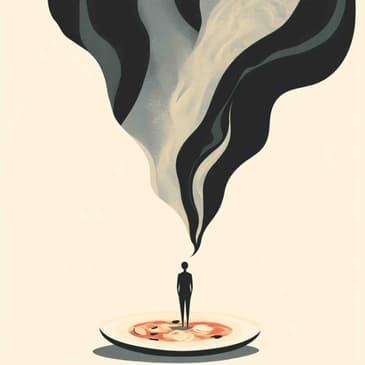



Discover all of the podcasts in our network, search for specific episodes, get the Optimal Living Daily workbook, and learn more at: OLDPodcast.com.
Episode 2728:
Dr. Lisa Firestone explores the deep emotional roots behind overeating, highlighting how unresolved childhood experiences and psychological factors often lead to unhealthy relationships with food. By understanding these underlying emotions, individuals can break the cycle of self-destructive eating habits and cultivate a healthier connection with food and their bodies.
Read along with the original article(s) here: https://www.psychalive.org/whats-behind-emotional-overeating/
Quotes to ponder:
"Our relationship with food is more complex than we often assume. Like any addictive substance, food is often used to cover or subdue emotional pain."
"All of us have an inner coach, or 'critical inner voice,' that lures us into destructive behavior then pounces on us the minute we mess up."
"To have a healthy relationship with food, it is necessary for us to understand ourselves on a deeper emotional level or to uncover why we eat the way we eat."
Learn more about your ad choices. Visit megaphone.fm/adchoices
[00:00:00] Damit aus H-H-H-H-Kein Hatschi wird! Bei beginnender Erkältung Immopret N. Jetzt in der kalten Jahreszeit darf Immopret N nicht fehlen. Mit der einzigartigen Sieben-Pflanzen-Kombination kann es die Erkältungsabwehr stärken, Erkältungserreger bekämpfen und den Erkältungsverlauf meldern.
[00:00:17] Wenn eine Kältung entsteht, Immopret!
[00:00:20] Überzeug dich selbst und hol dir alle Infos auf immopret.de.
[00:00:23] Zu Risiken und Nebenwirkungen lesen Sie die Packungsbeilage und fragen Sie Ihre Ärztin, Ihren Arzt oder in Ihrer Apotheke.
[00:00:30] Have you ever noticed how a calm mind can really set the stage for a good night's sleep?
[00:00:34] That's the idea behind our new podcast, Good Sleep.
[00:00:38] Greg, our host from Optimal Relationships Daily, is here to help ease you into a peaceful night's rest with some positive affirmations.
[00:00:45] And these affirmations aren't just comforting, they can help ease anxiety and nurture positive thoughts,
[00:00:51] setting you up for true good sleep.
[00:00:55] So, press play on Good Sleep tonight, because a good tomorrow starts with a good night's sleep.
[00:01:01] Just search for Good Sleep in your podcast app and be sure to pick the one from Optimal Living Daily.
[00:01:08] This is Optimal Health Daily.
[00:01:10] What's Behind Emotional Overeating?
[00:01:13] By Dr. Lisa Firestone of PsychAlive.org
[00:01:16] And I'm Dr. Neil Malek.
[00:01:18] Hey there, happy Monday and welcome back to Optimal Health Daily,
[00:01:22] where I act as your narrator of the best health and fitness blogs, all for free.
[00:01:26] And always with a bit of my commentary at the end.
[00:01:29] And don't forget, we have a bunch of shows covering different topics.
[00:01:33] Just search for Optimal Living Daily in any podcast app to find them.
[00:01:37] But for now, let's get right to it and start optimizing your life.
[00:01:45] What's Behind Emotional Overeating?
[00:01:48] By Dr. Lisa Firestone of PsychAlive.org
[00:01:52] I remember when Michelle Obama made a special guest appearance on the long-running hit TV show,
[00:01:58] The Biggest Loser.
[00:01:59] I'd heard about the show's premise.
[00:02:01] Contestants who struggle with obesity and often face serious health risks relocate to a fitness ranch,
[00:02:07] where together they learn about nutrition, diet, and exercise while competing to lose weight.
[00:02:13] But I had never watched it until I saw the episode featuring the then first lady.
[00:02:18] The contestants were invited to the White House where
[00:02:20] Mrs. Obama, in her typically down-to-earth and enthusiastic manner,
[00:02:25] joined in on the show's intense workout
[00:02:27] in an effort to spotlight the importance of diet and exercise.
[00:02:31] While the issue of obesity and poor nutrition are of tremendous significance,
[00:02:35] as our country struggles to get fit,
[00:02:38] we should also be shedding light on the emotional side of eating.
[00:02:41] Whatever one may think of The Biggest Loser's reality TV editing or competitive format,
[00:02:47] one thing I personally appreciate is that the show acknowledges that the factors contributing to obesity,
[00:02:53] food addiction, and weight gain go deeper than the surface.
[00:02:57] Contestants are encouraged to uncover and understand the psychological and emotional roots
[00:03:02] and implications of their struggle with their weight.
[00:03:05] When it comes to our relationship with food,
[00:03:08] there's much more going on than we would often assume.
[00:03:11] Like any addictive substance,
[00:03:13] food is often used to cover or subdue emotional pain.
[00:03:17] It's used to numb or soothe us,
[00:03:20] yet it is also used to torment us or cause us anxiety.
[00:03:24] Struggles with eating and weight gain usually start early,
[00:03:28] when our relationship with food is first established.
[00:03:30] One contestant on The Biggest Loser described how the physical abuse he experienced throughout his childhood
[00:03:36] left him with a desire to somehow shield himself both physically and emotionally.
[00:03:42] Growing up with a violent and erratic stepfather and a fearful mother who failed to protect him,
[00:03:48] he used food to
[00:03:49] feel bigger,
[00:03:51] safer,
[00:03:51] and comforted.
[00:03:52] It's easy to see how such an extreme example of physical abuse
[00:03:56] could lead a child to start to use food as consolation and weight as armor.
[00:04:02] However, it is far more difficult to identify how more subtle forms of mistreatment,
[00:04:07] misattunement,
[00:04:08] and abuse can lead to issues with eating.
[00:04:11] As children,
[00:04:12] we all experience varying degrees of emotional pain.
[00:04:16] The love,
[00:04:17] care,
[00:04:17] and nurturance we get from our caregivers
[00:04:19] lead us to form a positive sense of self
[00:04:22] and helps us to create our identity.
[00:04:26] Yet no parent or person is perfect.
[00:04:29] Even the best parents are only attuned to their child's needs about 30% of the time.
[00:04:34] This means that as children,
[00:04:36] each of us was inevitably left lacking certain things we needed.
[00:04:40] We may have felt rejected,
[00:04:42] isolated,
[00:04:43] unseen,
[00:04:44] or unheard.
[00:04:45] Conversely,
[00:04:46] we may have felt intruded on,
[00:04:47] overly controlled,
[00:04:48] or intimidated by our parents.
[00:04:51] All of these factors could have impacted our relationship with food.
[00:04:55] We literally and figuratively learned how to feed ourselves from how we were nurtured by our parents
[00:05:01] and influential caretakers.
[00:05:03] Many of us eat for reasons other than to nourish our bodies,
[00:05:07] or even to enjoy one of life's pleasures.
[00:05:09] To understand why we overeat,
[00:05:11] it's valuable to identify what the emotions are that lead us to mindlessly snack,
[00:05:17] overindulge,
[00:05:18] or binge.
[00:05:19] Are these feelings familiar?
[00:05:21] Do they bring up any memories or remind us of ways we felt in our past?
[00:05:25] Do our patterns of eating remind us of ways we saw our parents use food or other substances?
[00:05:30] Or, conversely,
[00:05:32] might our actions seem like a reaction to ways we saw our parents use food or other substances?
[00:05:37] A woman I know tells a story of her 30-year struggle with her weight.
[00:05:41] One of her earliest memories is of being barely over a year old
[00:05:45] and crying through the night for her bottle,
[00:05:47] while neither her mother nor her father woke to feed her.
[00:05:51] Night after night,
[00:05:53] hungry and alone,
[00:05:54] she would wait,
[00:05:55] but no one came.
[00:05:56] Finally,
[00:05:57] one morning when her mother brought her bottle,
[00:05:59] the child took the bottle,
[00:06:00] and even though she was starving,
[00:06:02] she refused it,
[00:06:03] and threw it on the floor.
[00:06:05] She recalls that something shut down in her,
[00:06:08] and she never wanted food from her mother again.
[00:06:10] As she grew up,
[00:06:12] her relationship with food was further complicated by her mother's own struggle with weight
[00:06:16] and consistent focus on her young daughter's figure.
[00:06:19] As a result,
[00:06:20] the woman grew up suffering from binge eating,
[00:06:23] overfeeding herself with a desperation
[00:06:25] that indicated a disconnectedness from her body.
[00:06:29] She had trouble distinguishing her real feelings of hunger
[00:06:32] from a desire to fill herself up.
[00:06:34] People with eating disorders,
[00:06:36] both overeaters and anorexics,
[00:06:39] disregard their own values and personal goals
[00:06:41] in relation to their health,
[00:06:42] looks,
[00:06:43] and lifestyle.
[00:06:44] They use food to feel bad about themselves,
[00:06:47] to punish themselves,
[00:06:48] or to gain a sense of control.
[00:06:50] Instead of using it to fuel their bodies,
[00:06:52] they use food to fuel a cycle of self-hatred and self-protection.
[00:06:56] All of us have an inner coach,
[00:06:58] or critical inner voice,
[00:07:00] that lures us into destructive behavior,
[00:07:02] then pounces on us the minute we mess up.
[00:07:05] The critical inner voice is a driving force behind an eating disorder,
[00:07:09] and to challenge an unhealthy relationship with food,
[00:07:12] a person must deal with this internal enemy.
[00:07:16] We live in a society that supports being slim,
[00:07:19] sometimes to the extreme.
[00:07:21] This unrealistic ideal
[00:07:23] can be used in the service of our inner critic
[00:07:26] to put ourselves down,
[00:07:27] to feel inadequate,
[00:07:28] or to isolate us from the world around us.
[00:07:31] Failing to identify our critical voices as they come up
[00:07:34] leaves us more at risk for falling off the wagon.
[00:07:38] However,
[00:07:39] we can challenge our voices
[00:07:40] by not engaging in the behaviors they are supporting,
[00:07:43] and even though they may initially become louder,
[00:07:46] enticing us and telling us we will fail,
[00:07:49] the more we ignore them,
[00:07:50] the more they lose their hold on us,
[00:07:52] and the stronger we become.
[00:07:54] To have a healthy body,
[00:07:56] it is necessary for us to take action
[00:07:58] of a physical level with diet and exercise,
[00:08:00] but to have a healthy relationship with food,
[00:08:03] it's necessary for us to understand ourselves
[00:08:05] on a deeper emotional level,
[00:08:07] or to uncover why we eat the way we eat.
[00:08:11] If we challenge the behaviors alone
[00:08:13] through diet and exercise,
[00:08:15] the emotions we were using eating to cover up
[00:08:17] won't just go away.
[00:08:19] Once we identify the feelings and inner voices
[00:08:22] that perpetuate the cycle of self-hatred
[00:08:24] and the insensitivity to our body,
[00:08:26] we can gain control of self-destructive eating habits,
[00:08:30] and not react adversely to pressure and triggers
[00:08:33] that lead us to abuse food.
[00:08:35] By taking action on a physical level
[00:08:38] and taking interest on an emotional level,
[00:08:40] we can reestablish our relationship with food,
[00:08:43] with our bodies,
[00:08:44] with our past,
[00:08:45] and with ourselves as a whole.
[00:08:47] We can uncover who we really are,
[00:08:49] our real wants,
[00:08:50] desires,
[00:08:51] and goals,
[00:08:51] and we can stop engaging in the patterns
[00:08:54] that get in our way.
[00:08:59] You just listened to the post titled,
[00:09:01] What's Behind Emotional Overeating?
[00:09:03] by Dr. Lisa Firestone of psychalive.org,
[00:09:07] and I'll be right back with my commentary.
[00:09:09] Dr. Neil here for my commentary.
[00:09:12] Reestablishing our relationship with food
[00:09:14] and our past can take time
[00:09:16] and require help from a healthcare professional
[00:09:19] like a psychologist or psychiatrist.
[00:09:22] Because these behaviors
[00:09:23] may be deep-rooted from our past,
[00:09:25] they may be particularly difficult to change.
[00:09:28] If we're interested in becoming more aware
[00:09:30] of our relationship with food,
[00:09:32] one step we can take
[00:09:33] is to start keeping a food record.
[00:09:35] So a food record typically involves
[00:09:37] keeping track of
[00:09:38] the time we ate,
[00:09:39] what we ate,
[00:09:41] how it was prepared,
[00:09:42] how much we ate,
[00:09:44] and so on.
[00:09:44] But noting our feelings
[00:09:46] before, during,
[00:09:47] and after we eat
[00:09:49] can help us find that relationship
[00:09:51] between food and our feelings.
[00:09:54] For example,
[00:09:56] did we eat because we were truly hungry?
[00:09:58] Or did we eat because
[00:09:59] we were feeling stressed?
[00:10:02] Or anxious?
[00:10:03] Or bored?
[00:10:04] Or happy?
[00:10:05] Keeping this kind of food record
[00:10:07] and looking at patterns
[00:10:08] can help you
[00:10:10] and or your psychologist
[00:10:11] or psychiatrist
[00:10:12] get to the root of the issue.
[00:10:15] So if you or a loved one
[00:10:16] are experiencing
[00:10:17] emotional overeating,
[00:10:19] please don't hesitate
[00:10:20] to contact a healthcare professional.
[00:10:22] And if you're not sure
[00:10:23] where to start,
[00:10:24] your primary care provider
[00:10:25] is a great resource.
[00:10:27] All right,
[00:10:28] that'll do it for today.
[00:10:29] I hope you have a great start
[00:10:30] to your week
[00:10:31] and I'll see you back here
[00:10:32] tomorrow as usual
[00:10:33] where your optimal life awaits.
[00:10:35] Let's see you next time.
[00:10:36] Let's see you next time.
[00:10:36] Thank you.