



Discover all of the podcasts in our network, search for specific episodes, get the Optimal Living Daily workbook, and learn more at: OLDPodcast.com.
Episode 2765:
Dr. Margaret Rutherford explores the nuances between comfort eating and binge eating, sharing personal stories of emotional eating to highlight the importance of self-awareness. She provides practical tips to help differentiate emotional hunger from physical hunger and suggests healthier coping mechanisms to address emotional distress without resorting to food.
Read along with the original article(s) here: https://drmargaretrutherford.com/bingeing-or-comfort-eating-five-ways-for-comfort-eating-to-stay-comfortable/
Quotes to ponder:
"Comfort eating, while not a clinical term, is almost exclusively for self-soothing."
"Shame and hatred will only serve as a hurdle rather than some kind of self-punitive motivation."
"Grief, sadness, guilt, anger, disappointment, humiliation none of these emotions are easy to feel. Yet the more you avoid them, the stronger they can become."
Learn more about your ad choices. Visit megaphone.fm/adchoices
[00:00:00] OrtoMul Immun ist dein Partner fürs Immunsystem. Und damit das einwandfrei funktionieren kann, ist eine ausreichende Versorgung mit Mikronährstoffen wichtig. OrtoMul Immun ist ein Nahrungsergänzungsmittel zur gezielten Unterstützung des Immunsystems. Mit wichtigen Nährstoffen wie Vitamin C, D und Zink als Beitrag zu einer normalen Funktion des Immunsystems. Such jetzt online nach OrtoMul Immun, informiere dich und sicher dir deine kostenlose Produktprobe.
[00:00:27] Brauchen wir wirklich noch einen Computer? Alle wahrscheinlich nicht. Aber wenn du Musik mit der Power eines Neuralprozessors neu erfindest oder unterwegs Migrationsmuster mit einem ganztägigen Akku analysierst oder deine Ideen mit dem KI-gesteuerten Co-Creator zum Leben erwächst, dann kann ein Co-Pilot-Plus-PC einen Unterschied machen. Nicht alle brauchen einen leistungsstärkeren KI-Computer. Aber wenn du versuchst, die Welt zu verändern, auch wenn es nur deine eigene ist, haben wir einen für dich entwickelt. Microsoft Co-Pilot-Plus-PC mit Snapdragon. Die bisher schnellsten und intelligentesten Windows-PCs.
[00:00:54] Die Akkulaufzeit variiert hier nach Nutzung und Einstellungen.
[00:01:25] Und given she identifies as female, there will be parts where I reference her being pregnant, for example, which may at first sound a bit odd coming from me, who identifies as male.
[00:01:37] So, just giving you that heads up before I jump right into today's post, which we should do right about now. So, let's get right to it as we optimize your life.
[00:01:50] Is Eating for Comfort Okay? By Dr. Margaret Rutherford of DrMargaretRutherford.com
[00:01:57] Let me tell you a couple of emotionally laden stories from my own past that were about food.
[00:02:02] One horrified me at the time, the other brought a sense of being understood.
[00:02:08] A memory that fueled anorexia.
[00:02:10] Like most others living in a dormitory, I had a small fridge in my room in college.
[00:02:15] I was beginning to develop anorexia and was eating less and less while receiving all kinds of accolades for becoming thin, which of course, egged on my disorder.
[00:02:25] One afternoon, I ran back to my room because I was terribly hungry.
[00:02:29] I hadn't quite reached the stage of anorexia where you mentally and emotionally detach from your body.
[00:02:34] The first thing I did was open the fridge door and reach for something, anything, that might fill me up.
[00:02:41] I stuffed it in my mouth like a dog who hadn't been fed for days.
[00:02:45] Then, I sensed something.
[00:02:47] I looked up, and my partner was sitting in a chair in the corner, watching and laughing.
[00:02:52] Never mind that that was pretty boundary-less behavior on their part.
[00:02:56] I don't think I swallowed any of the food I stuffed in my mouth.
[00:02:59] But I was instantly full of shame for being seen as that out of control.
[00:03:05] It only made me want to have more control.
[00:03:08] A memory of being understood.
[00:03:10] Fast forward 20 years later.
[00:03:12] My partner was walking down the hall of our home and could see me sitting on the den couch.
[00:03:17] I'd learned that afternoon that I wasn't pregnant.
[00:03:20] Again, after three years of infertility treatment.
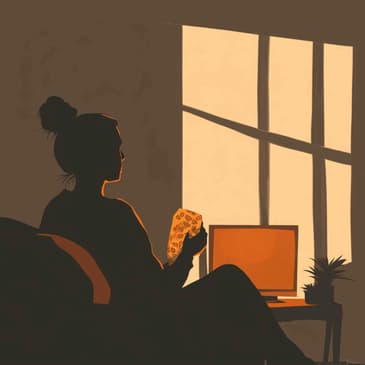
[00:03:23] I was handling those feelings by polishing off a big bag of Ruffles potato chips.
[00:03:28] As he got closer, he could see that I was frantically reaching into the bottom of the bag,
[00:03:33] trying to get the crumbs stuck to my fingers so I could lick them off.
[00:03:36] Dried tears were on my face.
[00:03:38] Some talk show blared on the TV.
[00:03:41] All he kindly said after looking at me and the empty bag in my hand was,
[00:03:45] Do you want another one?
[00:03:46] No shaming.
[00:03:48] No laughter.
[00:03:49] Just empathy.
[00:03:50] I knew I'd married the right person.
[00:03:53] These two events, one couched in the development of an actual eating disorder,
[00:03:58] the other, the seeking of comfort through eating, have stuck in my mind for years.
[00:04:02] What did eating mean at those times?
[00:04:06] What's the difference between binge eating and comfort eating?
[00:04:09] It's important to recognize the difference between an actual eating disorder,
[00:04:13] such as binge eating and plain old comfort eating.
[00:04:16] The first is a mental illness that tends to begin in adolescence and young adulthood.
[00:04:21] The two major characteristics of binge eating are eating in a fairly short period of time
[00:04:26] a much larger amount of food than what most people would eat,
[00:04:30] and a lack of control over that eating.
[00:04:33] It doesn't feel like a choice.
[00:04:35] It's a compulsion.
[00:04:36] But it can be triggered by emotions.
[00:04:39] Studies show that close to half of those who binge eat have a history of depression.
[00:04:43] There are also links to anxiety, impulsive behavior, and other mental health struggles.
[00:04:49] My friend, Dr. Amy Scheinberg, who specializes in eating disorders, tells us,
[00:04:54] quote,
[00:04:54] Each are generally associated with a trigger,
[00:04:57] but a binge suggests a compulsive need to eat large quantities of food,
[00:05:01] not necessarily comfort foods, but foods that are generally labeled red light foods,
[00:05:06] in a discrete period of time.
[00:05:08] Soothing might be a sought-after effect of a binge,
[00:05:11] but binging can also be associated with other effects, including self-punishment.
[00:05:16] Comfort eating, while not a clinical term,
[00:05:19] is almost exclusively for self-soothing.
[00:05:22] Foods chosen are generally associated with past memories that are recalled with fondness.
[00:05:27] There is no defined pace, and in fact,
[00:05:29] the food consumed may be eaten in normal portions.
[00:05:33] End quote.
[00:05:34] So, it sounds like comfort eating, if it happens once in a while, isn't a problem.
[00:05:39] Having chocolate meringue pie for breakfast can seem like a great idea if you're in a funk.
[00:05:44] But there are things to be aware of,
[00:05:46] and how you know the comfort you find in food is just that,
[00:05:51] temporary comfort.
[00:05:52] Be careful if you eat when you're not hungry,
[00:05:55] if you eat when you're bored or lonely,
[00:05:58] if eating takes the place of feeling your emotions,
[00:06:01] if you don't know how to comfort yourself in any other way,
[00:06:04] or if shame over your body causes you to want to punish yourself by eating more.
[00:06:11] So, what can I do about it?
[00:06:14] 1. Eating when you're not hungry
[00:06:17] Ask yourself the question,
[00:06:18] Am I really hungry?
[00:06:19] And if so, what am I hungry for?
[00:06:22] Research shows, for example, that often when we're feeling hungry,
[00:06:26] we're actually thirsty,
[00:06:27] and not in need of food at all.
[00:06:30] Getting in tune with what you're hungry for
[00:06:32] lends intentionality to eating.
[00:06:35] I'm hungry for something really fresh-tasting
[00:06:37] can feel very different than
[00:06:39] I'm hungry for anything.
[00:06:41] Do I want one Hershey's Kiss,
[00:06:42] or do I need 15 Hershey's Kisses?
[00:06:45] Going to a nutrition expert,
[00:06:47] like a registered dietitian,
[00:06:48] can help you figure out your relationship with different foods.
[00:06:52] 2. Eating when you're bored or lonely
[00:06:55] Food can act as a friend.
[00:06:57] It's there when you need it.
[00:06:58] But it's not.
[00:06:59] Not really.
[00:07:01] The more we isolate and hover over iPads,
[00:07:03] the more food may be acting as our hangout buddy.
[00:07:06] Reach out to a real person instead,
[00:07:08] and it will be much more rewarding.
[00:07:11] 3. Eating to distract from or avoid painful emotions
[00:07:16] Grief, sadness, guilt, anger, disappointment, humiliation.
[00:07:22] None of these emotions are easy to feel.
[00:07:24] Yet, the more you avoid them,
[00:07:26] the stronger they can become.
[00:07:28] And quite literally,
[00:07:29] stuffing down emotions can morph into a destructive cycle.
[00:07:32] You have to eat more to handle the growing feelings.
[00:07:35] But you can choose to stop that cycle.
[00:07:38] Journal.
[00:07:39] Go to therapy.
[00:07:40] Talk to a friend.
[00:07:42] Sit with the feelings.
[00:07:43] Cry.
[00:07:44] Vent.
[00:07:45] Chop wood.
[00:07:46] Scream.
[00:07:47] Do anything that will help that's not self-destructive
[00:07:49] or hurts someone else.
[00:07:52] 4. Eating because you don't know how to comfort yourself in another way.
[00:07:57] Try other ways of comforting yourself.
[00:08:00] Read.
[00:08:00] Walk.
[00:08:01] Watch an old movie.
[00:08:03] Talk.
[00:08:04] Stretch.
[00:08:05] Meditate.
[00:08:06] Laugh.
[00:08:07] Paint.
[00:08:08] Exercise.
[00:08:09] Write.
[00:08:10] Do something else that helps you feel better.
[00:08:13] And 5. Eating because you're ashamed of or even hate your body,
[00:08:17] so it's punishment.
[00:08:19] Self-acceptance is paramount to good mental health.
[00:08:22] It's not resignation.
[00:08:23] It's accepting yourself as you are,
[00:08:25] where you are,
[00:08:26] and how you got there.
[00:08:27] It's practicing self-compassion.
[00:08:29] The best way you can grow and change
[00:08:31] is to acknowledge where you are.
[00:08:34] Shame and hatred will only serve as a hurdle
[00:08:37] rather than some kind of self-punitive motivation.
[00:08:40] So, what can you actually do about this shame?
[00:08:44] Be aware of how loudly and how often
[00:08:47] you're hearing that inner voice of shame.
[00:08:49] The more you're open about the size you are
[00:08:51] or try to make friends that don't body shame
[00:08:53] but support each other,
[00:08:55] then you can make positive moves
[00:08:57] towards self-acceptance.
[00:09:02] You just listened to the post titled
[00:09:04] Is Eating for Comfort Okay?
[00:09:06] by Dr. Margaret Rutherford
[00:09:08] of drmargaretrutherford.com
[00:09:10] and I'll be right back with my commentary.
[00:09:12] While we can't control every aspect
[00:09:15] of our future health,
[00:09:16] we can be proactive about it.
[00:09:18] That's why I'm excited about my experience
[00:09:20] with 23andMePlus Total Health.
[00:09:22] This isn't just another health service.
[00:09:25] It's a comprehensive longevity platform
[00:09:27] that gives you insights
[00:09:28] you typically wouldn't get
[00:09:30] from traditional healthcare.
[00:09:31] I recently joined
[00:09:33] and what excites me most
[00:09:34] is how it combines advanced genetic screening
[00:09:36] with regular blood testing
[00:09:38] throughout the year.
[00:09:39] What sets this apart
[00:09:40] is having clinicians
[00:09:42] with specialized genetics training
[00:09:43] who help create
[00:09:45] a personalized preventive health plan.
[00:09:47] I'm particularly fascinated
[00:09:48] by their biological age feature
[00:09:50] which tells you how old you really are
[00:09:53] based on your internal biomarkers.
[00:09:55] And the best part?
[00:09:56] Unlike your calendar age,
[00:09:57] this number could actually decrease
[00:10:00] with lifestyle changes.
[00:10:01] So advocate for your health today.
[00:10:04] Go to 23andMe.com
[00:10:07] slash OHD
[00:10:08] for your limited time offer.
[00:10:10] That's 23andMe.com
[00:10:13] slash OHD.
[00:10:16] Dr. Neil here for my commentary.
[00:10:18] In a previous life,
[00:10:20] I was a health educator
[00:10:21] for a large hospital
[00:10:22] out here in California.
[00:10:23] My job was to lead
[00:10:25] weight management classes.
[00:10:27] Many of my patients
[00:10:28] had the exact same issues
[00:10:29] that today's author,
[00:10:30] Dr. Rutherford,
[00:10:31] described like
[00:10:32] eating when they weren't
[00:10:33] really hungry,
[00:10:34] eating when they felt bored,
[00:10:36] lonely, or anxious,
[00:10:37] eating for comfort,
[00:10:38] or because
[00:10:39] they felt ashamed.
[00:10:41] And just as Dr. Rutherford suggested,
[00:10:43] I had patients pause
[00:10:45] before eating
[00:10:45] and ask themselves,
[00:10:47] am I eating right now
[00:10:48] because I'm actually hungry
[00:10:50] or for some other reason?
[00:10:52] Taking a moment to stop
[00:10:53] and ask this question
[00:10:54] forces us to bring awareness
[00:10:56] to our behavior.
[00:10:57] It forces us to be more mindful
[00:10:59] of what we're doing.
[00:11:00] But just stopping
[00:11:02] to ask ourselves
[00:11:03] whether we're actually hungry
[00:11:04] or not usually isn't enough
[00:11:06] to stop the behavior.
[00:11:07] After we've asked ourselves
[00:11:09] whether we're actually hungry
[00:11:10] or not,
[00:11:11] and if the answer is no,
[00:11:13] I'm not actually hungry,
[00:11:14] then the next step
[00:11:16] is to distract ourselves
[00:11:17] with something
[00:11:18] that's not food related.
[00:11:20] It could be anything,
[00:11:21] but the distraction
[00:11:22] tends to work best
[00:11:24] when again,
[00:11:24] it's not food related,
[00:11:25] it's something
[00:11:26] we actually enjoy,
[00:11:27] and it keeps our attention
[00:11:29] for at least 10 minutes.
[00:11:31] In fact,
[00:11:32] one study found
[00:11:33] that playing the game Tetris
[00:11:34] for just 3 minutes
[00:11:36] was enough
[00:11:36] to reduce food cravings.
[00:11:38] Now, of course,
[00:11:39] if Tetris isn't something
[00:11:40] you enjoy,
[00:11:41] that's okay.
[00:11:42] The key, again,
[00:11:43] is to find something
[00:11:44] you do like
[00:11:45] that's not food related.
[00:11:48] All right,
[00:11:49] that'll do it for today.
[00:11:50] Thank you so much
[00:11:50] for listening.
[00:11:51] Thank you for being
[00:11:51] a subscriber
[00:11:52] or follower of the show.
[00:11:54] I hope you have
[00:11:54] a great rest of your day
[00:11:55] and I'll see you
[00:11:56] back here tomorrow
[00:11:57] where your optimal life awaits.