



Discover all of the podcasts in our network, search for specific episodes, get the Optimal Living Daily workbook, and learn more at: OLDPodcast.com.
Episode 2788:
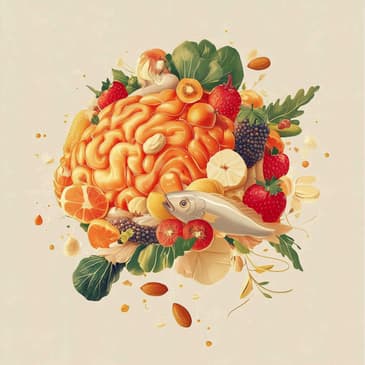
Discover how to enhance your cognitive function through dietary choices and supplements. Dr. Neal Malik explores the benefits of omega-3 fatty acids, antioxidants, caffeine, and the Mediterranean diet in supporting brain health. Learn practical tips to incorporate these elements into your daily routine for improved mental clarity and focus.
Quotes to ponder:
"Your brain is one of the most energy-demanding organs, relying on quality nutrients to perform at its peak."
"Antioxidants, found in foods like blueberries and leafy greens, play a crucial role in protecting brain cells from oxidative stress."
"Omega-3 fatty acids are essential for maintaining the structure of brain cells and supporting neural communication."
Episode references:
Brain Health Research: https://www.ncbi.nlm.nih.gov/pmc/articles/PMC2805706
Learn more about your ad choices. Visit megaphone.fm/adchoices
[00:00:00] Brauchen wir wirklich noch einen Computer? Alle wahrscheinlich nicht. Aber wenn du Musik mit der Power eines Neuralprozessors neu erfindest oder unterwegs Migrationsmuster mit einem ganztägigen Akku analysierst oder deine Ideen mit dem KI-gesteuerten Co-Creator zum Leben erwächst, dann kann ein Co-Pilot Plus PC einen Unterschied machen. Nicht alle brauchen einen leistungsstärkeren KI-Computer. Aber wenn du versuchst, die Welt zu verändern, auch wenn es nur deine eigene ist, haben wir einen für dich entwickelt. Microsoft Co-Pilot Plus PC mit Snapdragon. Die bisher schnellsten und intelligentesten Windows PCs. Die Akkulaufzeit variiert hier nach Nutzung und Einstellungen.
[00:00:30] It's another Q&A edition of Optimal Health Daily and I'm Dr. Neal, your host of the show. Welcome back to another special Friday edition of Optimal Health Daily where I answer your questions. On the other days, I read health and fitness blogs to you like an audiobook, but on Fridays, it's my favorite day because I love answering your questions. Now the other day, I was at my doctor's office just for a regular checkup and he was going over my latest numbers and saying, your blood pressure is fantastic, your heart rate is great,
[00:00:59] but, and then he kind of pauses, I would like you to lose some weight. I was silent. I think that was the first time a doctor had ever told me that. I let it go, I didn't say anything, and so we moved on and eventually he started asking, so I forget, what do you do again? And I said, oh, I'm an assistant professor of nutrition and department chair.
[00:01:19] And he chuckled and goes, oh yeah, look at me, I'm telling the guy whose expertise is nutrition, I'm telling him to lose weight. And so that's where I pounced.
[00:01:28] I said, yeah, you know, I spend quite a bit of time at the gym and I've been lifting kind of heavy weights. And so he interrupted me at that point and goes, oh, so yeah, you probably got quite a bit of muscle and that's why your weight might be looking high to me.
[00:01:42] And I said, yeah, that's probably it. I've been checking to make sure my body fat percentage is within a healthy range and my waist and hip circumferences are looking good.
[00:01:50] And he kind of cut me off and said, okay, yeah, no worries. So basically the doc was just looking at my height, my weight, and then something called my body mass index, which is not always the most accurate indicator for how healthy your weight is.
[00:02:03] And so while medical doctors know a tremendous amount and I have the utmost respect for them, I have two medical doctors in my family, there are other experts who understand nutrition and fitness.
[00:02:15] Where medical doctors, depending on what their research is like, may not know as much about it.
[00:02:20] And so if you found that situation to be true for you and you have like a specific nutrition or stress management or fitness question, feel free to ask me.
[00:02:29] That's what I'm here for. That's my area of expertise.
[00:02:32] All right. I'm sure you're anxious to hear today's question and start optimizing your life.
[00:02:41] Hi, Dr. Malik. So I recently heard that eating certain foods can improve your brain health.
[00:02:47] Foods like blueberries, walnuts, avocado, turmeric, and coconut oil.
[00:02:54] Should I be looking to eat these certain foods in order to improve my memory, thinking speed, and focus?
[00:03:01] Or would eating an overall well-balanced diet of different fruits and vegetables work just as well?
[00:03:09] If you answer, I would very much appreciate it. Thank you.
[00:03:13] Thank you for your question, Buster.
[00:03:15] How does the saying go, you can't teach an old dog new tricks?
[00:03:19] Is there some truth to the idea that as we get older, we just aren't able to learn new things?
[00:03:24] We're finding that our brain's ability to process information definitely changes as we age.
[00:03:29] What's unique about us as human beings is that when we compare ourselves to our close animal cousins,
[00:03:35] our brain space has lots of room to learn.
[00:03:39] Compare our brains to that of a house cat, for example.
[00:03:42] Now, why a house cat, you may ask?
[00:03:44] Well, one of my cats just happened to jump onto my lap as I was writing this.
[00:03:48] So I took that as a sign to use them as an example.
[00:03:51] So not only is a house cat's brain much smaller than ours,
[00:03:54] much of the brain space is actually occupied by instinct.
[00:03:58] This means that cats have a limit to what they're able to learn and process.
[00:04:02] Now, part of this, of course, is based on the size of their brain,
[00:04:05] and certain brain structures are larger than others, but also instinct.
[00:04:09] The same is true for many other animals.
[00:04:12] Now, we as human beings aren't born with many instincts at all.
[00:04:15] This is why human babies require so much care and for such a long period of time.
[00:04:21] Domestic cats only need to be with their moms for, what, six weeks before they're good to go?
[00:04:25] But as human beings, we need time to learn how to interact with our environment.
[00:04:30] So we know that when we're young, our brains are very plastic.
[00:04:35] Meaning, instead of being taken up by all of this instinctual knowledge,
[00:04:38] there's lots of room to learn new things.
[00:04:41] But as we age, our brains aren't as plastic.
[00:04:44] Don't get me wrong, we can still learn new things.
[00:04:47] But things are kind of set in place.
[00:04:49] And we know that for most of us, the neurons in our brain,
[00:04:53] which are basically responsible for learning memory and processing information,
[00:04:57] start to shrink as we age.
[00:04:59] Some neurons may even die.
[00:05:01] If enough of them die, this may lead to dementia.
[00:05:04] If enough neurons die and the dementia is severe enough,
[00:05:07] the person may have what we call Alzheimer's disease.
[00:05:10] So back to your question, Buster.
[00:05:12] Are there things we can do to keep some of the brain's plasticity
[00:05:16] and prevent the death of these neurons?
[00:05:18] When we look at diet,
[00:05:20] there do appear to be some foods that may promote brain health.
[00:05:23] You mentioned some of this in your question.
[00:05:25] Foods like walnuts and berries, for example.
[00:05:28] Walnuts are a good source of a particular type of fat that the brain likes.
[00:05:32] These are omega-3 fats.
[00:05:34] When we look at what our brain neurons are made mostly of
[00:05:37] and what helps them function their best,
[00:05:39] it comes down to fat.
[00:05:41] The brain actually has a high concentration of omega-3 fatty acids.
[00:05:45] So it's possible that consuming enough of these fats throughout your life
[00:05:49] may help preserve brain function.
[00:05:51] The added benefit to consuming foods high in omega-3s
[00:05:54] is that they tend to reduce inflammation in the body.
[00:05:57] We're finding that chronic systemic inflammation,
[00:06:01] meaning the body is under stress for long periods of time,
[00:06:04] can damage the neurons in our brain.
[00:06:06] So by consuming foods high in omega-3 fats,
[00:06:10] you're supplying the brain with its favorite food
[00:06:12] and potentially reducing inflammation at the same time.
[00:06:16] So that means really any foods that are high in omega-3s
[00:06:19] can help promote brain health, not just walnuts.
[00:06:23] So some species of fish are great sources of these types of fats.
[00:06:27] Use the acronym SMASHED to help you remember
[00:06:30] those that are high in omega-3s.
[00:06:33] SMASHED is spelled S-M-A-S-H-T,
[00:06:38] where the first S stands for salmon,
[00:06:40] the M-Mackerel,
[00:06:42] A-anchovies,
[00:06:44] the second S-sardines,
[00:06:47] H-halibut,
[00:06:48] and T-trout.
[00:06:50] So those six fish in particular
[00:06:52] are good sources of omega-3s.
[00:06:54] And really, most nuts and seeds
[00:06:56] are also beneficial for brain health.
[00:06:59] This is because many nuts and seeds
[00:07:01] not only contain healthy fats like omega-3 fatty acids,
[00:07:04] but they're also a great source of vitamin E,
[00:07:06] which may prevent cognitive decline.
[00:07:08] So what's the deal with berries?
[00:07:10] Are they high in omega-3 fats?
[00:07:12] No.
[00:07:13] But they are loaded with
[00:07:15] inflammation-extinguishing compounds
[00:07:17] called antioxidants.
[00:07:19] Berries reduce systemic inflammation,
[00:07:22] which can preserve brain health.
[00:07:24] So let me pause for a second.
[00:07:25] In your question, Buster,
[00:07:27] you mentioned plant-based foods
[00:07:29] having the potential to keep your brain young and healthy.
[00:07:32] Many plant-based foods are full of antioxidants,
[00:07:35] which is why they may help preserve brain health.
[00:07:37] So yes, you're absolutely right.
[00:07:39] Plant-based foods in general
[00:07:41] are a great source of antioxidants,
[00:07:42] which can preserve brain health.
[00:07:45] Beans are another wonderful source of antioxidants.
[00:07:47] And as a bonus,
[00:07:49] they're also a wonderful source of fiber and protein.
[00:07:51] So really, it comes down to these antioxidants
[00:07:54] that are most critical.
[00:07:55] This is why you may also hear that
[00:07:56] tea and dark chocolate may help prevent dementia.
[00:07:59] Both are good sources of, guess what?
[00:08:02] Antioxidants.
[00:08:03] Now what about avocado and coconut oil?
[00:08:05] Avocado can help promote brain health
[00:08:08] because it keeps our heart and blood vessels healthy.
[00:08:11] Here's the deal.
[00:08:12] If your brain gets enough blood flow,
[00:08:14] but not too much, of course,
[00:08:16] then it supplies your brain cells
[00:08:18] with enough nutrients, like omega-3s,
[00:08:21] and oxygen to help keep them alive.
[00:08:23] The thing about coconut oil
[00:08:25] is that we're not sure what to think about it,
[00:08:27] pun intended.
[00:08:29] Coconut oil's nutrient profile
[00:08:30] is different from other plant-based foods,
[00:08:32] like avocado, and its nut and seeds cousins.
[00:08:36] Coconut is higher in saturated fat.
[00:08:38] Even though this type of saturated fat
[00:08:40] is coming from plant-based foods
[00:08:42] as opposed to meat or butter, let's say,
[00:08:44] there's still evidence that saturated fat in general
[00:08:47] can lead to more inflammation in the body.
[00:08:50] Plus, saturated fats may narrow our blood vessels,
[00:08:53] which means the brain gets less blood
[00:08:55] and as a result, less oxygen and fewer nutrients.
[00:08:58] Less oxygen and fewer nutrients means
[00:09:01] you're starving your neurons,
[00:09:02] which means they shrink and or die.
[00:09:05] Okay, so what's the bottom line here?
[00:09:07] Yes, nutrition does seem to play an important role
[00:09:10] when it comes to brain health.
[00:09:11] If you consume foods that are good sources
[00:09:14] of healthy fats, like omega-3s,
[00:09:16] and consume lots of plant-based foods
[00:09:18] which are full of antioxidants,
[00:09:20] you may be able to help protect your neurons
[00:09:22] and promote brain health.
[00:09:24] But foods high in those quote-unquote unhealthy fats,
[00:09:27] like trans fat and saturated fat,
[00:09:30] may cause damage to the neurons in our brains.
[00:09:32] There are other lifestyle behaviors
[00:09:34] that we need to consider too.
[00:09:36] We're finding that staying active,
[00:09:38] not only physically, but mentally and socially,
[00:09:41] are very important for preventing dementia
[00:09:43] and Alzheimer's.
[00:09:44] Moving your body through exercise
[00:09:46] promotes the health of the neurons in the brain
[00:09:48] and also reduces inflammation in the body.
[00:09:51] Challenging your brain with puzzles
[00:09:52] and learning new skills can also strengthen neurons.
[00:09:55] Visiting with friends and family
[00:09:57] can help stave off disease as well.
[00:09:59] Researchers are finding that meditation
[00:10:01] may also promote brain health.
[00:10:03] Now, it's important to note
[00:10:05] that none of the nutrients or foods I mentioned
[00:10:07] or the other lifestyle behaviors by themselves
[00:10:10] will prevent disease.
[00:10:11] It's really about combining all of these
[00:10:14] and performing them consistently
[00:10:16] that seems to be the most helpful.
[00:10:18] Even if you're not doing some of these things right now,
[00:10:21] pick one or two and that will still help.
[00:10:27] Thank you again so much for taking the time
[00:10:30] to send in your question, Buster.
[00:10:31] Now, if you want to submit a question
[00:10:33] to be answered right here on the show,
[00:10:35] plus get a copy of our workbook for free,
[00:10:38] you can email a question to health at oldpodcast.com.
[00:10:42] You can also call in your question.
[00:10:44] The number is country code 1-61-ILOVE-OHD.
[00:10:50] That's 1-614-568-3643.
[00:10:56] Or you can submit your audio question
[00:10:58] at oldpodcast.com slash ask.
[00:11:02] Right there on that page,
[00:11:04] it's really easy to send in your audio question
[00:11:07] and you can even do retakes before sending it in.
[00:11:10] Again, that's oldpodcast.com slash ask.
[00:11:14] All right, that's another Q&A edition
[00:11:16] of Optimal Health Daily.
[00:11:18] Thank you so much for listening every day
[00:11:20] and all the way through.
[00:11:21] And I'll see you back here over the weekend
[00:11:23] where your optimal life awaits.
[00:11:25] And if you want to hear me shiny and look at all.
[00:11:25] You can see the lights on the back.
[00:11:25] Thank you.