



Discover all of the podcasts in our network, search for specific episodes, get the Optimal Living Daily workbook, and learn more at: OLDPodcast.com.
Episode 2820:
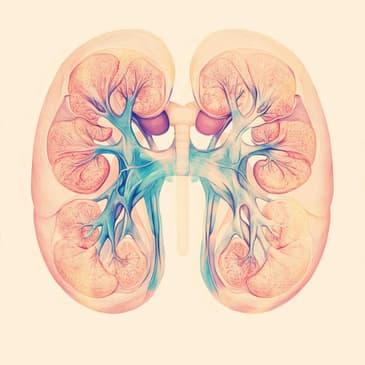
This article unpacks the debate over protein consumption, exploring how much is too much and its potential health effects. It addresses concerns about overloading the body, potential kidney stress, and the balance needed for optimal health, offering practical advice backed by science.
Quotes to ponder:
"Too much protein can strain the kidneys, especially for individuals with preexisting conditions."
"Protein is essential for muscle repair and growth, but balance is key to maintaining overall health."
"Overconsumption of any nutrient, even protein, can have unintended health consequences."
Episode references:
The Truth About Protein: https://www.healthline.com/nutrition/too-much-protein
Learn more about your ad choices. Visit megaphone.fm/adchoices
[00:00:00] It's another Q&A edition of Optimal Health Daily and I'm Dr. Neal, your host of the show.
[00:00:05] Hey there, hope you're having a wonderful Friday. Welcome to another Q&A edition of Optimal Health Daily where I answer your health questions.
[00:00:12] On the other days, I read health and fitness blogs to you kind of like an audiobook.
[00:00:16] And like I always say, nutrition, fitness, wellness, health, these are things I'm passionate about so I'm happy to share my knowledge with you.
[00:00:24] And with that, I'm sure you're curious to hear today's question so let's jump right in as we optimize your life.
[00:00:35] Hi, my name is Courtney. My question is for Dr. Neal regarding just health in general.
[00:00:42] If a person wants to lose a lot of weight, a lot of fat, exactly how much protein should that person be taking in?
[00:00:53] I've heard that you need to load up on protein. I've heard that you need to eat six, seven times a day.
[00:00:59] But what do you do if you A, want to have a more plant-based diet and B, either aren't hungry or don't have time to eat six or seven times a day?
[00:01:11] What are your opinions on that? And can that person still achieve a lot of fat loss without doing those things? Thank you.
[00:01:20] Thank you for your question, Courtney. Fat loss is definitely a tricky thing. There are so many mechanisms involved.
[00:01:26] This is probably why we still don't have the magic ingredient recipe or workout that guarantees fat loss.
[00:01:32] I'll start by talking about protein specifically. Now I'm going to use my psychic abilities and go out on a limb by saying chances are you're probably already consuming enough protein.
[00:01:42] How could I possibly know this? It's because there have been a lot of data collected on how much and what types of food populations around the world consume regularly.
[00:01:52] And what we've learned is that most consume plenty of protein each day.
[00:01:56] But how much protein do we need to support fat loss? Is there a magic number?
[00:02:01] Okay, let's say, Courtney, that you are relatively active and incorporate resistance training into your routine.
[00:02:07] The American College of Sports Medicine says that in this case, you need to consume between 1.2 and 1.7 grams of protein per kilogram of body weight.
[00:02:19] Now it's frustrating for those of us in the U.S. because their recommendations don't use ounces of protein and pounds of body weight.
[00:02:26] But luckily the math isn't too hard to get those conversions.
[00:02:29] We'll figure this out together. Stay with me here.
[00:02:32] So, Courtney, let's say you weigh 125 pounds.
[00:02:35] To use the American College of Sports Medicine's recommendations, we need to convert your weight from pounds to kilograms.
[00:02:43] Luckily, again, the math is simple.
[00:02:45] Take 125 pounds and divide that by 2.2.
[00:02:49] Now, even if you don't weigh 125 pounds, you would still divide your body weight in pounds, whatever it is, by 2.2.
[00:02:57] So, if someone weighed 150 pounds, divide 150 by 2.2.
[00:03:02] If you weigh 110 pounds, same thing.
[00:03:06] Divide 110 by, guess what, 2.2.
[00:03:09] So, that gives you your weight in kilograms.
[00:03:12] So, Courtney, we said you weigh, hypothetically, 125 pounds.
[00:03:16] So, 125 divide that by 2.2 is 56.82 kilograms.
[00:03:24] Okay, so now what?
[00:03:25] Well, now that we know this, we can figure out how much protein you need to consume each day.
[00:03:31] Now, like I mentioned before, the American College of Sports Medicine says if you're performing a good amount of resistance training,
[00:03:37] you need somewhere between 1.2 and 1.7 grams of protein per kilogram of body weight.
[00:03:44] Okay, so we know your hypothetical body weight in kilograms now.
[00:03:47] We just figured that out, and it's 56.82, assuming you weigh 125 pounds.
[00:03:53] So, now we take that 56.82, your body weight in kilograms, and multiply it by the American College of Sports Medicine's recommendations.
[00:04:02] So, we'll start by multiplying 56.82, body weight in kilograms, by 1.2 grams of protein.
[00:04:11] So, plug that into your calculator, and you get about 68 grams of protein.
[00:04:15] That means, at a minimum, you need to consume about 68 grams of protein each day to build strength and muscle.
[00:04:24] Now, let's find out how much you need to consume at a maximum.
[00:04:28] So, according to those recommendations, we'll again take your body weight in kilograms, 56.82, assuming you weigh 125 pounds,
[00:04:35] and then we're going to multiply it by that higher number, 1.7.
[00:04:38] Remember, the American College of Sports Medicine's recommendation said anywhere between 1.2 to 1.7 grams of protein should be consumed each day.
[00:04:47] So, now we're just using the higher number here.
[00:04:50] So, 56.82 times 1.7, break out that calculator, and you've got 97 grams of protein.
[00:04:57] So, if you, or really anyone else that weighs 125 pounds and is incorporating some resistance training,
[00:05:04] wants to be getting enough protein for muscle growth,
[00:05:07] you basically need to consume anywhere between 68 and 97 grams of protein per day.
[00:05:13] Whew, okay.
[00:05:14] We did that.
[00:05:15] Great.
[00:05:15] So, again, for those of us in the States, we still don't quite know how to make sense of grams either,
[00:05:21] so bear with us.
[00:05:23] 68 and 97 grams of protein is about a third to a half a cup of cooked chicken, for example.
[00:05:29] So, for someone who weighs 125 pounds and is moderately active doing resistance training,
[00:05:33] they need to eat about a half a cup of cooked chicken each day
[00:05:37] to make sure they're getting enough protein to build strength and muscle.
[00:05:41] Okay, that's not much, I know.
[00:05:43] Plus, this doesn't include any protein you're getting from other sources,
[00:05:47] like eggs, meat, dairy, beans, soy, breads, you name it.
[00:05:52] So, sadly, I'm not really psychic.
[00:05:54] I just know that most people get way more protein than that each day.
[00:05:58] So, how does this relate to fat loss?
[00:06:00] Some studies have found that if you consume more protein,
[00:06:03] more than what's often recommended,
[00:06:05] you may be more likely to lose body fat.
[00:06:08] Now, this may happen because protein helps us feel full,
[00:06:11] which can prevent us from eating too much and too often.
[00:06:14] So, consuming fewer calories consistently
[00:06:17] will definitely lead to weight loss and possibly fat loss.
[00:06:20] But here's the trouble.
[00:06:22] Just like carbs can get converted by the body to fat,
[00:06:25] so can protein.
[00:06:27] So, if we eat too much protein, like if we eat too much carbs,
[00:06:31] our bodies may convert it to body fat also.
[00:06:33] So, increasing protein intakes may not help with fat loss.
[00:06:38] Okay, so what about eating five to six times a day?
[00:06:40] This isn't necessary.
[00:06:42] Again, the theory here is that by eating more often,
[00:06:45] you will actually end up eating less in the long run.
[00:06:48] This is because you won't ever feel starving
[00:06:50] and have those binge eating moments.
[00:06:52] But the problem is,
[00:06:53] you may never really feel satisfied either.
[00:06:56] And as you mentioned,
[00:06:57] what if you're not really hungry, but it's time to eat?
[00:07:00] If you force yourself to eat when you're not really hungry,
[00:07:03] you could be hurting your progress.
[00:07:05] Plus, if you keep doing this behavior,
[00:07:07] you could end up developing a new bad habit,
[00:07:09] eating when you're not really hungry.
[00:07:10] So, what's the bottom line?
[00:07:13] First, getting enough protein is important for a number of reasons,
[00:07:16] not just fat loss.
[00:07:17] But you're probably consuming enough protein each day as it is.
[00:07:22] Consuming more may not lead to fat loss, but fat gain.
[00:07:25] So, if you want to support fat loss,
[00:07:28] consider focusing instead on watching calories,
[00:07:31] incorporating regular exercise,
[00:07:33] particularly resistance training,
[00:07:35] maybe even some high-intensity interval training.
[00:07:37] Then, do these things consistently.
[00:07:40] And in time, the fat will come off.
[00:07:43] You may notice that it starts coming off from the weirdest places,
[00:07:46] like your wrist.
[00:07:48] The watch you wear on your wrist may start to feel loose,
[00:07:51] but that's okay.
[00:07:51] It means it's working.
[00:07:53] Eventually, the body will turn to losing fat around the other areas,
[00:07:57] like the belly, hips, legs, and arms.
[00:07:59] Where your body first chooses to give up its fat stores is based on genetics.
[00:08:03] So, if it doesn't come off your hips as quickly as you'd like,
[00:08:07] you can blame your parents for that one.
[00:08:13] Thank you again for your question, Courtney.
[00:08:15] If you want to submit a question to be answered right here on the show,
[00:08:18] you can email your question to health at oldpodcast.com.
[00:08:23] And don't forget, you can also call in your question.
[00:08:26] The number is 61-ILOVE-OH-D.
[00:08:30] Or you can submit your audio question at oldpodcast.com slash ask.
[00:08:37] Thank you again so much for listening every day.
[00:08:39] Thank you for listening all the way through.
[00:08:41] Thank you for sharing this show with someone.
[00:08:42] And I'll see you back here over the weekend
[00:08:44] and where your optimal life awaits.
[00:08:47] brauch got Creek Habits.
[00:08:47] Do you know what?