



Discover all of the podcasts in our network, search for specific episodes, get the Optimal Living Daily workbook, and learn more at: OLDPodcast.com.
Episode 2824:
Leo Babauta explores the concept of reframing risk, emphasizing how our fears often exaggerate potential downsides while undervaluing the opportunities for growth and fulfillment. He offers practical insights into shifting your mindset to embrace challenges and step into a more expansive, courageous way of living.
Read along with the original article(s) here: https://zenhabits.net/unrisky/
Quotes to ponder:
"Risk isn’t as dangerous as our minds make it out to be."
"When we embrace risk, we open ourselves to a world of growth, adventure, and connection."
"The idea is to reframe risk into something that energizes us instead of holding us back."
Learn more about your ad choices. Visit megaphone.fm/adchoices
[00:00:00] This is Optimal Health Daily, The 8 Habits of Healthy Living by Leo Babauta of ZenHabits.net and I'm Dr. Neal, your host and narrator.
[00:00:09] Hello, very happy Monday to you. Welcome back to another week of Optimal Health Daily.
[00:00:14] This is where I read to you from some of the best health and fitness blogs on the web, kind of like an ongoing audiobook.
[00:00:20] So let's jump right in, get right to today's post as we optimize your life.
[00:00:25] The 8 Habits of Healthy Living by Leo Babauta of ZenHabits.net
[00:00:35] Quote,
[00:00:36] The art of living well and the art of dying well are one.
[00:00:40] Epicurus
[00:00:41] I don't have health insurance, so I have a big investment in staying healthy.
[00:00:45] And so I did a little research today.
[00:00:48] I found the top causes of death, then created a spreadsheet for the controllable risk factors for each.
[00:00:53] Some things can't be controlled, like your age, your family history of disease, gender, etc.
[00:00:59] But others can.
[00:01:01] And those things aren't a huge surprise.
[00:01:03] You already know not to smoke or drink too much or eat fully.
[00:01:07] It's interesting though, how all of the major diseases are caused by the same things.
[00:01:12] Smoking, diet, exercise, alcohol, and stress.
[00:01:16] So I'm going to list the top habits you can change and a simple method for changing them.
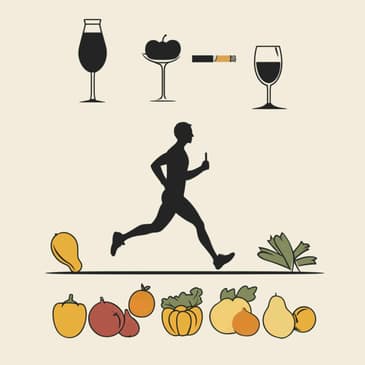
[00:01:22] The 8 Habits of Healthy Living
[00:01:25] Number 1.
[00:01:26] Stop Smoking
[00:01:27] This is by far the most important habit, as it affects almost every single one of the leading causes of death.
[00:01:33] It's also the hardest of these habits to change.
[00:01:36] It's not at all impossible.
[00:01:37] I quit 6 years ago next month.
[00:01:40] Tip number 2.
[00:01:41] Lose Weight if You're Overweight
[00:01:43] This is not exactly a habit.
[00:01:45] The best habit to form to lose weight is to eat less.
[00:01:48] Or eat more of the things that don't have a lot of calories, like fruits and veggies.
[00:01:53] Being overweight is just below smoking as the worst risk factor for many diseases.
[00:01:58] Tip number 3.
[00:02:00] Exercise
[00:02:01] You don't need me to tell you to exercise.
[00:02:03] But listen to this.
[00:02:04] Lack of exercise is a major risk factor for heart disease, stroke, colon and rectal cancers,
[00:02:10] diabetes, breast cancer, high blood pressure, and high cholesterol.
[00:02:15] If you don't exercise, you're just asking to get a major disease.
[00:02:19] It's almost a magic pill.
[00:02:21] Do a bit of exercise every day and you get healthy.
[00:02:24] You don't need much.
[00:02:25] Start with 5 minutes a day in the morning.
[00:02:28] Tip number 4.
[00:02:29] Drink Only in Moderation
[00:02:31] Heavy drinking is one of the worst risk factors for many diseases.
[00:02:35] That's more than two drinks of alcohol a day for men and more than one drink for women.
[00:02:40] A glass of red wine is a good thing, but too many and you're greatly increasing your risk
[00:02:44] for disease.
[00:02:46] Tip number 5.
[00:02:47] Cut Out Red and Processed Meats
[00:02:49] Eating red meats and processed meats like sausages, bacon, canned meats, and so on is a risk factor
[00:02:57] for colon and colorectal cancer, stomach cancer, and high cholesterol, which in turn is a leading
[00:03:03] risk factor for coronary artery disease and stroke.
[00:03:07] While this won't sit well with many people, the overwhelming mass of research supports this.
[00:03:12] Tip number 6.
[00:03:14] Eat Fruits and Veggies
[00:03:15] This is obvious, but it's amazing how few veggies most people eat.
[00:03:19] Eating fruits and veggies reduces your risk of several leading diseases, and it's one
[00:03:23] of the easiest habits to form.
[00:03:25] You can eat a salad without heavy dressings or bacon or other meats, croutons, or cheese
[00:03:30] if you can.
[00:03:31] Add veggies to soups or veggie chili, or cook up veggies as a healthy side dish with dinner
[00:03:36] or lunch.
[00:03:37] Eat fruits with breakfast and as snacks.
[00:03:40] Tip number 7.
[00:03:41] Reduce Salt and Saturated and Trans Fats
[00:03:44] Salt, saturated fat, and trans fat are in so many processed or prepared foods, and they
[00:03:52] increase risk for high blood pressure and high cholesterol, which then increase risk
[00:03:56] for heart disease and stroke.
[00:03:58] Despite what the Westin Price Foundation and other people on the internet tell you, saturated
[00:04:02] fat isn't healthy.
[00:04:04] Read the sources.
[00:04:05] Note that this isn't a controversy in the medical community, but the quote-unquote harmlessness
[00:04:10] of saturated fats is perpetuated by the dairy and meat industries, and laywriters like Gary
[00:04:16] Taub.
[00:04:17] Cook your own healthy meals instead of dining out or eating prepared foods.
[00:04:22] Tip number 8.
[00:04:23] Reduce Stress
[00:04:24] Stress is a risk factor for heart disease and high blood pressure, which is itself a risk
[00:04:29] factor for stroke.
[00:04:30] Smoke
[00:04:31] Simplify your workday so that you're not overly stressed and exercise to relieve that stress.
[00:04:37] How to form the habits
[00:04:38] This may seem like a lot to change if you're not already doing these things, but let me share
[00:04:44] something with you.
[00:04:44] I changed all of these in the last 6 years.
[00:04:48] In 2005, I was incredibly unhealthy.
[00:04:51] Then, I learned to change my habits.
[00:04:53] And slowly, I quit smoking, started running, became vegan, lost 70 pounds, cleaned up, and
[00:05:00] got rid of unhealthy stuff, simplified my life and reduced stress, and cut drinking down
[00:05:06] to 1-2 glasses of red wine per day.
[00:05:09] I did it, and so can you.
[00:05:11] I changed one habit at a time, slowly, in tiny, tiny steps, and it wasn't hard.
[00:05:18] Don't try to change everything, and don't make it hard on yourself.
[00:05:21] It's actually very easy if you're patient and if you just start.
[00:05:25] So, here's how to change these habits.
[00:05:28] 1. Change only one habit at a time.
[00:05:32] It doesn't matter which habit you choose.
[00:05:34] Just choose one.
[00:05:35] You'll want to do more than one, but don't.
[00:05:38] 2. Create positive habits you enjoy.
[00:05:42] I'm going to read that last word again.
[00:05:44] Enjoy.
[00:05:45] If you enjoy it, the habit change will be easy.
[00:05:49] Replace smoking with positive habits you enjoy that fulfill the needs that smoking now fulfills,
[00:05:54] like stress reduction, social lubrication, boredom relief, etc.
[00:05:59] Replace red meats with healthy foods you enjoy.
[00:06:03] 3. Start as small as possible.
[00:06:06] Just do 5 minutes the first week, and try to be consistent as much as possible.
[00:06:11] Then do 10 minutes.
[00:06:13] Small change is by far the most effective method I've used for changing habits.
[00:06:17] 1. Slow change lasts.
[00:06:20] And 4. Make it social.
[00:06:22] Find a partner or group to change the habit with you, so you're more likely to stick with it.
[00:06:28] These work.
[00:06:29] I've done them many times, and every time I stick to these principles, I've changed a habit.
[00:06:34] Healthy living isn't impossible, or even especially difficult.
[00:06:37] It's just slower to come by than most people care for.
[00:06:44] You just listened to the post titled, The 8 Habits of Healthy Living, by Leo Babauta of zenhabits.net,
[00:06:51] and I'll be right back with my commentary.
[00:06:54] Dr. Neil here for my commentary.
[00:06:56] All right, so I'm going to go on a quick tangent about saturated fats.
[00:06:59] My stance on that right now is that we need more research to know whether saturated fat is good for us.
[00:07:07] Okay, so listen to that one more time.
[00:07:09] I feel like I need more research to know whether saturated fat might be okay to consume.
[00:07:16] Because right now what we do have are over 600 studies, I believe, that basically show,
[00:07:23] with pretty solid quality evidence, that saturated fat, when consumed above the 10% of your calorie range,
[00:07:31] can lead to increased risk for disease.
[00:07:33] Because the way I look at it is this.
[00:07:35] It has the potential to cause harm, and getting rid of it wouldn't cause a whole lot of harm most likely,
[00:07:42] so why not just get rid of it?
[00:07:45] Do you see what I mean?
[00:07:46] So for me, it's risk-reward.
[00:07:48] I'd rather lower my intakes of saturated fat than roll the dice and see what might happen
[00:07:53] if I consume a lot of saturated fat for a while.
[00:07:56] Now a quick tangent about processed meats.
[00:07:59] First, yes, red meat and processed meats, those include sausages, bacon, cold cuts.
[00:08:05] Those kinds of things have been shown through lots and lots of good research
[00:08:10] to increase risk for certain types of cancer.
[00:08:13] In fact, there was a study published, oh, let's see, two weeks ago,
[00:08:16] that just confirmed that bacon does increase risk for cancer.
[00:08:20] Oh, and red meat does include pork.
[00:08:22] Even though it's called the other white meat, don't believe it, that's not true.
[00:08:26] The reason pork is classified as a red meat, even though if you were to look at it, it looks white,
[00:08:31] it's because of the way the body responds to it.
[00:08:35] So when a person consumes pork, the body responds to it kind of in the same way as it would to other red meats,
[00:08:41] like beef.
[00:08:42] And for lots of folks, what we're finding is red meat consumption and processed meat consumption
[00:08:48] increases systemic inflammation, which means it puts the body under some stress.
[00:08:53] More stress for long periods of time, meaning if you consume these foods for years and years,
[00:08:59] leads to increased risk for disease.
[00:09:01] So right now, I wouldn't necessarily say butter is back or bacon is back.
[00:09:06] Although I don't know if you could really say bacon is back.
[00:09:08] I don't know if it was ever really considered healthy.
[00:09:10] But you get my drift.
[00:09:12] If you like those foods, again, no need to completely cut them out.
[00:09:15] But I would say reduce your intake and you might achieve some of the benefits
[00:09:20] as opposed to putting yourself potentially at risk for disease.
[00:09:23] All right, that'll do it for me and for the Monday episode.
[00:09:26] I hope you have a great start to your week.
[00:09:28] I'll be back here tomorrow where your optimal life awaits.