



Discover all of the podcasts in our network, search for specific episodes, get the Optimal Living Daily workbook, and learn more at: OLDPodcast.com.
Episode 2884:
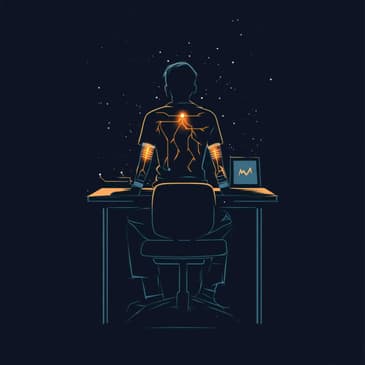
Electrical muscle stimulation (EMS) forces muscles to contract using electrical impulses, bypassing the brain’s natural signals. Dr. Neal Malik explores research showing that while EMS can increase muscle size, it doesn’t necessarily improve strength, and improper use may lead to injury. Since studies on combining EMS with exercise are still limited, traditional strength training remains the safer and more effective approach.
Quotes to ponder:
"Even though muscle size increased due to EMS treatment, the actual strength of the muscle didn’t improve."
"With EMS, it can be easy to overdo it like use too much electrical stimulation for too long or too often. This can then lead to muscle damage."
"Regular exercise that incorporates cardiovascular activities, strength training, and flexibility will probably lead to the best results."
Learn more about your ad choices. Visit megaphone.fm/adchoices
[00:00:00] Überlass deine gesunde Ernährung und die Gains nicht nur deinem Bauchgefühl. Denn bei der Ernährung gaukelt uns unser innerer Schweinehund manchmal ganz schön was vor. Sag stattdessen Hallo zu deinem neuen Coach, Yasio. Yasio ist die meistgenutzte Ernährungs-App Europas, made in Germany. Egal ob Massephase oder ein bisschen Abnehmen, tracke Kalorien, Proteine, Carbs, Fette, Bewegung und Intervallfasten. Und mit den Tasty-Rezepten bist du ready für deine Ziele. Let's go! Lade die Yasio-App jetzt herunter.
[00:00:30] It's another Q&A edition of Optimal Health Daily, and I'm Dr. Neal Malik. Hey there, happy Friday and welcome to another Q&A edition of Optimal Health Daily, where I answer your health questions related to fitness, diet and nutrition, and lots more. You send in the questions and I answer them for you. Oh, and if you do send one in, we'll physically mail you a copy of our hardcover workbook as long as you're in the U.S. and as long as we have some left. And if you're outside of the U.S., we'll email you a digital version.
[00:00:59] I'll tell you how to send in a question at the end of the show, but for now, let's hear today's question as we optimize your life. Today's question came via email. Bonnie writes, Hello Dr. Neal, what do you know about combining electrical muscle stimulation, or EMS, with exercise? There's a gym nearby offering this service and I would love your opinion on it. Thank you for taking the time to send in your question, Bonnie.
[00:01:28] Whenever I think of electrical muscle stimulation, or EMS, I think of Bruce Lee. Yes, the Bruce Lee. There's a scene from one of my favorite movies, Dragon, the Bruce Lee story, where the actor playing Bruce Lee is sitting at a typewriter. Now, while sitting at the typewriter, he's wearing these thick bands that have electrodes attached to them.
[00:01:49] The electrodes on these bands are attached to his chest and arms, and the purpose is for them to send electrical impulses to those areas of his body. And these electrical impulses will cause his muscles to contract. So, instead of Bruce Lee having to use his own energy to flex and contract his chest and bicep muscles, by sending electrical impulses through the skin, the muscles would contract on their own. Hence the term, electrical muscle stimulation, or EMS.
[00:02:19] And since I'm a huge nerd, and sat and listened to the audio commentary by the film's director, Rob Cohen, I learned that Bruce Lee would actually use this form of electrical muscle stimulation, believing it would help increase the size, strength, and endurance of his muscles. But does it actually do those things? To understand this question, we first have to get a bit of background about how EMS works. When the electrodes from an EMS machine force the muscles to contract,
[00:02:47] it's essentially bypassing the brain. Meaning, instead of our brain telling the muscles they need to contract, the machine is doing the thinking for us. Now, this isn't a problem. In fact, some health professionals see this as an advantage. By bypassing the brain, EMS may cause larger, faster motor units within the muscles to grow more efficiently. In turn, this may lead to stronger muscles in less time and with less training.
[00:03:14] In fact, EMS has been used in clinical settings for years to help those that are unable to exercise maintain some muscle. In fact, a recent meta-analysis looked at whether EMS increased muscle size and strength among otherwise healthy adults. The authors found that EMS actually did increase muscle size. But here was the weird thing. Even though muscle size increased in response to EMS treatment,
[00:03:42] the actual strength of the muscles didn't improve. So, it's like the muscles got bigger, but they were just for show. They didn't help participants lift heavier weights. The authors also went on to say that since there were so many different ways EMS has been used in previously published studies, it's hard to know how long EMS treatment should be used for. Plus, the strength of the electrical impulses can change.
[00:04:08] So, we don't really know how intense the electrode settings should be. Let's think of it this way. When we exercise, we always want to progress slowly. For example, after not exercising for years, we wouldn't suddenly step outside and run a marathon. Or, we wouldn't try and pick up 135 pounds and lift it over our heads. These might be goals we would set for ourselves, but we would take gradual steps to get there.
[00:04:35] With EMS, it can be easy to overdo it, like use too much electrical stimulation for too long or too often. This can then lead to actual muscle damage. For example, should EMS be used every day? Or should we treat it like high-intensity vigorous exercise and only use it three times per week? Researchers still don't know the answers to these questions. In fact, the Food and Drug Administration here in the US
[00:05:03] is responsible for regulating the safety of EMS products. The only EMS products the FDA has approved are those used by health professionals for physical therapy or rehabilitation. Some EMS machines that have been sold and not approved by the FDA have led to injuries. There have been reports of users getting shocked, burned, and bruised after using them. And, of course, if someone has a heart pacemaker, let's say, they definitely shouldn't use EMS devices.
[00:05:32] So, back to your question, Bonnie, what about combining EMS with exercise? Well, it's too early to know whether that's effective because scientists haven't studied the combination of EMS with exercise for long enough. But, given what we do know about the effects of EMS, combining exercise with EMS could lead to more definition and larger muscles over time. But, the trick is finding the right dose of EMS to support those goals
[00:06:02] and, of course, finding a machine that's FDA approved. In the meantime, regular exercise that incorporates cardiovascular activities, strength training, and flexibility will probably lead to the best results. Thank you so much again for taking the time to send in your question, Bonnie. Answering listener questions is one of my favorite parts of the show. And if you want to send in a question, remember, you'll get a physical copy
[00:06:31] of our workbook mailed to you, if you're in the U.S., and as long as we still have some available. You can email your question to health at oldpodcast.com Or, if you want your voice played on the show, come by oldpodcast.com You can record your question straight from your computer's microphone. You can even play back your message and do retakes before sending it in. Or, you can call in your question. The number is 1-61-ILOVE-OHD
[00:07:00] That's 1-614-568-3643 Thank you so much again for sending your questions in. But that'll do it for another Q&A edition of Optimal Health Daily. Thank you so much for listening every day and all the way through. I hope you have a great start to your weekend. And I'll see you back here tomorrow where your optimal life awaits.