



Discover all of the podcasts in our network, search for specific episodes, get the Optimal Living Daily workbook, and learn more at: OLDPodcast.com.
Episode 2925:
Riley Pearce explains how upper crossed syndrome, a common postural issue from prolonged desk work, leads to muscle imbalances, chronic pain, and even nerve issues. She outlines a structured exercise program to restore proper alignment and mobility. Pearce also highlights the increased protein needs of aging adults, showing how a moderate boost in protein intake, especially when paired with resistance training, can help maintain muscle mass, strength, and overall health.
Read along with the original article(s) here: https://freeformfitness.ca/upper-crossed-syndrome/ & https://freeformfitness.ca/protein-as-you-age/
Quotes to ponder:
"Over time, this will cause your mid-back and shoulders and your neck flexors to weaken, while your traps and pecs become overactive and tight."
"In order to maintain muscle mass, you have to be eating adequate protein."
"Older adults who were eating 1.0 - 1.3g/kg of body weight had a greater resistance to developing weaknesses and physical disability."
Learn more about your ad choices. Visit megaphone.fm/adchoices
[00:00:00] This is Optimal Health Daily, Upper Crossed Syndrome, Why You Need To Fix This Before It's Too Late by Riley Pearce, and How Much Protein Do You Really Need As You Age by Ashley Laurie, both of Freeformfitness.ca. And I'm Dr. Neal, your host and narrator. Hey there, welcome to another Saturday edition of Optimal Health Daily. This is just one of a bunch of podcasts where we read to you from blogs for free so that you don't have to read them yourself.
[00:00:29] Now on Fridays, like yesterday, I do something a little different. I answer your questions. Oh, and don't forget, we have a bunch of other shows where we narrate blogs for you. Just search for Optimal Living Daily wherever you're hearing this. Now today, I have two posts for you. And I usually do this when the posts are a bit on the shorter side. You've probably come to expect this show will last, oh, about 10 minutes or so.
[00:00:53] But when the posts are extra short, this would only last maybe five minutes. So on those days, I like to read you two posts to really make sure we get the most out of our time together. So with that, let's get right to them and start optimizing your life. Upper Crossed Syndrome. Why You Need to Fix This Before It's Too Late by Riley Pierce of FreeformFitness.ca
[00:01:20] You may have accepted the fact that your neck and shoulders are sore. You sit at a desk at work all day and the aches and pains are just part of aging, right? Wrong. Those aches and pains are likely caused by something known as Upper Crossed Syndrome or UCS. In the following article, we'll break down what Upper Crossed Syndrome is, how it could impact your health in the long term, and of course, we provide you with ways to correct it. Keep listening to learn more.
[00:01:50] What is Upper Crossed Syndrome? The human body was made to adapt. It's always finding ways to conserve energy by adapting to training, changes in the environment, and changes to our daily routines. Working at a desk for 7-9 hours out of your day is one of these routines that the body adapts to. Unfortunately, the adaptations have negative consequences for your shoulder health, among other things.
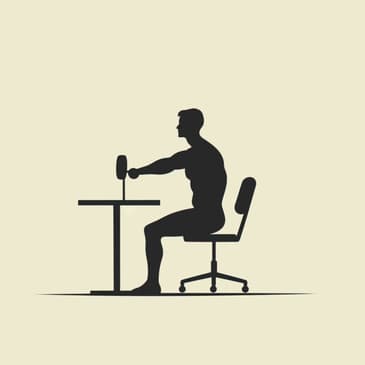
[00:02:17] As you sit at your desk, your hands are in front of you with your head slightly tilted downwards and your chin forward. And your neck is also stretched forward. Over time, this will cause your mid-back and shoulders and your neck flexors to weaken, while your traps and pecs become overactive and tight. What are the side effects of Upper Crossed Syndrome?
[00:02:40] As the body becomes more misaligned with Upper Crossed Syndrome, the functionality of this area of the body worsens. Your posture will slowly change, and your head will be positioned ahead of the shoulders from a side view perspective. Your shoulders will be rounded forward and down, and your upper back hunched. The imbalances from this type of altered posture will then cause headaches, limited range of motion in the shoulders,
[00:03:07] and in some cases can cause tingling and neuropathies in the upper arm. And of course, you will experience chronic pain in the neck and shoulders. If untreated, Upper Crossed Syndrome can lead to chronic shoulder issues, and can result in lost work time and an inability to complete regular daily tasks, such as lifting things above your head, and even sleeping comfortably. How to correct Upper Crossed Syndrome
[00:03:33] If you are experiencing symptoms of Upper Crossed Syndrome, there is a way to correct it. In a study published in the Scientific Reports Journal, they found that a comprehensive corrective exercise program was effective at improving the mobility of participants with Upper Crossed Syndrome. Now there are three phases to the program, and the initial phase focuses on simple movements that help reconnect the participant with the weakened muscles while relaxing tight muscles.
[00:04:02] Here's a breakdown of the initial phase exercises from the study. Lay on your back on a foam roller, and for exercise 1, use 3 different arm abduction angles. Exercise 2, perform a side-lying external rotation. Exercise 3, perform a side-lying forward flexion. Exercise 4, perform a standing diagonal flexion.
[00:04:29] And exercise 5, perform military presses. Once you've regained the mind-to-muscle connection with your weakened muscles, meaning your mid-back, shoulder, and deep neck flexors, you can move on to strengthening those weakened muscles. Summary Upper Crossed Syndrome is a common misalignment of the shoulders, neck, and head. This posture deviation leads to pain in the neck and shoulders, and can lead to headaches and even neuropathies in the upper arm.
[00:04:58] Upper Crossed Syndrome can be corrected with a multiple-phase approach of corrective exercises known as the Comprehensive Corrective Exercise Program. How Much Protein Do You Really Need As You Age? By Ashley Laurie of Freeformfitness.ca There are many changes that you can expect as you age. A long life takes a toll on the body, untrained muscles get weaker,
[00:05:27] bones become more fragile, and our ability to absorb nutrients decreases. All of this means that, as you age, you need to be paying attention to your nutrient intake to make sure you are getting enough to keep you active. In this article, we are going to highlight the importance of getting enough protein as you age and how it can impact your overall strength, independence, and health. What Does Protein Do? Protein is one of three major macronutrients,
[00:05:55] the other two consisting of carbohydrates and fats. A macronutrient is something that must be consumed in larger quantities in order to maintain a healthy body. Now, protein serves many important functions. Protein is involved in many structural elements of the body, such as the hair, teeth, skin, nails, bones, and muscles. Now, protein also plays a part in our metabolism, allowing reactions to occur. It also repairs and rebuilds cells,
[00:06:24] and can even be used for energy in extreme circumstances. Protein is so important for maintaining good health, yet it's the one nutrient that older adults have the hardest time getting enough of. So, what happens when you don't get enough protein? Protein Deficiency Now, the good news is that protein deficiency is very rare, actually extremely rare in the Western world. Now, because protein plays an important role in so many critical functions,
[00:06:52] we're built with multiple backup plans. Amino acids are the building blocks of proteins. Now, there are 20 amino acids, nine of which are essential because we cannot produce them ourselves. However, in the case of a low-protein diet, our body has ways to take incomplete proteins and make them complete by recycling amino acids. Now, there are a few ways that the body will tell you that it needs more protein. For example, if you're having a hard time
[00:07:21] recovering quickly after a workout, it could be because you haven't given your body adequate protein to rebuild the muscles. Or, if your skin, hair, and nails feel brittle or dry. Or, if you experience mental fog. You may also experience swelling of the hands, ankles, and feet, along with food cravings and poor sleep. Now, if you want to avoid this, consume the recommended daily protein intake, which is 0.8 grams of protein
[00:07:50] per kilogram body weight, or about 10 to 35% of your total daily caloric intake. Now, does this cover the needs for the older population? Protein needs as you age. Now, there are two sides to understanding how much protein is required as you age. The first is that your body is going to get rid of energy-expensive tissues first. It takes a lot to maintain muscles, which is why muscle mass decreases significantly in the older population.
[00:08:21] In order to maintain muscle mass, you have to be eating adequate protein. Now, the other side of this is, if you continue to do resistance training as you age, which is highly encouraged, you will need more protein to fuel the recovery process after your workouts. So, how much do you need? Now, in a small study of 10 participants, researchers found that the decrease in nitrogen excretion in urine and the decrease in mid-thigh size
[00:08:51] could possibly mean that the 0.8 grams of protein per kilogram of body weight per day may not be enough for older adults. In a slightly larger study of 29 participants, researchers tested the adequacy of protein and the efficacy of lower body versus full body resistance training. The researchers found that there was a decrease in body weight and mid-thigh size. So, they also concluded
[00:09:19] that this 0.8 grams of protein per kilogram of body weight per day may not be enough for the aging population. So, how much has been observed to be enough? In a study of almost 800 participants, researchers found that older adults who consumed slightly more than the recommended amount saw improvements in their muscle health. More specifically, they saw that older adults who were eating 1 to 1.3 grams of protein
[00:09:48] per kilogram of body weight per day had a greater resistance to developing weaknesses and physical disabilities. As we age, there are increasing limitations on nutrient absorption. So, increasing protein intake may help offset that. Plus, everything starts to slow down and that means systems within the body that absorb proteins have lost some of their efficiency. This is why slightly more protein may be required as you age.
[00:10:19] You just listened to the post titled Upper Cross Syndrome Why You Need to Fix This Before It's Too Late by Riley Pierce and How Much Protein Do You Really Need As You Age by Ashley Laurie both of FreeformFitness.ca Then I'll be right back with my commentary. Dr. Neil here for my commentary. I want to comment specifically on the protein recommendations for older adults. The nutrient needs of older adults is something that I don't discuss all that often
[00:10:48] but it's really important. So, it's true that as we age our muscle mass decreases. All of the studies I have seen have concluded that loss of muscle mass as we age is a problem. What that means is loss of muscle mass can lead to balance issues, increased risk of falls, poorer protection from illness, poorer recovery from illnesses, and the list goes on and on. So, researchers have ramped up their studies in older adults to see is there a way
[00:11:18] to slow this process down as we age? And it turns out resistance training along with a slight increase in daily protein consumption can help. The resistance training is helpful for lots of reasons. I mean, for one, it creates a demand for that extra protein which means that we force our muscles to grow larger through resistance training and then the body is more likely to divert that extra protein we eat to those muscles to help repair them. Plus, as an added bonus,
[00:11:48] resistance training can help maintain balance and coordination as we age too. There have also been studies that have shown creatine supplementation in both older men and women when combined with resistance training may preserve muscle too. Now, this doesn't mean every older adult that lifts weights should be supplementing with creatine, but it just supports this idea that slightly more protein as we age may be beneficial. Either way, this topic
[00:12:17] is a great conversation starter the next time you speak with your doctor. Alright, that'll do it for today. Thank you so much for listening. Thank you for subscribing to this show. If you want to keep the show going, one of the best things you can do is to share this episode with someone. So I thank you so much in advance for doing that. I hope you have a great rest of your day and I'll see you back here tomorrow where your optimal life awaits.