



Discover all of the podcasts in our network, search for specific episodes, get the Optimal Living Daily workbook, and learn more at: OLDPodcast.com.
Episode 3374:
Chris Reining explains how human nature pushes investors to follow the herd, leading to poor decisions like selling low and buying high. Drawing on insights from Warren Buffett and Benjamin Graham, he shows that real success comes from acting against the crowd and staying rational during market chaos. Understanding this mindset shift can help you turn volatility into opportunity.
Read along with the original article(s) here: https://chrisreining.com/herd/
Quotes to ponder:
"It’s mostly nonsense, because don’t you think if analysts, economists, or strategists knew where the market was headed they’d be investing for themselves instead of working for a salary?"
“Make the market your servant, not your master.”
"But if you want to make the most money investing you need to do what most people can’t do: buy when everyone else panics and sells."
Learn more about your ad choices. Visit megaphone.fm/adchoices
[00:00:00] Sierra has all the best active and outdoor brands for the super athletic stuff, like running gear for cruising up the trail. Woo! And the super athletic-ish stuff, like fishing gear for chilling by the creek. Nice cast. Fitness apparel to push for higher reps. You got this! And golf balls priced so you can afford to lose one. Or a few. Head to Sierra or Sierra.com for the brands you want at the prices that let you do it all. From athletic to athletic-ish, Sierra's got it.
[00:00:30] Enjoy more ways to save at Fred Meyer like low prices in every aisle. And when you download the Fred Meyer app, you can clip and save more with digital coupons every week. Plus, you can earn fuel points to save up to $1 per gallon at the pump. At Fred Meyer, you can enjoy more ways to save and more rewards every time you shop. So it's always easy to save big every day with savings and rewards. Fred Meyer. Fresh for everyone. Savings may vary by state. Fuel restrictions apply. See site for details.
[00:01:00] This is Optimal Health Daily. The market heard is human nature. By Chris Reining of chrisreining.com. And I'm Dr. Neal Malik. Hello and welcome back to our Sunday bonus episode. This is where I share an episode from another podcast in our network. And today's comes from Optimal Finance Daily. You can find that show wherever you're listening to this. Diana covers saving, investing, and earning more every day of the week.
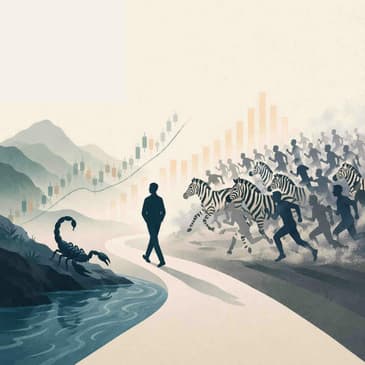
[00:01:26] So with that, here's Diana reading for you and her commentary as we optimize your life. The market heard is human nature by Chris Reining of chrisreining.com. A scorpion asks a frog to carry it across a river. The frog hesitates, afraid of being stung. But the scorpion argues that if it did so, they would both drown. Considering this, the frog agrees.
[00:01:56] But midway across the river, the scorpion does indeed sting the frog, dooming them both. While drowning, the frog cries, but why? Replies the scorpion, it's in my nature. Just like the scorpion, it's in our nature to do what humans do. For one, we obsess about low probability events and take risks on the high probability ones. Like being terrified to fly on an airplane, but not wearing a seatbelt when driving a car.
[00:02:27] Getting out of the stock market when it falls and getting back in when it rises. Most people might not know it at the time, but that strategy, selling low and buying high, isn't the best way to invest and make money. Making matters worse, the financial news media lines up so-called experts to make predictions about the market. It's mostly nonsense, because don't you think if analysts, economists, or strategists knew where the market was headed, they'd be investing for themselves instead of working for a salary?
[00:02:55] It's extremely difficult to know what the market will do. Often impossible. So what happens is people listen to all the pundits, look around what everyone else is doing, and just do that. I don't know much about this. They know more than I do, so why shouldn't I follow them? Now from an evolutionary standpoint, following the herd makes sense. That lone zebra grazing out there on the grasslands is an easy meal for the lion. But if it stays with the group, it survives.
[00:03:23] That safety in numbers thing. And this herd behavior you've seen in countless nature documentaries is how people behave in the market. They panic and sell because everyone is panicking and selling. Also, what fuels this behavior during drawdowns is the fact that stocks are liquid assets. They can be bought and sold with the click of a mouse. Look, you wouldn't sell your house if some real estate database said the price fell 10%. So why sell stocks if the market says the same thing?
[00:03:53] The more you think about this, the more it makes sense. First of all, you have the constant media coverage of the market. And secondly, that market is continuously nagging you to do business with it. Which reminds me of the story Warren Buffett told about buying a 400-acre farm north of Omaha, Nebraska. If a moody fellow with a farm bordering my property yelled out a price every day at me, which he would either buy my farm or sell me his,
[00:04:21] and those prices varied wildly over short periods of time depending on his mental state, how in the world could I be other than benefited by his erratic behavior? If his daily shoutout was ridiculously low and I had some spare cash, I would buy his farm. What he's saying is, when the market falls, it provides an opportunity for the long-term investor. Buffett's mentor, Benjamin Graham, got this right when he said, make the market your servant, not your master.
[00:04:50] The truth is, making the market serve you means exploiting human nature. That's how to make the most money investing. And isn't that the whole point? To make money? So when everyone is panicking and selling, you run against the herd and buy. Of course, this is easier said than done. Plus, it's hard to explain what it's like. You need to experience it firsthand. Maybe an example would help.
[00:05:14] In 2006, before the recession, I took a small stake in Starbucks at $19.12 per share. At the time, it was trading at a high valuation. The price-to-earnings ratio was 53. Two years later, during the recession, I bought more shares, but this time at $9.04. The price-to-earnings ratio was 21. Better price, better value. It wasn't long before the share price dropped under $5.
[00:05:44] Sitting there watching your $19 shares go to $9 is easy. You tell yourself it's just a paper loss. What's hard is opening your wallet to buy more. But then watching all your shares fall below $5, now that's the hardest thing. You think, maybe everybody else is right. I tell this story because Starbucks now trades around $60.
[00:06:08] The $19 shares are up some 200%, but the $9 shares are up 550%. If you had bought shares at $5, you'd be up 1,100%. What you learn is that even if you buy stocks at the worst possible time, like right before a recession, you can still make money. Ben Carlson proved that. But if you want to make the most money investing, you need to do what most people can't do.
[00:06:37] Buy when everyone else panics and sells. The problem is that means going against human nature, and human nature never changes. You just listened to the post titled, The Market Herd is Human Nature by Chris Reining of chrisreining.com. If you're a small business, the right hire can be make or break. Hoping the right people see your job posting isn't the best growth strategy.
[00:07:04] When the pressure's on and you need the right hire, this is a job for sponsored jobs. Join the 3.3 million employers worldwide that use Indeed to connect with quality talent that fits their needs. Spend less time searching and more time actually interviewing candidates who check all your boxes. Less stress, less time, more results. When you need the right person to cut through the chaos, this is a job for Indeed sponsored jobs.
[00:07:31] And listeners of this show will get a $75 sponsored job credit to help get your job the premium status it deserves at Indeed.com slash podcast. Just go to Indeed.com slash podcast right now and support our show by saying you heard about Indeed on this podcast. Indeed.com slash podcast. Terms and conditions apply. Need to hire? This is a job for Indeed sponsored jobs.
[00:08:30] This article is a great reminder that when we invest in the stock market, we're signing up for a roller coaster ride. When the roller coaster starts, it's downward spiral and everyone around us is screaming and freaking out. The worst thing we can do is unbuckle our seatbelt and jump off. And most of us wouldn't do that on an actual roller coaster, right? Because we got on the ride knowing that there were going to be ups and downs.
[00:08:59] We need to get on the stock market ride with the same knowledge. There will be ups and downs. But if we stay on, we can enjoy the wind in our hair on the way to financial freedom. Because the market always goes up. Always. Not over the course of any one month, year or day. But over the long term, it does go up. And in the many years you will be an investor, you should expect some big crashes and recoveries.
[00:09:26] While the media will say, oh, but it's different this time. We're all headed for financial ruin. And that's like saying on the roller coaster's descent, it's just going to crash horribly into the earth and we're all going to die. Is that possible? Sure. But if it did, we're all dead anyway. And in the financial sense, it's not going to matter if you invested your money in stocks or stuffed it in your mattress. It'll be worthless.
[00:09:51] So even in the absolute worst case scenario, the advice is the same. Stay on the roller coaster. That'll do it for today and another installment of Optimal Finance Daily. Have a happy Thursday. Thank you for being here every day and listening. And I'll see you on the Friday show tomorrow where your optimal life awaits.