



Discover all of the podcasts in our network, search for specific episodes, get the Optimal Living Daily workbook, and learn more at: OLDPodcast.com.
Episode 3383:
Kerry Ogden explores how dopamine, once earned through effort and movement, is now endlessly available through modern technology, rewiring our brains and fueling subtle addiction. By understanding the balance between pleasure and pain, listeners can reclaim control, rebuild natural reward systems, and learn how to thrive in a world overflowing with instant gratification.
Read along with the original article(s) here: https://kerryogden.com/2025/11/dopamine/
Quotes to ponder:
"These days, dopamine sources are overly abundant and readily accessible, two main components of addiction."
"Smartphones are the new hypodermic needle, delivering a continuous supply of digital dopamine to our prehistoric nervous system turning us into a nation of junkies."
"Dopamine is a neurotransmitter and hormone that plays a crucial role in motivation, movement, pleasure, and reward-seeking behavior."
Learn more about your ad choices. Visit megaphone.fm/adchoices
[00:00:00] This episode is brought to you by Prime. Obsession is in session. And this summer, Prime originals have everything you want. Steamy romances, irresistible love stories, and the book-to-screen favorites you've already read twice. Off Campus, Elle, Every Year After, The Love Hypothesis, Sterling Point, and more. Slow burns, second chances, chemistry you can feel through the screen. Your next obsession is waiting. Watch only on Prime.
[00:00:28] This is Optimal Health Daily, Dopamine, by Kerry Ogden of kerryogden.com. And I'm Dr. Neal Malik, your host. Welcome back to Optimal Health Daily, or welcome for the first time if you're new here. This is the podcast where I act as your very own personal narrator and read to you from some of the most popular health and fitness blogs online. All right, and with that, let's get right to it as we optimize your life. Dopamine, by Kerry Ogden of kerryogden.com.
[00:01:03] Dopamine.com. Approaching pleasure and avoiding pain is in our DNA. In the deepest sense, it keeps us alive. We usually get it by doing something, usually in the form of movement. We make something with our hands, garden, play an instrument, or do cartwheels. The brain likes it and rewards us with a tiny dose of dopamine.
[00:01:26] That little dose of dopamine has kept us motivated for millennia. If you're wondering why this matters, it's because we are meant to earn it, little dose by little dose. These days, dopamine sources are overly abundant and readily accessible, two main components of addiction. Dopamine is a neurotransmitter and hormone that plays a crucial role in motivation, movement, pleasure, and reward-seeking behavior.
[00:01:54] It's part of a collection of feel-good chemicals we make naturally as a result of doing something. These brain chemicals are essential for daily life, including mood, learning, and emotional responses. Slippery Slope. The three factors that make anything addictive are quantity, potency, and accessibility.
[00:02:16] Over the last 30 years, our technologically innovative society has produced infinite quantity, incredible potency, and endless accessibility. Smartphones are the new hypodermic needle, delivering a continuous supply of digital dopamine to our prehistoric nervous system, turning us into a nation of digital junkies. Neuroplasticity is the brain's ability to reroute normal functioning.
[00:02:42] In an attempt to restore homeostasis, the brain develops tolerance, forcing the user to increase the dosage for a fraction of the original effect. And the older we get, the less brain plasticity we have, making it harder to quit bad habits. As a result, people are slipping into addiction in unprecedented numbers during later stages in life, and one of the biggest forms of soft addiction is technology.
[00:03:09] Regardless of the source, pleasure funnels a cascade of chemicals into a single pathway that releases into the reward centers of the brain. Whether it be opioids, stimulants, nicotine, alcohol, shopping, gambling, and so on, the end result is the same. Tipping the Scale. All systems in the body continuously seek homeostasis. It's the definition of healthy functioning. When the reward centers in the brain tip toward pleasure,
[00:03:38] the sensation is fleeting due to this self-regulating mechanism. It's a pendulum. The higher the high, the lower the low before it rebalances. The low dip is the source of craving. We feel agitated, irritable, and out of sorts. All the while, right next to that thought is a well-worn neural pathway to pleasure. So we swipe another video perpetuating the cycle. Know that we come by this behavior honestly,
[00:04:06] and the odds were stacked against us from the start. The fact is, we need moments of boredom and quietude to offset environmental stimuli. Quietude creates space for the prefrontal cortex to do what it does best. Discern. Instead, we go to great lengths to avoid the tedious task of time alone with ourselves. Balancing pleasure and pain have kept us intact through evolution.
[00:04:33] In a world of scarcity, this is a life-saving skill. But in a world of abundance, it's life-threatening. Our brains have not evolved for this world of plenty. Learning how to thrive in a dopamine-driven world is a life skill we must all master. Natural dopamine timeline. Natural dopamine production starts to rebalance within one to two weeks of sobriety, but significant gains typically take three to six months,
[00:05:00] depending on factors like the duration and intensity of use. During the first few weeks, withdrawal symptoms and mood swings may be intense due to dopamine depletion, but as the brain begins to heal and form new pathways, motivation and emotional regulation improve. Recovery timeline. The first one to two weeks. As the substance leaves the system, dopamine levels will be low. This is an excellent time to begin exercising.
[00:05:29] If you already have a fitness routine, take it up a notch or try something new. The brain will reward the novelty. One to three months. This period sees significant progress as dopamine and serotonin levels rebalance, improving mood and reducing cravings. Brain fog may lift, and you might experience improvements in focus, memory, and emotional regulation. Three to six months. The brain's reward system continues to normalize,
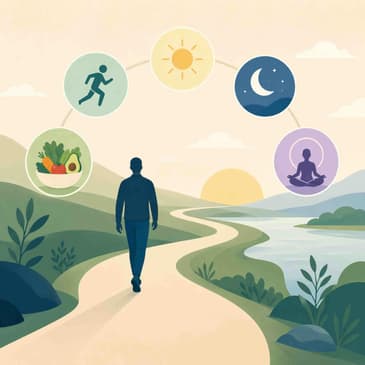
[00:05:58] making natural rewards feel more pleasurable. You can expect better emotional stability and impulse control. One year and beyond. The brain continues to repair itself, with dopamine levels stabilizing further and the risk of relapse decreasing significantly. At this stage, cognitive functions are often significantly restored. Supporting production. Exercise. Regular physical activity can naturally boost dopamine.
[00:06:28] Diet. A balanced and healthy diet supports brain health. Sleep. Prioritizing good sleep hygiene is crucial for neurotransmitter balance. And mindfulness. Practices like meditation can help the brain regulate stress and emotions. You just listened to the post titled, dopamine, by Kerry Ogden, of KerryOgden.com, and I'll be right back with my commentary.
[00:06:57] If you've been optimizing your diet, your protein intake, your sleep, you're already ahead of most people. But here's one thing most of us completely miss. The quality of the water we're drinking every single day. That's why I started using CovePure at home. It's a water purifier that sits right on your counter and plugs straight in. No plumber or drilling required. CovePure's ClearWave Reverse Osmosis technology is lab certified to remove up to 99.9% of contaminants.
[00:07:27] It's not just chlorine, PFAS, lead, microplastics,, pharmaceutical residue. If it isn't water, CovePure removes it. The removable pitcher is super convenient and being able to choose whatever temperature you want is my favorite feature. Water is the most fundamental thing you put in your body. Every cell runs on it. So make sure what you're drinking is clean. Go to CovePure.com slash OHD and because you're a listener of the show, if you use that link,
[00:07:56] you can get $250 off. That's C-O-V-E-P-U-R-E dot com slash OHD If you're a small business, the right hire can be make or break. Hoping the right people see your job posting isn't the best growth strategy. When the pressure's on and you need the right hire, this is a job for sponsored jobs. Join the 3.3 million employers worldwide that use Indeed to connect with quality talent that fits their needs.
[00:08:25] Spend less time searching and more time actually interviewing candidates who check all your boxes. Less stress, less time, more results. When you need the right person to cut through the chaos, this is a job for Indeed sponsored jobs. And listeners of this show will get a $75 sponsored job credit to help get your job the premium status it deserves at Indeed.com slash podcast. Just go to Indeed.com slash podcast right now
[00:08:55] and support our show by saying you heard about Indeed on this podcast. Indeed.com slash podcast. Terms and conditions apply. Need to hire? This is a job for Indeed sponsored jobs. Dr. Neal Malik here with my commentary. Dr. Robert Lustig has made a career out of researching the effects of dopamine and how it influences our habits. To help better regulate our responses to dopamine, Dr. Lustig has come up with ways to increase
[00:09:25] another good feeling hormone, serotonin, while at the same time helping us become a little less reliant on dopamine. Dr. Lustig calls them the four C's of happiness and you're going to hear that this very much aligns with what today's author Kerry Ogden was talking about. So the four C's of happiness according to Dr. Lustig are one, connect. Catch up with a friend, spend time with loved ones, take time to connect with yourself
[00:09:54] like practicing mindfulness. You can even spend time with animals that you love. All of this will trigger those same reward center pathways in the brain. Next, contribute. Make time to contribute to something bigger than yourself. So, we're talking about opportunities to use your time and energy to make the world a better place. The next one, cope. Take action to look after your body. So things like getting sufficient sleep,
[00:10:24] calming your mind with again mindful activities like meditation and yoga and exercise. exercise. The last C, cook. Meaning, consume a well-balanced healthy diet most of the time. Now, if you're not doing any of these four C's, that's okay. The most important thing is to just start with one. So, now the question is, which one of the C's are you going to start with? All right, that'll do it for another edition of Optimal Health Daily.
[00:10:54] Thank you so much for listening. Thank you for sharing the show with someone. I hope you're having a great weekend and of course, I'll see you back here tomorrow as usual where your optimal life awaits. lights.