



Discover all of the podcasts in our network, search for specific episodes, get the Optimal Living Daily workbook, and learn more at: OLDPodcast.com.
Episode 3412:
Dr. Neal Malik explores the risks of “bulking up” by overeating before building muscle, explaining why rapidly gaining fat may make long-term weight management harder. Drawing on research around fat cells, set point theory, and muscle growth, he offers a smarter approach focused on nutrient-dense foods, hydration, and sustainable strength gains without unnecessary fat accumulation.
Quotes to ponder:
"Imagine your body has its own internal thermostat instead of this thermostat controlling your body temperature it controls your body weight."
"Fat cells can get smaller but we can never really reduce the actual number of fat cells in the body."
"I typically do not recommend individuals gain weight prior to building muscle."
Learn more about your ad choices. Visit megaphone.fm/adchoices
[00:00:00] Sierra has all the best active and outdoor brands for the super athletic stuff, like running gear for cruising up the trail. Woo! And the super athletic-ish stuff, like fishing gear for chilling by the creek. Nice cast. Fitness apparel to push for higher reps. You got this! And golf balls priced so you can afford to lose one. Or a few. Head to Sierra or Sierra.com for the brands you want at the prices that let you do it all. From athletic to athletic-ish, Sierra's got it.
[00:00:31] If you've ever blasted synth beats from your boom box or burn CDs for your besties, this one's for you. As people get older, much like their music tastes, their health needs change. AG1 is the simple daily health drink designed to deliver over 75 essential daily nutrients and pre- and probiotics to support energy, digestion, and mood. So you can make the most out of every decade. And dance break! Learn more at drinkag1.com.
[00:00:57] It's another Q&A edition of Optimal Health Daily. And I'm Dr. Neal Malik. Hello there. Happy Friday. Welcome to another Q&A edition of Optimal Health Daily, where I answer your health questions related to fitness, diet and nutrition, and lots more. You send in the questions, and I answer them for you. Alright, let's hear today's question as I help you optimize your life.
[00:01:21] Hi, Dr. Neil. Thank you so much for your podcast, which I appreciate immensely. I have a question regarding my son. He is 25 years old, very tall, until recently very skinny, working at a desk all day long, and in my opinion, moderately active in his spare time.
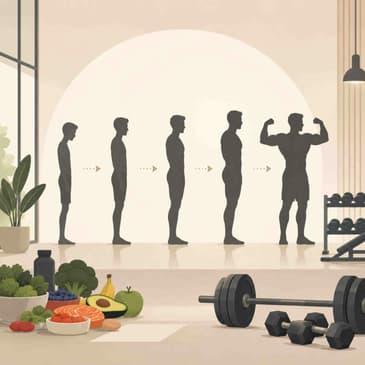
[00:01:46] Now he would like to have a muscular body. He is trying to fatten up, and then, once he reached the desired weight, turn the fat into muscle with a rigorous exercise program. I understand that this is a recommended procedure for bodybuilding. What I am worried about is the very noticeable belly he is putting on, and the massive amounts of coffee cream he is drinking,
[00:02:14] in an effort to get many calories fast. What is your opinion about this regime? Thank you so much for your answer. Thank you for your question, Suzanne. And, thank you for listening to the show and for your kind words. I am so glad you find this show helpful. I appreciate your concern regarding your son's plan to become more muscular. Honestly, I am with you on this one. I typically do not recommend individuals gain weight prior to building muscle.
[00:02:43] Instead of exceeding their daily caloric needs, I prefer that they simply meet them. Let me explain. Now, there is a theory with regards to weight management. It is called the set point theory. It goes something like this. Imagine your body has its own internal thermostat. Now, instead of this thermostat controlling your body temperature, it controls your body weight. Okay, so this body weight thermostat has a special built-in mechanism.
[00:03:11] Once you have set the thermostat to a certain body weight, you can never go back and set it for less than that. So, let's say your son has a goal weight of 200 pounds. The set point theory would say that, okay, once you reach that body weight, you won't be able to move the thermostat any lower. It can go up, but the setting can never go less than 200 pounds. So, let's say your son gets to his goal weight of 200 pounds.
[00:03:39] But then he begins training and wants to cut his weight down a bit. The set point theory would say, uh-oh, we can't set the body weight thermostat any lower. We are set at 200 pounds. So, if he goes under 200 pounds, his body will say, hmm, we're supposed to be at 200. We're not supposed to be at 190 or whatever. So, his body will always try to fight to get back to 200 pounds. That's the body's new set point.
[00:04:07] Now, I realize that this is just a theory. And in the words of the great Joey Tribbiani from the television show Friends, whoa, whoa, that was just a theory. A lot of theories didn't pan out. Lone gunman, communism, geometry. But there's another side to this story, Suzanne. You mentioned your son may be starting to develop a little belly. We can safely assume this weight gain around his abdomen is not the beginnings of a muscular six-pack,
[00:04:36] but rather mostly fat. So, in order to grow a belly, his body had to create more fat cells. What's interesting about fat cells is that once we have them, we can never really get rid of them. Now, don't get me wrong. Fat cells can get smaller, but we can never really reduce the actual number of fat cells in the body. So, this kind of relates back to the set point theory I just mentioned. So, in your son's case, in all likelihood, what has happened is his body's created more fat cells around his abdomen
[00:05:05] and they grew in size, which led to the visible increased collection of fat around his belly. Now, when it comes time to try and cut his weight and reduce body fat through exercise, he'll never be able to get rid of those fat cells that he's been accumulating. He will only be able to shrink them. But that means they still exist and may just lay in waiting for the next time he consumes too many calories. Those fat cells may be starving and eager to gather up those calories so they can plump up again.
[00:05:36] So, here's what I recommend he do instead. Continue his exercise program, but stop trying to consume all of those potentially unnecessary calories. Instead, focus on consuming nutrient-rich, whole foods and meeting his daily caloric needs. These foods would include vegetables like leafy greens, nuts and seeds, beans and lentils, lean proteins like poultry and fish,
[00:06:00] and heart-healthy fats like monounsaturated fats from the aforementioned nuts and seeds, as well as fish and avocado and olive oil. When he feels hungry, eat. When he doesn't, there's no need to force it. If he forces himself to eat and continues this behavior for long enough, he may unintentionally develop a new, not-so-desirable habit. Eating when he doesn't really need to. Not listening to his body.
[00:06:27] Oh, and he needs to be sure he always stays hydrated. Water is the best. He doesn't need any fancy protein shakes. This is because as his muscles grow, his body's demand for water will increase. After all, muscles are made of quite a bit of water. Lastly, if he really wants to maximize his muscle gains through his diet, consuming 20 grams of leucine-rich protein within 30 minutes of finishing a resistance training session may help.
[00:06:54] Leucine-rich proteins would include any animal-based protein like fish, chicken, turkey, yogurt, cheese, and you can also get leucine from beans and lentils. I wish your son lots of success, Suzanne, and hope he reaches his goals. If you're a small business, the right hire can be make or break. Hoping the right people see your job posting isn't the best growth strategy.
[00:07:21] When the pressure's on and you need the right hire, this is a job for sponsored jobs. Join the 3.3 million employers worldwide that use Indeed to connect with quality talent that fits their needs. Spend less time searching and more time actually interviewing candidates who check all your boxes. Less stress, less time, more results. When you need the right person to cut through the chaos, this is a job for Indeed sponsored jobs.
[00:07:47] And listeners of this show will get a $75 sponsored job credit to help get your job the premium status it deserves at indeed.com slash podcast. Just go to indeed.com slash podcast right now and support our show by saying you heard about Indeed on this podcast. Indeed.com slash podcast. Terms and conditions apply. Need to hire? This is a job for Indeed sponsored jobs.
[00:08:16] If we knew more about our sleep, what would we do differently? Would we go to bed at a consistent time or take steps to reduce interruptions to our sleep? With Sleep Score, Apple Watch measures your bedtime consistency, interruptions, and sleep duration. Then, every morning it combines these factors into an easy to understand score from one to a hundred. So you'll know how to take the quality of your sleep from okay to very high. Know your sleep score with Apple Watch.
[00:08:45] iPhone 11 or later required. Thank you for sending in your question. Now, if you want to send your questions in and get a copy of our Optimal Living Daily Workbook for doing so, you can email them to health at oldpodcast.com. That's health at oldpodcast.com. Or, if you want your voice played on the show, come by oldpodcast.com slash ask. Or, you can do it the old-fashioned way and call in your question.
[00:09:14] The number is 161-ILOVE-OHD. That's 1614-568-3643. Thank you so much for sending me your questions. Answering them is one of my favorite parts of this show. Alright, that's another Q&A edition of Optimal Health Daily. Thank you so much for listening every day and all the way through. I hope you have a great start to your weekend and I'll see you back here tomorrow, where your optimal life awaits.