



Discover all of the podcasts in our network, search for specific episodes, get the Optimal Living Daily workbook, and learn more at: OLDPodcast.com.
Episode 3433:
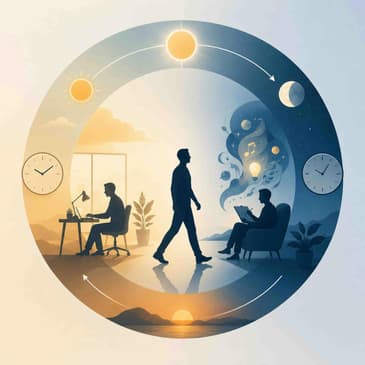
Ben Greenfield explores how understanding your natural energy patterns can help you stop relying on guesswork and start working more effectively. By matching analytical and creative tasks to the times of day when your brain performs best, he shows how to boost productivity while making better use of every hour.
Read along with the original article(s) here: https://bengreenfieldlife.com/article/lifestyle-articles/which-time-of-day-is-most-productive/
Quotes to ponder:
"During your optimal, peak time of day, you’ll be better at focusing in on a task and eliminating distractions."
"If you are someone who has to conform to another person’s work schedule or peak time, then you’ll want to do some things to help shift your sleep patterns or keep you more alert even when you’re outside your peak time."
"You’ll find yourself becoming much more efficient compared to simply guessing when you get the most done and squandering your hours working like a madman during that time."
Episode references:
NatureBright SunTouch Plus Light and Ion Therapy Lamp: https://www.amazon.com/s?k=NatureBright+SunTouch+Plus
BioBrite Sunrise Clock: https://www.amazon.com/s?k=BioBrite+sunrise+clock
EarthPulse PEMF Device: https://earthpulse.net/
Mind Alive CES Devices: https://mindalive.com/
Brain-Derived Neurotrophic Factor (BDNF): https://en.wikipedia.org/wiki/Brain-derived_neurotrophic_factor
Morningness-Eveningness Questionnaire (MEQ): https://en.wikipedia.org/wiki/Morningness%E2%80%93eveningness_questionnaire
Learn more about your ad choices. Visit megaphone.fm/adchoices
[00:00:00] This Father's Day, do more with Dad and spend less with low prices guaranteed at The Home Depot. Get him fired up with a new grill and accessories, like the NexGrill 5 Burner for just $299 so you can spend more time together while he becomes the grill master he was always meant to be. Or build memories with savings on top brand power tools so you can tackle projects side by side. Gift more and do more together this Father's Day with help from The Home Depot. Exclusions apply. See homedeepot.com slash price match for details.
[00:00:30] This is Optimal Health Daily, 4 Steps To Getting More Done During Your Peak Time Of The Day by Ben Greenfield of bengreenfieldlife.com and I'm Dr. Neal Malik, your host and narrator. Hey there, welcome back to Optimal Health Daily or OHD, where I act as your narrator of popular health and fitness blogs and always with a bit of my commentary at the end. And with that, let's get right to today's post and start optimizing your life.
[00:01:02] 4 Steps To Getting More Done During Your Peak Time Of The Day by Ben Greenfield of bengreenfieldlife.com If you read A Sneak Peek Into One Day In The Life Of A Fitness Coach, then you know how a basic day of work and life goes for me. But what about you? Do you pride yourself on hard work? Do you want to get as much as possible done with each day of your life?
[00:01:27] And finally, if you are going to work your butt off, would you A, prefer to be working hard during the time of day when you know beyond a shadow of a doubt you're most productive? Or B, opt to waste your valuable time with a daily cram shoot of random hours that, fingers crossed, you guess might be your most productive times of day. I'm not sure about you, but I'd choose the former.
[00:01:53] Here's exactly how in 4 easy steps to getting more done during your peak time of the day and how to find out which time of day is most productive for you. Step 1. Determine Your Morningness-Eveningness Score There's a questionnaire that you could take for free called the Morningness-Eveningness Questionnaire. It's been around since the 1970s and is designed to determine what your peak productivity time of day is.
[00:02:20] It's actually been shown to correlate with your body temperature, meaning that if you're less sleepy and more alert in the morning, you tend to have higher peak temperatures and improved muscular force and nervous system activity in the morning, and vice versa for the evening. Step 2. Do Your Most Attention-Demanding Tasks During Your Peak Time
[00:02:46] Once you've taken the questionnaire, things aren't quite as simple as merely working during your most alert time of day and avoiding work during your non-alert times. Instead, you should pay attention to the recommendations from a study which researched night owls versus early risers and found that no matter who you are, you should opt to do challenging and attention-demanding tasks during your peak time of day.
[00:03:11] These are the type of activities that require more focused and linear thinking or simply more motivation. So during your peak time of day, you should choose activities like business meetings that involve planning or scheduling, billing or accounting work, or conversations requiring math, writing articles that contain technical expertise, and mechanical work like fixing something broken in your office. During your optimal peak time of day,
[00:03:40] you'll be better at focusing in on a task and eliminating distractions. And yes, that means, when possible, you should do any exercise sessions during your peak time of day. Step 3. Do Creative Tasks During Your Non-Peak Time This same study mentioned earlier showed that when you're less alert, meaning outside your peak time of day, you're actually more creative. So during your non-peak time of day,
[00:04:07] you should choose activities that require outside-of-the-box thinking or creative problem-solving, like meetings that engage brainstorming or mind mapping, conversations that require unique problem-solving approaches, writing articles that involve blue-sky thinking, fiction, or humor, and artistic work, like rearranging your office. Interestingly, when it comes to play, this also means you're going to be more likely to enjoy creative activities
[00:04:34] during your most non-analytical, non-peak time of day. So if you find you're an evening person and you have the option for flexible work hours, then save analytical thinking work for later in the day and watch that funny TV show or entertaining book you've been wanting to read in the morning. And step 4. Hack Your Peak Time Obviously, despite your morning versus evening preference, we live in a society where we mostly follow an early riser schedule
[00:05:04] and we also frequently communicate with people who may not share our peak times. If you're someone who has to conform to another person's work schedule or peak time, then you'll want to do some things to help shift your sleep patterns or keep you more alert even when you're outside your peak time. Some tricks you can use to hack your peak time include 1. Lightboxing Lightboxes emit bright light from the blue light wave spectrum,
[00:05:31] which causes a cortisol release and increased alertness. If you're an evening person trying to be a morning person, using one of these for 10 to 15 minutes in the morning can help. If you're a morning person trying to be an evening person, I don't recommend it as it can disrupt your sleep for a few hours after you use it. You can easily find lightboxes at most mainstream stores. 2. Exercise
[00:05:56] When you do exercise, especially aerobic exercise such as a 20-minute brisk treadmill walk, you produce brain-derived neurotrophic factor or BDNF, which is a protein that acts on neurons in your central nervous system and peripheral nervous system to help your existing neurons survive and also to encourage growth of new neurons and neuronal connections. Whether you're a morning or evening person,
[00:06:23] this can be a great reason to squeeze in a quick 20 to 45-minute run, bike ride, or bout of cardio before any non-peak time of day activity during which you anticipate having high intellectual demands. 3. Boost Brainwaves There are a number of devices that can help push your brain into a state of alert alpha brainwave production. These include pulsed electromagnetic frequency, such as Earth Pulse, which is a device you can simply place a few feet from your body
[00:06:53] and leave running for up to an hour, or cranial electrotherapy stimulation, which emits lights and sounds via a device you wear on your head, or even audio tracks or sounds you can play in your home or office. Summary So, those are the four steps to getting more done during your peak time of day. Simply, 1. Find your peak time 2 and 3. Split up your tasks accordingly
[00:07:19] And 4. Use tricks to shift your peak time when necessary. You'll find yourself becoming much more efficient compared to simply guessing when you get the most done and squandering your hours working like a madman during that time. You just listened to the post titled, 4 Steps to Getting More Done During Your Peak Time of the Day by Ben Greenfield of bengreenfieldlife.com And I'll be right back with my commentary.
[00:07:48] When summer rolls around, I sweat just thinking about how heavy my clothes are. This year, I finally fixed that, thanks to Quince. They make high-quality essentials that look and feel amazing with breathable linen and soft organic cotton without the luxury markup. Their European linen pants and shirts are the perfect warm weather upgrade, starting at just $34. And everything at Quince is priced 50-80% less than similar brands
[00:08:14] because they work directly with ethical factories and cut out the middlemen. A piece that changed my summer is their Italian swim trunk. I love swimming, and these are quick drying with UPF 50 protection, available in different lengths. They resist fading, pilling, and snagging. Great from the beach to the backyard barbecue. Elevate your summer wardrobe. Go to quince.com slash OHD for free shipping on your order and 365-day returns, now available in Canada too.
[00:08:44] That's Q-U-I-N-C-E dot com slash OHD for free shipping and 365-day returns. Quince.com slash OHD. If you're a small business, the right hire can be make or break. Hoping the right people see your job posting isn't the best growth strategy. When the pressure's on and you need the right hire, this is a job for sponsored jobs. Join the 3.3 million employers worldwide
[00:09:13] that use Indeed to connect with quality talent that fits their needs. Spend less time searching and more time actually interviewing candidates who check all your boxes. Less stress, less time, more results. When you need the right person to cut through the chaos, this is a job for Indeed sponsored jobs. And listeners of this show will get a $75 sponsored job credit to help get your job the premium status it deserves at Indeed.com slash podcast.
[00:09:42] Just go to Indeed.com slash podcast right now and support our show by saying you heard about Indeed on this podcast. Indeed.com slash podcast. Terms and conditions apply. Need to hire? This is a job for Indeed sponsored jobs. Dr. Neal Malik here with my commentary. I took today's author's advice and completed the morning this evening this questionnaire. Based on my results, I'm what they refer to
[00:10:11] as a moderately evening type. This means I tend to feel my best in the late afternoons and early evenings. And if I had my choice, I would go to bed later in the evenings or even early the next morning, like between 11pm and 1am. So, I need to maximize my more demanding tasks during the late afternoons and early evenings. And then try and incorporate my creative activities in the morning. Now, what about some of the newer technologies that Ben mentioned,
[00:10:40] like pulsed electromagnetic frequency and cranial electrotherapy stimulation? In the US, the Food and Drug Administration, or FDA, has approved use of both of these devices, but for very specific conditions. Pulsed electromagnetic frequency has been approved for relieving back pain, relieving pain after surgery, and helping heal certain types of bone fractures. It hasn't been studied as much for boosting brainwaves. Also,
[00:11:08] some cranial electrotherapy stimulation devices have been FDA approved for help treating anxiety, depression, and even insomnia. But again, not necessarily when it comes to boosting brainwaves. So, if you are interested in trying pulsed electromagnetic frequency or cranial electrotherapy stimulation, it may be worth having a conversation with your healthcare provider first to see if either are worth trying. But in the meantime, you can take the morningness-eveningness questionnaire
[00:11:38] and see where your peak times are. And, if you're able to, plan your schedules accordingly. Alright, that'll do it for today. I hope you have a great rest of your day. And of course, I will see you back here tomorrow for more OHD and where your optimal life awaits. I hope you have a great