



Get the 200+ Page Optimal Living Daily Workbook (PDF) — Free.
Want to turn today’s episode into an actionable plan? Join the Optimal Living Weekly newsletter and I’ll send you our 200-page digital workbook immediately. It’s packed with the best takeaways from the show, formatted for easy reading and implementation at home.
Get your free PDF workbook here: https://oldpodcast.eo.page/join
Discover all of the podcasts in our network, search for specific episodes and learn more at: OLDPodcast.com.
Episode 3453:
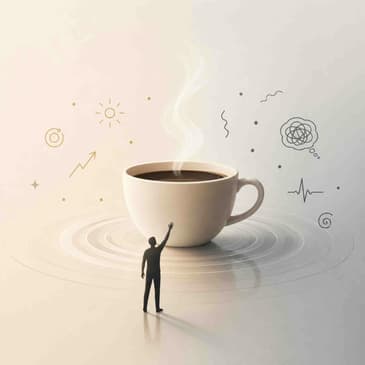
Dr. Jenny Brockis explores the fine line between enjoying caffeine and becoming dependent on it, sharing her own experience of consuming too much tea and the surprising effects it had on her mood and anxiety levels. She also highlights the brain and longevity benefits associated with moderate caffeine intake, offering a balanced perspective on how to find the amount that works best for you.
Read along with the original article(s) here: https://drjennybrockis.com/2014/2/3/could-you-be-addicted-to-caffeine/
Quotes to ponder:
"It seems that caffeine can be good or bad for you depending on how much you consume on a daily basis. As Goldilocks discovered, it’s about not having too much or too little, but just enough."
"There are a number of health benefits to the brain that caffeine provides, but like most things, if we overdo it, we can run into trouble."
"Certain plants (coffea and citrus) produce nectar that contains just a teensy bit of caffeine, but enough to enhance the honeybee’s memory, making them more effective pollinators of those plants."
Episode references:
Nurses' Health Study: https://nurseshealthstudy.org/
The New England Journal of Medicine – Association of Coffee Drinking with Total and Cause-Specific Mortality: https://www.nejm.org/doi/full/10.1056/NEJMoa1112010
Learn more about your ad choices. Visit megaphone.fm/adchoices
[00:00:00] Have you ever noticed how a calm mind can really set the stage for a good night's sleep? That's the idea behind our new podcast, Good Sleep. Greg, our host from Optimal Relationships Daily, is here to help ease you into a peaceful night's rest with some positive affirmations. And these affirmations aren't just comforting, they can help ease anxiety and nurture positive thoughts, setting you up for true good sleep.
[00:00:24] So, press play on Good Sleep tonight because a good tomorrow starts with a good night's sleep. Just search for Good Sleep in your podcast app and be sure to pick the one from Optimal Living Daily. This is Optimal Health Daily. Could You Be Addicted To Caffeine? By Dr. Jenny Brockis of drjennybrockis.com And I'm Dr. Neal Malik Malik, your very own personal narrator.
[00:00:50] Hey there, happy Saturday and welcome back to Optimal Health Daily or OHD, where I act as your narrator of popular health and fitness articles and always with a bit of my commentary at the end. Now, don't forget we have a bunch of shows covering a bunch of different topics. Just search for Optimal Living Daily in any podcast app to find them. Alright, and with that, let's get right to it and start optimizing your life.
[00:01:18] Could You Be Addicted To Caffeine? By Dr. Jenny Brockis of drjennybrockis.com Being brought up in the UK, at home we drank a lot of tea. It was, and in many instances still is, the national beverage, though being rapidly usurped by coffee. I've always loved my cuppa. I like it strong and always start my day with a fresh brew.
[00:01:41] I recently went back to the UK to visit my parents, and while I was there, I noticed that for some inexplicable reason, I was feeling a bit edgy. A bit anxious, even. How could this be? I was on holiday enjoying special family time, and yet, I was a bit off. Then I realized that I was, over the course of the day, drinking far more tea than usual. Aha! Ah! Culprit identified, and once dealt with, produced immediate positive results.
[00:02:11] Tea, like coffee, contains caffeine, the world's most widely consumed psychostimulant. How many people you know will tell you, My brain doesn't function until I've had my first coffee. Or, I can't think until I've had my coffee fix. Don't get me wrong, there's nothing wrong with enjoying tea, coffee, or chocolate. Though I don't believe that carbonated drinks with caffeine are good for us in any shape or form, for our bodies or our brains.
[00:02:39] And it's not just humans that so love their caffeine. Honeybees like their caffeine fix too. Yes, that's right, honeybees. Certain plants, like citrus, produce nectar that contains just a teensy bit of caffeine, but enough to enhance the honeybee's memory, making them more effective pollinators of those plants. Clever! There are a number of health benefits to the brain that caffeine provides,
[00:03:05] but like most things, if we overdo it, we can run into trouble. I recently became aware of a condition called caffeine use disorder. Sounds a bit gruesome, but it simply relates to the fact that some people do become dependent on caffeine, to the point where, if it's not available, they suffer withdrawal symptoms. Over the years, I've seen a number of people with caffeine withdrawal headaches. It can be quite severe and is cured by having a caffeine-containing beverage.
[00:03:35] Problematic use, that's a nice psychological-sounding term, from overindulging in caffeine can result in jitteriness, agitation, tachycardia, which is a fancy way of saying a rapid heart rate, and anxiety. It may cause interference with normal functioning and work activities, and can be difficult to give up. Research from Johns Hopkins University reports that more than 50% of regular caffeine consumers report difficulty quitting or reducing their caffeine use.
[00:04:05] How much should we be drinking? Current thinking is no more than 400mg of caffeine each day. That's around 2-3 8-ounce cups of coffee. So, if that's what you normally would have consumed by 10am, perhaps your caffeine consumption needs a review. By the way, depending on the brand, black tea could contain almost as much caffeine as a cup of coffee, and green tea also contains a significant amount. Benefits of caffeine
[00:04:35] So as not to leave you in a complete funk, despairing that you are hopelessly addicted to caffeine, there are some good things about it I want to leave you with. 1. Recent research has revealed how drinking coffee after learning helps to consolidate long-term memory. 2. Caffeine stimulates your neurons to fire at a faster rate, so it will certainly help to keep you alert and awake. It competes with adenosine, our naturally occurring neurochemical
[00:05:03] that is released to slow down the rate of neuronal firing and prepare the body for sleep. 3. Research has found that older French ladies, meaning those 65 years of age or older, who drink 3 cups of coffee a day, preserve their memory for longer. This suggests it could be useful for halting cognitive decline.
[00:05:22] 4. Research from Harvard University through the nurses study has shown how caffeine is associated with a reduced risk of depression among women with the average age of 63. 5. A 2012 study published in the New England Journal of Medicine found that older adults, both men and women, who drink coffee have an overall lower risk of death than non-coffee drinkers. The lower risk of death was around 10%.
[00:05:50] Now, which, if any, of the thousand compounds in coffee that might contribute to this finding is unclear. But hey, this is good news for coffee drinkers. So it seems that caffeine could be good or bad for you depending on how much you consume on a daily basis. As Goldilocks discovered, it's about not having too much or too little, but just enough. You just listened to the post titled, Could You Be Addicted to Caffeine?
[00:06:19] by Dr. Jenny Brockis of drjennybrockis.com and I'll be right back with my commentary. This episode is brought to you by Google Health. Stop chasing someone else's definition of health. What matters is what's healthy for you. Google Health offers a new kind of coach, built with Gemini for effortless tracking, sleep insights, and holistic coaching tailored to you. Visit googlestore.com to learn more and start a new relationship with your health. Requires Google account, Google Health app, internet, and Google Health premium subscription.
[00:06:48] Features subject to change. Availability and results vary. Not intended for medical purposes. Works independently of Gemini apps. Check responses for accuracy. If you're a small business, the right hire can be make or break. Hoping the right people see your job posting isn't the best growth strategy. When the pressure's on and you need the right hire, this is a job for sponsored jobs. Join the 3.3 million employers worldwide that use Indeed to connect with quality talent that fits their needs.
[00:07:15] Spend less time searching and more time actually interviewing candidates who check all your boxes. Less stress, less time, more results. When you need the right person to cut through the chaos, this is a job for Indeed sponsored jobs. And listeners of this show will get a $75 sponsored job credit to help get your job the premium status it deserves at indeed.com slash podcast.
[00:07:40] Just go to indeed.com slash podcast right now and support our show by saying you heard about Indeed on this podcast. Indeed.com slash podcast. Terms and conditions apply. Need to hire? This is a job for Indeed sponsored jobs. Dr. Neil here with my commentary. When I was in graduate school, my teacher assigned us to write a research paper that described in detail the health effects of caffeine.
[00:08:09] I dove into this assignment believing I knew what I'd find. That obviously caffeine is bad for us. When I started to look for published studies on caffeine, something very strange happened. I couldn't find a single study that showed that caffeine consumption increased risk for disease. The only negative effects I could find were about, as Dr. Bracus mentioned in today's article, caffeine use disorder. But even then,
[00:08:38] caffeine use disorder symptoms are mild for most people. Instead, I found study after study after study that said caffeine consumption tended to reduce disease risk. Since that time I had to write that research paper, even more studies have come out discussing the benefits of regularly consuming coffee and tea. In fact, many studies have found that drinking three to four cups of plain coffee each day may protect against, get this, type 2 diabetes,
[00:09:08] colon cancer, liver cancer, Parkinson's disease, cardiovascular disease, cognitive decline, and even death from all causes. Again, three to four cups of plain coffee or tea protects against all of those. So, if you enjoy drinking your plain cups of coffee or tea each day and it's not making you feel more jittery or anxious or leading to insomnia, then enjoy. All right, that'll do it for today.
[00:09:37] Thank you so much for being here. Thank you for sharing this show with someone. I hope you have a great weekend. And of course, I'll see you back here tomorrow as usual where your optimal life awaits. I'll see you back in the comments. Thank you.