



Get the 200+ Page Optimal Living Daily Workbook (PDF) - Free.
Want to turn today's episode into an actionable plan? Join the Optimal Living Weekly newsletter and I'll send you our 200-page digital workbook immediately. It's packed with the best takeaways from the show, formatted for easy reading and implementation at home.
Get your free PDF workbook here: https://oldpodcast.eo.page/join
Discover all of the podcasts in our network, search for specific episodes, get the Optimal Living Daily workbook, and learn more at: OLDPodcast.com
Episode 3559:
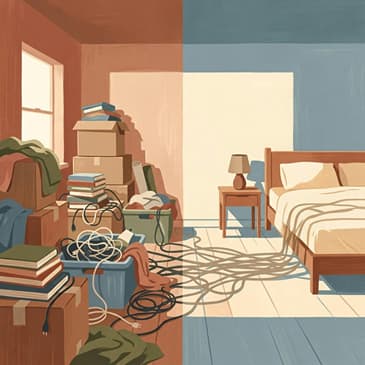
Joshua Becker gathers the research on what household clutter does to the people living in it, from elevated stress hormones and disrupted sleep to reduced focus and heavier snacking. He argues that the cost of a cluttered home is not cosmetic but physical and psychological, and that it accumulates quietly. His case is that decluttering is less about impressing visitors than about building a home where healthy habits come easier for everyone in it.
Read along with the original article(s) here: https://www.becomingminimalist.com/how-clutter-affects-our-health/
Quotes to ponder:
"Clutter is so much more than a nuisance."
"When you start, you begin to enjoy the physical, emotional, and psychological benefits of living with less clutter."
"A decluttered home isn't just about impressing the neighbors when they come over; it's about preparing an environment where everyone in our family has the best chance to succeed."
Ready to clean out your closet and make some extra money? Download the Vinted app for free and start listing. With no seller fees, you keep every dollar you earn.
Optimal Health Daily is a daily health and wellness podcast where we narrate the best articles on nutrition, fitness, weight loss, and healthy habits, read to you by a professional narrator so you can improve your health a little more every day.
Learn more about your ad choices. Visit megaphone.fm/adchoices
[00:00:00] This episode is sponsored by Vinted. I recently looked at my closet and realized how many clothes I keep telling myself I'll wear again, but somehow never do. They're taking up space, and some of that could be extra money instead. That's where Vinted comes in. Vinted is the second-hand marketplace app that makes it simple to sell pre-loved fashion and give your clothes a second life. Listing on Vinted is quick and straightforward, and once an item sells, Vinted creates the prepaid shipping label for you.
[00:00:30] Without adding much to your routine. What I especially like is that Vinted has no seller fees, so you keep everything you earn. That makes finally clearing out your closet feel a lot more worthwhile, and it may even make room for something you'll actually wear. So, take another look at what's sitting unworn in your closet. Give your clothes a second life with Vinted. Download the Vinted app for free and start listing today. With no seller fees, you keep every dollar you earn.
[00:01:01] This is Optimal Health Daily. 10 Ways Clutter Affects Our Health by Joshua Becker of BecomingMinimalist.com, and I'm Dr. Neal Malik, your host and narrator. Hey there, happy Sunday, and welcome to Optimal Health Daily, or OHD, where I read to you from some of the most popular health and fitness blogs online. All right, let's get right to it as we optimize your life.
[00:01:28] 10 Ways Clutter Affects Our Health by Joshua Becker of BecomingMinimalist.com Mindy, a mother of three, is an engaged and creative mom. On any given day, there might be paintbrushes soaking in the family's kitchen sink, social media-inspired sculptures on the counter, board games strewn about on the dining room table, or a child's artwork fighting for space on the door of the refrigerator. Backpacks, sports jerseys, books, and toys would often be strewn across the floor.
[00:01:58] When Mindy visited friends' homes, with clear countertops, organized desks, and coffee tables, with room to rest a cup of coffee, she saw a different way of living, one that appeared freeing to her. But dismissing these tidy homemakers as being of a different personality, Mindy made very few changes at home. Mindy admitted that when she was forced to straighten her home, scrambling to clean up before company and begging her kids to do the same,
[00:02:26] she felt better about the space and the way it made them feel. But when the clutter began to creep into their home again, as eventually it always did, Mindy lacked the confidence to believe that regular clutter-free living was possible for her and for her family. So, they continued to limp along, kicking loose soccer balls, stumbling over cleats, and endlessly moving around piles of junk mail. She would routinely say to herself, what's the problem with a little mess here and there?
[00:02:54] Other than a minor pain after stepping on a plastic game piece hidden in the carpet, Mindy's family had deftly avoided major injuries. So, what was the harm with a little clutter? If your home is like Mindy's, cluttered most of the time, you might ask yourself the same question. What's the harm? Maybe more than you realize. What our clutter is doing to us. When we look into the research and studies that have been conducted in this area, we notice a troubling trend.
[00:03:23] The clutter in our home may be having more of a negative impact on our family's health and well-being than we realize. Consider these examples. 10 Ways Clutter Affects Our Health 1. Increased Stress Researchers at UCLA have discovered a link between high levels of stress hormones and a high density of household objects. In other words, clutter increases stress levels almost undoubtedly. Psychology Today reinforced their study,
[00:03:52] citing eight specific reasons why messy rooms contribute to higher levels of stress in our bodies. Among their reasons, clutter bombards our minds with excessive stimuli. Clutter signals to our brain that our work is not done. Clutter creates feelings of guilt. Clutter produces feelings of anxiety. Clutter frustrates us by preventing us from locating what we need quickly. 2. Stress-Induced Physical Symptoms
[00:04:20] Clutter is a contributing factor to the level of stress in our lives. And given the fact that the average American home now contains 300,000 items, there's no wonder why the New York Times recently referred to the modern American generation as the most stressed of all time. All of this stress begins to take its toll, affecting almost every system in our bodies. Stress cues the body to breathe faster, which can aggravate conditions such as asthma and emphysema.
[00:04:47] It increases blood pressure by causing blood vessels to constrict. Stress increases the likelihood of heartburn and acid reflux. And it can overtax our muscles, causing headaches and body aches. 3. Decreased Ability to Focus Closely related to the stress mentioned earlier, Princeton scientists discovered that a cluttered environment limits our ability to focus. Their study reports that a visually disorganized environment
[00:05:14] has neurological effects similar to what we experience when barraged and overwhelmed by lots of different noises at once. 4. Overeating Did you know that a cluttered kitchen can contribute to overeating? Brian Wansink of Cornell University and his colleagues conducted a study back in 2016 to better understand how cluttered, chaotic environments such as messy kitchens influence snacking behavior. Among their findings,
[00:05:42] women in a messy kitchen tended to consume twice as many calories from cookies as women in a tidy kitchen. Dr. Wansink summarized their findings this way, quote, The notion that places such as cluttered offices or disorganized homes can be modified to help us control our food intake is becoming an important solution. End quote. 5. Unhealthy Habits and Choices In a similar study published in Psychological Science,
[00:06:10] researchers at the University of Minnesota confirmed the prediction that an orderly environment leads to more desirable, normatively good behaviors such as being generous to the needy. We think we're not being affected by the physical environment around us, but in reality, a cluttered environment negatively influences our habits and behavior more than we realize or care to admit. 6. Diminished Air Quality and Environment According to WebMD,
[00:06:40] clutter increases the risk of asthma and allergies. According to the medically reviewed article, quote, You may think your house is messy but not dirty, but it's hard to clean around piles of belongings. Decluttering can prevent pests and reduce dust, mold, and mildew, which may trigger asthma and allergies. End quote. 7. Impaired Learning According to a study conducted by Carnegie Mellon University, children in decluttered classrooms
[00:07:09] perform 13% better on tests than children in disorganized classrooms. And what's true for the classroom is true for the home, for both the adults and the kids. 8. Less Restful Sleep A cluttered environment can lead to difficulty falling and staying asleep, resulting in a reduced quality of sleep. When our bedrooms are cluttered, according to a study funded by the National Institute of Mental Health and others, we have a harder time falling asleep
[00:07:37] and experience more sleep disturbances throughout the night. 9. Lower Self-Esteem Clutter often brings negative self-talk and feelings of self-criticism. According to research conducted by the University of New Mexico, this results in a negative impact on our psychological and subjective well-being. 10. Negatively Impacts Wellness In the Post, How Minimalism Can Help You Find Wellness,
[00:08:06] I lay out all seven dimensions of human wellness and how clutter, or its opposite, affects each of them. If you'd like to continue this conversation and take an even deeper dive into minimalism and wellness, take a look at that article. 10. Beginning to Live Well Clutter is so much more than a nuisance. It impacts the health and well-being of our families in ways we might not even notice. A decluttered home isn't just about impressing the neighbors when they come over. It's about preparing an environment where everyone in our family
[00:08:36] has the best chance to succeed. And that positive change is always possible. Living well is possible for your family. When you start, you begin to enjoy the physical, emotional, and psychological benefits of living with less clutter. You can do this. We're all cheering for you. You have so much to gain. You just listened to the post titled 10 Ways Clutter Affects Our Health by Joshua Becker
[00:09:05] of becomingminimalist.com and I'll be right back with my commentary. You're listening to a quick ad. You know what else is quick? Selling your car on Carvana. Just put in your vehicle information and we'll give you an offer. Done. No hassle. No negotiation. No guy from an online listing lowballing you. Which means, by the time I'm done explaining this, you could have basically done it. Still haven't started?
[00:09:33] Hey, better late than never. Sell your car today on Carvana. Pickup fees may apply. Sierra has all the best active and outdoor brands you need. From athletic stuff, like a full-court pickup game, swish, to athletic-ish stuff, like a half-mile stroll. Get those steps in! And for morning hikes up the mountain trail, good pace! To nighttime ghost stories from the camping chair. What a twist! Whatever level of active, Sierra loves it all.
[00:10:02] Head to Sierra or Sierra.com for the brands you want at the prices that let you do it all. From athletic to athletic-ish, Sierra's got it. Dr. Neal Malik here with my commentary. Remember the study today's author, Joshua Becker, mentioned from Cornell University that described Dr. Wansink's research on messy kitchens? Well, just in case you don't remember, Dr. Wansink found that messy kitchens led to more calories consumed when compared to those with a tidy kitchen. Well, Dr. Wansink performed
[00:10:31] a separate study looking at how the kitchen can influence eating habits. And he found in that study that those that had breakfast cereals sitting on their kitchen countertops tended to weigh about 20 pounds more when compared to their neighbors who didn't have breakfast cereals sitting on their kitchen countertops. Not only that, but Dr. Wansink's study found that those that had soft drinks sitting out on their kitchen countertops tended to weigh about 25 pounds more than their neighbors. So yes, our home environment
[00:11:01] and possibly clutter can absolutely influence our eating habits and our behaviors. So, when we're following today's author, Joshua Becker's advice to declutter, let's be sure we take some time to declutter our kitchens too. All right, that'll do it for today's episode. Thank you so much for being here and thank you for sharing this show and listening every day. I hope you have a great rest of your weekend and I'll see you back here tomorrow where your optimal life awaits. enjoy now. See you next time. You're welcome.