


Discover all of the podcasts in our network, search for specific episodes, get the Optimal Living Daily workbook, and learn more at: OLDPodcast.com.
Episode 3391:
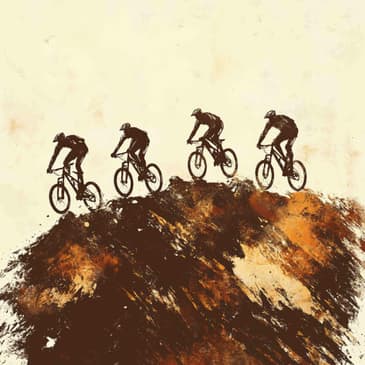
Bryan Shelton explores how applying behavioral science can accelerate skill development, showing how to set and achieve goals using structured, deliberate practice. Through steps like pinpointing specific behaviors and reinforcing improvements, he demonstrates how teams can both "go fast" and "go far" by building momentum together, making learning a more efficient and collaborative experience.
Read along with the original article(s) here: https://www.aubreydaniels.com/blog/developing-skills-quickly-with-the-science-of-behavior
Quotes to ponder:
"Mountain biking is made up of several complex behavior chains. As a biker develops their skills in these areas, they have the ability to pick up and maintain speed."
"Sessioning is a fancy word for deliberate practice building the skills necessary to complete our goal."
"Maybe we need to ditch the proverb, 'If you want to go fast, go alone. If you want to go far, go together,' and replace it with something that recognizes that fast and far are achievable with deliberate practice."
Learn more about your ad choices. Visit megaphone.fm/adchoices
[00:00:00] Brauchen wir wirklich noch einen Computer? Alle wahrscheinlich nicht. Aber wenn du Musik mit der Power eines Neuralprozessors neu erfindest, oder unterwegs Migrationsmuster mit einem ganztägigen Akku analysierst, oder deine Ideen mit dem KI-gesteuerten Co-Creator zum Leben erwächst, dann kann ein Co-Pilot Plus PC einen Unterschied machen. Nicht alle brauchen einen leistungsstärkeren KI-Computer. Aber wenn du versuchst, die Welt zu verändern, auch wenn es nur deine eigene ist, haben wir einen für dich entwickelt. Microsoft Co-Pilot Plus PC mit Snapdragon. Die bisher schnellsten und intelligentesten Windows-PCs. Die Akkulaufzeit variiert hier nach Nutzung und Einstellungen.
[00:00:30] Before we start, please check out our new podcast, Good Sleep. Have you ever noticed how a calm mind can really set the stage for a good night's sleep? That's the idea behind our new podcast, Good Sleep. Greg, our host from Optimal Relationships Daily, is here to help ease you into a peaceful night's rest with some positive affirmations. And these affirmations aren't just comforting, they can help ease anxiety and nurture positive thoughts, setting you up for true good sleep. So press play on Good Sleep tonight because a good tomorrow starts with a good day.
[00:01:00] Just search for good sleep in your podcast app and be sure to pick the one from Optimal Living Daily.
[00:01:08] This is Optimal Living Daily, developing skills quickly with the science of behavior. By Brian Shelton with AubreyDaniels.com and I'm Justin Malek. Happy Friday, this is the award-winning podcast where I read articles to you, hopefully adding a little bit of inspiration, motivation, or happiness to your day.
[00:01:27] This is all with permission from the websites, by the way. I'm going to keep this intro nice and short, so let's get right to it as we optimize your life.
[00:01:39] Developing skills quickly with the science of behavior. By Brian Shelton with AubreyDaniels.com.
[00:01:46] There's an old saying that has always bothered me. If you want to go fast, go alone. If you want to go far, go together.
[00:01:55] If it's just a proverb to point out how important community is, I get it. However, it feels a bit static to me, as if someone can't learn, develop, and grow.
[00:02:05] As an avid mountain biker, this saying has never resonated with me because, let's face it, being fast on a mountain bike is much more fun than being slow, and I'd much rather ride with my crew than ride alone.
[00:02:19] In other words, I want to have my cake and eat it too, or more specifically, I want to go fast together.
[00:02:27] This is where the science of behavior can help.
[00:02:30] Mountain biking is made up of several complex behavior chains.
[00:02:34] There are easier chains, keeping balance, pedaling, braking, and shifting your weight,
[00:02:40] and there are more complex chains, scanning terrain to find lines, adapting body position, wheelies, jumping, and getting over large obstacles.
[00:02:50] As a biker develops their skills in these and more areas, they have the ability to pick up and maintain speed.
[00:02:56] On a team, developing the skills in each other is the key to getting the team to go faster and farther.
[00:03:04] Much like a mountain biker, a leader can use behavioral science to develop skills quickly.
[00:03:10] Here are the steps to do so.
[00:03:13] Number one, set a goal.
[00:03:16] It can be a specific event or improvement in a critical result measure.
[00:03:20] Whenever possible, allow the group to collaborate on the goal and the success outcomes.
[00:03:25] My crew and I set a goal to ride the Palisade Plunge by the end of the year,
[00:03:31] which is 32 miles of physically demanding single track with a descent of 6,000 feet.
[00:03:37] Number two, set sub-goals.
[00:03:40] Sub-goals can be individual or group-focused,
[00:03:43] and they should all tell you if you're moving in the right direction
[00:03:46] and allow you to see improvements much faster than if only using the main goal.
[00:03:51] To achieve our goal of completing the plunge,
[00:03:54] I have several sub-goals, including improving my average mile per hour,
[00:03:59] increasing the length of the trail I do at one time,
[00:04:02] and increasing the level of difficulty of the trails I regularly ride.
[00:04:06] Other members of the crew have different goals,
[00:04:09] each set to help us achieve our main goal.
[00:04:12] Number three, pinpoint behaviors that will help achieve the goals.
[00:04:17] Select behaviors critical to mission success that need to be developed as habits.
[00:04:22] These are actions that one person or the whole team needs to develop to achieve the goal.
[00:04:28] For me, I'm currently focused on the critical behavior of body position,
[00:04:32] arms and knees bent, hips behind the seat, looking up, while on steep descents.
[00:04:39] Number four, session those behaviors.
[00:04:42] Sessioning is a fancy word for deliberate practice.
[00:04:45] Find opportunities to practice the pinpointed behaviors that will help you achieve your goal
[00:04:51] until those skills become habits.
[00:04:54] We do this by selecting trails that have multiple opportunities to practice the developing behaviors
[00:05:00] and by stopping on the trail to repeat the behavior over and over.
[00:05:04] This way, we're building the skills necessary to complete our goal.
[00:05:08] And number five, reinforce, coach, and ask questions.
[00:05:14] Behaviors need reinforcement to strengthen them.
[00:05:17] Providing high rates of positive reinforcement will not only help others develop their skills faster,
[00:05:22] but also makes it more likely they will be engaged and motivated in the future.
[00:05:27] People are not going to find success all the time.
[00:05:30] This is where good coaching is useful.
[00:05:32] Show them how to do the behavior successfully.
[00:05:36] Walk them through what they need to do.
[00:05:38] For my group, it might be, let's practice that obstacle and this time try X.
[00:05:45] Finally, ask lots of questions to help the team clarify how they achieve success.
[00:05:50] Questions like, what did you do differently this time?
[00:05:54] Or how'd you do that?
[00:05:55] Can help someone pick out the subtle differences in their behavior
[00:05:58] that allowed them to do something they could not do before.
[00:06:02] All three of these things should be done often and in the moment.
[00:06:07] Following these steps will help you and your crew develop important skills and achieve goals.
[00:06:13] In the world of mountain biking, I want to go fast and far.
[00:06:18] So maybe we need to ditch the proverb,
[00:06:20] if you want to go fast, go alone.
[00:06:21] If you want to go far, go together.
[00:06:24] And replace it with something that recognizes that
[00:06:26] fast and far are achievable with deliberate practice.
[00:06:30] I'm not sure what the proverb would be,
[00:06:33] but I promise you both fast and far are attainable with the use of behavioral science.
[00:06:44] You just listened to the post titled,
[00:06:46] Developing Skills Quickly with the Science of Behavior
[00:06:49] by Brian Shelton with AubreyDaniels.com.
[00:06:53] And I'll be right back with my commentary.
[00:06:55] Thank you to Brian, a writer on Aubrey Daniels' site.
[00:06:58] I'm definitely not a mountain biker, but the analogy makes sense.
[00:07:03] And as my longer exercise of choice more recently has been rowing,
[00:07:08] I think it applies there too.
[00:07:10] Actually with rowing, the more people you have,
[00:07:13] I do think the faster you'd go.
[00:07:15] So the proverb doesn't really hold up in that example.
[00:07:19] It actually fits better with what Brian was saying in this article.
[00:07:22] Have your cake and eat it too.
[00:07:24] And while these steps might sound fairly obvious,
[00:07:27] I wonder how often we actually take the time to think about them.
[00:07:32] Because I'm not sure I have in quite a while.
[00:07:34] With rowing or other things, health-related or not,
[00:07:39] it could be about work or something completely different.
[00:07:42] For me, I never took the time to break down my rowing into goals,
[00:07:46] sub-goals, behaviors, deliberate practice of something specific,
[00:07:51] and asking questions or reinforcement.
[00:07:54] I just do it and hope that I improve daily.
[00:07:58] So this is a nice one to think about.
[00:08:00] Even a little thought could improve our performance quite a bit, I think.
[00:08:04] So thank you again to Brian for this one.
[00:08:07] Thank you for being here with me every day
[00:08:08] and for telling others about this show.
[00:08:10] That's the greatest thing you can do to help out.
[00:08:13] It means a lot.
[00:08:14] So thank you again, and I'll be back tomorrow as usual.
[00:08:17] Wear your optimal life.
[00:08:18] Oh, wait.
[00:08:19] We'll be right back.