


Discover all of the podcasts in our network, search for specific episodes, get the Optimal Living Daily workbook, and learn more at: OLDPodcast.com.
Episode 3534:
Homo sapiens outlasted other human species not just because of bigger brains, but due to our unique ability for complex planning, a skill that also explains why we procrastinate. Cal Newport argues that procrastination isn’t a character flaw but an evolutionary response to weak or vague plans. Instead of forcing ourselves to push through, we should see procrastination as a cue to refine our approach, ensuring our strategies, whether for studying, work, or personal goals, are truly effective.
Read along with the original article(s) here: https://calnewport.com/the-procrastinating-caveman-what-human-evolution-teaches-us-about-why-we-put-off-work-and-how-to-stop/
Quotes to ponder:
“The most obvious answer [to the question of Homo sapiens’ survival] is that we had bigger brains. But it turns out that what matters is not overall brain size but the areas where the brain is larger - one of the crucial elements of Homo sapiens’ adaptations is - complex planning.”
“What I’m arguing is that the complex planning component of your brain evaluates this plan as it has evolved to do and then rejects it as not sound.”
“Procrastination is not your enemy. It is instead a constructive source of criticism, a voice from our paleolithic past telling us that although it likes our goals, we need to put a little bit more thought into how we’re going to get there.”
Learn more about your ad choices. Visit megaphone.fm/adchoices
[00:00:00] Before we start, please check out our new podcast, Good Sleep. Have you ever noticed how a calm mind can really set the stage for a good night's sleep? That's the idea behind our new podcast, Good Sleep. Greg, our host from Optimal Relationships Daily, is here to help ease you into a peaceful night's rest with some positive affirmations. And these affirmations aren't just comforting, they can help ease anxiety and nurture positive thoughts, setting you up for true good sleep. So press play on Good Sleep tonight because a good tomorrow starts with a good sleep.
[00:00:30] with a good night's sleep. Just search for Good Sleep in your podcast app and be sure to pick the one from Optimal Living Daily. This is Optimal Living Daily, The Procrastinating Caveman, What Human Evolution Teaches Us About Why We Put Off Work and How to Stop It by Cal Newport of calnewport.com. And I'm Justin Malik. Welcome to the podcast where I read to you covering mental health and self-help topics like mindfulness, happiness, productivity and minimalism.
[00:00:59] And we're going to get right to our post for today as we optimize your life. The Procrastinating Caveman, What Human Evolution Teaches Us About Why We Put Off Work and How to Stop It by Cal Newport of calnewport.com. Survivor, Paleolithic Edition. Rewind time 100,000 years ago. Several different species of humans coexist on Earth.
[00:01:27] There was, of course, our own species, Homo sapien. But we were joined by our more athletic siblings from the tree of life, Homo erectus, who had left Africa and colonized Asia long before we ventured beyond the mother continent, all the while another sibling, the stocky Neanderthal, was hunkered down in a European ice age. It advanced another 90,000 years, however, and our species is the only game left in town.
[00:01:54] Scientists have worked hard to figure out why we survived while other early humans did not. The answer to this question lies at the core of our species' story, but it also provides insight into a topic of significantly less importance on the grand scale, but nonetheless one that haunts many of us in our everyday lives. Procrastination. The planning edge. Paleoanthropologist John Shea explains, quote,
[00:02:21] The most obvious answer to the question of Homo sapien survival is that we had bigger brains, but it turns out that what matters is not overall brain size, but the areas where the brain is larger. One of the crucial elements of Homo sapien's adaptations is complex planning, end quote. Complex planning is a subtle skill. It requires you to both conceive of future steps and evaluate whether these steps are a good idea.
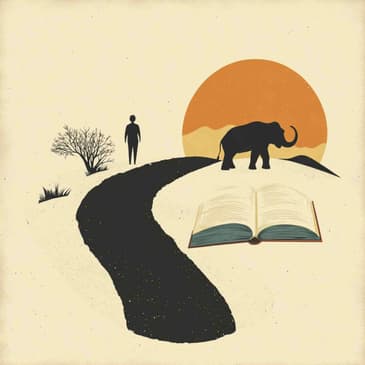
[00:02:49] Sharpening a spear and charging a mammoth and sharpening a spear and throwing it at a mammoth from a distance are both complex plans. Early Homo sapiens could not only conceive both plans, but they could also notice that the latter plan, with its much reduced risk of trampling, was the better choice. Scientists now recognize that this skill is one of the key reasons we survived, while Homo erectus and Neanderthals did not. It also, as I hinted,
[00:03:18] teaches us something interesting about procrastination. Rethinking student procrastination. We suffer from procrastination at all ages, but in this post, I want to focus on students, as it's the group whose work habits I understand the best. Professionals give lots of reason for student procrastination. Here are three examples from a representative university website on the topic. Fear, of both success and failure. Perfectionism.
[00:03:46] And we think our work is of low quality. I'm sure these can all play a role in procrastination, but in my experience, there's a fourth reason that's significantly more common. Your brain doesn't buy your plan. Let me flesh this out. Assume you're a student who feels a strong urge to put off studying for an exam. The first question to ask, what is your plan for studying? Most students don't put much thought into their study habits, so your plan is likely vague and haphazard,
[00:04:16] rife with distractions, pseudo-work, and passive review. What I'm arguing is that the complex planning component of your brain evaluates this plan, as it has evolved to do, and then rejects it as not sound. Grinding it out all night at the library is as haphazard a plan as charging the mammoth with a spear. Your frontal lobe is having none of it. Here's the second relevant question. What does this rejection feel like?
[00:04:44] Complex planning is a pre-verbal adaptation, so it's not going to manifest itself as a voice in your head exclaiming, plan rejected. Instead, it's going to be more intuitive, a biochemical cascade designed to steer you away from a bad decision, something perhaps that feels like a lack of motivation to get started. If this explanation is true, then you'd also expect that students with smart study habits to struggle less with procrastination.
[00:05:11] This is exactly what I observed when I studied elite undergrads for my Redbook. Only a small minority of the 50 hyper-organized students I interviewed reported procrastination as a serious problem. In this telling, procrastination is not a character flaw, but instead, a finely tuned evolutionary adaptation. You shouldn't lament procrastination, but instead, listen to it. Treat it as a sign that your skills as a student need more work.
[00:05:42] Procrastination beyond last-minute studying. This evolutionary perspective on procrastination applies beyond students putting off schoolwork. It also helps explain deprocrastination, a sinister variation of this trait that causes students to lose the will to start any work. As I've argued, deprocrastination afflicts students who are suffering through hard course loads without a strong sense of why. In other words, deprocrastination can be seen as a rejection of a plan,
[00:06:10] but this time, the plan is on a larger scale. Your grand narrative for why you're at college and how it'll help you live a good life. This perspective also helps us cope with procrastination beyond graduation. Why do we delay on ambitious projects that could change our life for the better? The common explanation from the blogosphere is because we're afraid of failure and lack courage. The evolutionary perspective on procrastination, by contrast,
[00:06:38] says we delay because our frontal lobe doesn't see a convincing plan behind our aspiration. The solution, therefore, is not to muster the courage to blindly charge ahead, but to instead accept what our brain is telling us. Our plans need more hard work invested before they're ready. These topics are deep, and I hope to address them in more detail in the near future. For now, I want to leave you with the general idea that procrastination is not your enemy.
[00:07:08] It is instead a constructive source of criticism, a voice from our Paleolithic past telling us that although it likes our goals, we need to put a little bit more thought into how we're going to get there. If this warning system was good enough to prevent mammoth trampling, certainly good enough to help you finish your term paper without pulling an all-nighter. You just listened to the post titled, The Procrastinating Caveman,
[00:07:37] What Human Evolution Teaches Us About Why We Put Off Work and How to Stop It, by Cal Newport of calnewport.com. And I'll be right back with my commentary. Thank you to Cozy Earth. Cozy Earth products are designed to transform your 5 to 9, the time that matters most, into the coziest sanctuary. Seriously. With Cozy Earth, my bedroom now is my personal retreat. With Cozy Earth's bamboo sheet set, luxury starts where you rest. These sheets are buttery soft,
[00:08:05] keep me at the perfect temperature all night, and I feel like I'm sleeping in a five-star hotel. And the bath sheets are a game changer. They're huge, super absorbent, and super soft. Now here's what I love most. They offer a 100-night sleep trial and a 10-year warranty on all Cozy Earth bedding and bath products. Try them risk-free, but I'm pretty sure you won't be sending anything back. Luxury shouldn't be out of reach. Head to CozyEarth.com and use my code OLD
[00:08:33] for 40% off sheets, towels, pajamas, and more. If you get a survey after purchasing, mention you heard about them right here on the podcast. That's 40% off at CozyEarth.com with code OLD. Sanctuary awaits at Cozy Earth. Thank you to Cal. An interesting take on procrastination, which is one of the most frequent struggles I hear from listeners of this show. For me, procrastination was probably at its worst in school.
[00:09:03] I remember back in college, I'd put off studying for certain classes or writing papers until the last minute, and I always just assumed it was because I didn't have enough willpower or something. But looking back, those were usually the classes where I didn't have a solid plan for how to study or what I was going to write about or any kind of plan, really. I was just going to review my notes or read through the textbook. Not exactly the most effective approach. And really, it's that avoidance of discomfort.
[00:09:31] We talk about being comfortable with being uncomfortable from time to time on this show. And it really is important for growth. When we procrastinate, we're avoiding discomfort. But maybe instead of pushing through it, we should step back for a second and ask, is my brain trying to tell me something? Is there a better way to approach this? And it definitely applies to many different areas outside of studying, work, appointments, other commitments, and so on. So instead of beating ourselves up for procrastinating,
[00:10:00] maybe we can use it as information. Let me know how it goes. Hopefully this one was helpful for you. But with that, thank you for being here and optimizing your life along with me. Hope you have a great rest of your day, and I'll see you tomorrow, where your optimal life awaits.