


Discover all of the podcasts in our network, search for specific episodes, get the Optimal Living Daily workbook, and learn more at: OLDPodcast.com.
Episode 4041:
Diane Renz explores how lasting lifestyle changes come from intention, consistency, and daily practice rather than quick fixes or trends. By focusing on small, sustainable habits like mindful movement, gratitude, quality sleep, and meaningful connection, she offers a compassionate framework for creating long-term well-being and balance.
Read along with the original article(s) here: https://www.psychalive.org/steps-to-healthy-lifestyle-changes/
Quotes to ponder:
"Intention is not a goal but an overarching frame for the “why” of doing something."
"We need to “cultivate” new habits; like a new language or learning how to play a musical instrument, we don’t just do it, we cultivate it."
"There is no reason to give up because you always have the next new moment to begin again."
Learn more about your ad choices. Visit megaphone.fm/adchoices
[00:00:00] [SPEAKER_05] So good, so good, so good. New markdowns up to 70% off are at Nordstrom Rack stores now. Stock up and stay big on shoes, tops, dresses, accessories and more must-haves for summer. Join the Nordstrom Club to unlock exclusive discounts, shop new arrivals first and more. Plus, buy online and pick up at your favorite rack store for free. Great brands, great prices. That's why you rack.
[00:00:28] [SPEAKER_03] Ready to soundtrack your summer? With Red Bull Summer All Day Play, you choose a playlist that fits your summer vibe the best. Are you a festival fanatic, a deep-end DJ, a road dog or a trail mixer? Just add a song to your chosen playlist and put your summer on track. Red Bull Summer All Day Play. Red Bull gives you wings. Visit redbull.com slash brightsummer ahead to learn more. See you this summer.
[00:00:52] [SPEAKER_01] This is Optimal Living Daily. Steps to Healthy Lifestyle Changes by Diane Renz with PsychAlive.org and I'm Justin Malik. Welcome back to our Sunday bonus episode where I think it's nice to share an episode from another podcast where we read to you.
[00:01:10] [SPEAKER_01] And today's comes from my brother's show, Optimal Health Daily. If you'd like to hear more about fitness, nutrition, diet, pretty much anything health-related, you can find Optimal Health Daily wherever you get your podcasts. And please do follow or subscribe to Optimal Health Daily to show your support. It really helps keep this show going. But with that, let's get right to it as we optimize your life.
[00:01:36] [SPEAKER_02] Steps to Healthy Lifestyle Changes by Diane Renz with PsychAlive.org Lifestyle changes begin with setting intention. If you don't have an intention, it's easy to lose commitment to action. Intention is not a goal, but an overarching frame for the why of doing something.
[00:01:56] [SPEAKER_02] For example, someone might have a goal of losing weight, but overarching intentions of feeling well with more vitality for life and relationships and to live a fuller life. Next is making a doable commitment for at least a period of 21 days. It helps to name this as your 21-day challenge.
[00:02:17] [SPEAKER_02] If you know you have a challenge with a time limit, you can hang in day by day knowing that you are running an experiment to see what outcomes you might have at the end of the 21 days. Having said that, if you fall off your commitment, you do not need to ditch the entire remaining days. All you need to do is just begin again, right here, right now. Be sure to specifically name your commitment to action that you will do each day. Write the intention and the commitment down.
[00:02:47] [SPEAKER_02] Not just once, but every day. It really is the way to stay focused on what you want in your life. It doesn't take long to jot down. For example, my intention is to feel more positive, my commitment is to go to sleep by 10 p.m. each night, and prior to sleep, name with specificity and sincerity what I am grateful for. Lifestyle changes are made over time with a steady turn of habits.
[00:03:12] [SPEAKER_02] This is crucial to remember because the trends, fads, diets, and gusto and excitement of the latest new idea fade quickly and are not user-friendly. We have spent many years, if not decades, cultivating habits, behaviors, ways of thinking that require a steady action to recalibrate. We need to cultivate new habits, like a new language, or learning how to play a musical instrument. We don't just do it, we cultivate it.
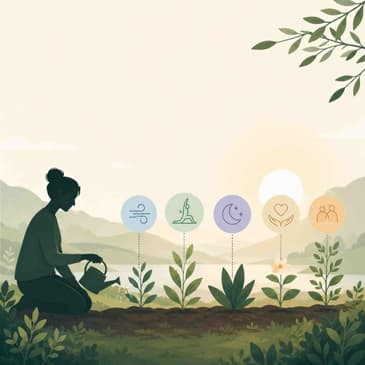
[00:03:42] [SPEAKER_02] Using the analogy of cultivating a garden, We plant the seed in soil we have prepared to receive it. Our job then is to water, provide light, fertilizer, and keep the weeds from overtaking. We don't then pull at the seedling and force it to grow. We create an environment that's conducive for it to thrive. Intention, commitment, cultivation. And then you must practice.
[00:04:08] [SPEAKER_02] On a daily basis, choose what you are ready to implement and practice, practice, practice. It's not supposed to feel good right away. In fact, as you make healthier changes in your life, often you might initially feel worse. Some of this is related to becoming more aware and less sedated by negative behaviors. Some has to do with physical toxicity, some to do with aches and pains of newness, and so on.
[00:04:33] [SPEAKER_02] This is why commitment is crucial, and to stay focused on the why of what you're doing to stay the course. Some options for living your best healthy lifestyle include 1. Begin and end each day with contemplative practice. Mindful breathing, meditation, prayer, focusing, and connecting to whatever you sense as the essence of you. You can call it spirit if you're comfortable with that. Bookend your days with this stillness.
[00:05:03] [SPEAKER_02] This can really help you stay connected to what's essential to your wholeness. Health and healing really means a return to wholeness. 2. Movement every day. Notice I use the word movement versus exercise. Movement can be of body, of bowels, of breath, of feelings, of expression. Quote, illness comes from stagnation, and healing from movement. End quote.
[00:05:29] [SPEAKER_02] 3. Aerobic movement for at least 30 minutes each day. Move and stretch throughout the day for better heart health and increase serotonin levels. 4. Practice gratitude. Become acutely aware of the simple pleasures and abundance of your life. 5. Smile. Sounds easy, but try it when you least feel like it. It triggers positive changes in the nervous system and reinforms negativity bias.
[00:05:58] [SPEAKER_02] 6. Practice loving kindness. Try to wish yourself good things instead of negative self-talk. Then, extend that to others. 7. Eat colorful, natural foods and begin with a good breakfast. In fact, consuming a good breakfast is essential for brain health and improved metabolism. If you're skipping breakfast to lose weight, it will have the opposite effect. Eat throughout the day with conscious awareness.
[00:06:26] [SPEAKER_02] 3 meals, 2 snacks, stop eating 2 hours prior to bed to help with better sleep, and so on. 8. Take breathing breaks throughout the day. Begin with an exhale when feeling stressed. It allows you to release and makes room for nice, deep, natural inhales. 8. You could try the famous 4-7-8 breath I learned from Dr. Andrew Weil, but has been a practice for over 2,000 years. Here's how to do it. Place the tip of the tongue behind the two front teeth.
[00:06:56] [SPEAKER_02] Blow out, and you will feel the wash around your tongue. Breathe in to a count of 4. Hold that for a count of 7. Exhale for a count of 8. And do this for 4 rounds. This will reduce urges and relieve anxiety and help balance the nervous system. 9. Take time outside with nature. Nature is resilient and in rhythm. We lose ourselves with late nights, not-so-nutritious foods, lack of movement, excessive anxiety, and so on.
[00:07:26] [SPEAKER_02] When we spend time in nature, we can attune to its rhythms because they are our own. 10. Every day, be sure you are making contact with someone in a positive way. We are social creatures and thrive with good contact. Often, food cravings and binges are really related to the need for love. When we give and receive kindness and contact, we thrive. Our oxytocin and serotonin levels go up,
[00:07:53] [SPEAKER_02] bringing feelings of well-being and desire for attachment. 11. Find what's fun. Enjoy those simple moments of fun, like doing a puzzle, kicking a ball around, or dancing to your favorite tune. It doesn't have to be a big activity, but it's essential for overall health and balance to play each day. 12. Focus on your work. Whatever is before you, whether it's a major business meeting,
[00:08:19] [SPEAKER_02] a pile of laundry, whatever it is, give it your full attention and focus. Be present to the task, and then you can clearly define when you are working and when you are playing. Multitasking truly does not work. Our brains do not function at optimal levels, and nothing gets done well. Focusing on one task is good for the health of your brain. Finding the balance of work and play is essential daily practice.
[00:08:45] [SPEAKER_02] 13. Be sure to sleep between 7 to 9 hours per night, and fall asleep before midnight for your biorhythm health. You can also experiment with an earlier bedtime and waking with the light, and then eventually letting your body find its way back to what's natural. Lost sleep can lead to weight gain due to less leptin in the brain that indicates fullness. 14. A little more on sleep.
[00:09:12] [SPEAKER_02] Limit computer technology and stop it 2 hours prior to sleep. The light from these machines diminishes your melatonin levels, which is a neurotransmitter which induces the sleep state, and throws your nervous system into an active state. In summary, eat well, sleep well, move well, breathe well, be still, play, smile, focus on love and gratitude, and connect to others.
[00:09:40] [SPEAKER_02] So, here you have a few ideas to start with. Make it simple. Choose three things you can commit to daily for the next 21 days, and see what you cultivate. There is no reason to give up, because you always have the next new moment to begin again. You just listened to the post titled, 7 Steps to Healthy Lifestyle Changes, by Diane Renz, with psychalive.org, and I'll be right back with my commentary.
[00:10:11] [SPEAKER_04] Good sleep is everything. That's why Oli's science back support is made with a blend of melatonin and L-theanine for both kiddos and grownups. So when your mind won't switch off, you've got something that can help. Erasing thoughts and restless nights won't stand a chance. Find Oli's sleep solutions for the whole family at Oli.com. That's Oli.com.
[00:10:35] [SPEAKER_00] This Father's Day, do more with Dad and spend less with low prices guaranteed at The Home Depot. Get him fired up with a new grill and accessories, like the Nex Grill 5 burner for just $299, so you can spend more time together while he becomes the grill master he was always meant to be. Or build memories with savings on top brand power tools, so you can tackle projects side by side. Gift more and do more together this Father's Day, with help from The Home Depot. Exclusions apply. See homekeeper.com slash price match for details.
[00:11:05] [SPEAKER_02] Dr. Neal here for my commentary. There were a few key points that today's author Diane mentioned that I must highlight. First, all of Diane's suggestions focused on changing behaviors. When we set goals for ourselves, we should focus on changing the behaviors that will help us reach those goals. For example, if weight loss is one of our goals, then we need to focus our attention on the behaviors that will help us lose weight.
[00:11:31] [SPEAKER_02] So behaviors like consuming fewer calories and moving more. So again, what I loved about Diane's suggestions was that they were all behavior focused. Now Diane mentioned that it's worthwhile to commit to these new behaviors for 21 days. Now, you may find that 21 days is just the right amount of time. Or maybe it's not enough time. Maybe it's too much time. 21 days is a nice time limit to sort of check in with yourself again.
[00:11:59] [SPEAKER_02] Just don't be surprised if after 21 days, you may need a little more time to make sure those new behaviors are truly habits. All right, that's another episode of Optimal Health Daily. Thank you so much for being here. Thank you for sharing this show with someone. I hope you have a great rest of your day. And I'll see you back here tomorrow for another Q&A episode where I answer your questions and where your optimal life awaits.